Beijing
The city ripples outward in concentric ring roads; the ancient walls gave way to traffic, but the central axis still holds the stone in place.
The Western and Jundu mountains form a protective curved rampart to the north, releasing the vast North China Plain toward the horizon. Across seven point eight kilometers, the historic Central Axis anchors palaces, sacrificial altars, and drum towers into strict geometrical symmetry. Autumn is Beijing's most lyrical season: clear blue skies frame the turning foliage of giant Chinese scholar trees, while flocks of pigeons bearing reed whistles sweep overhead. Grandeur belongs to the vermilion and gold of the Forbidden City; intimacy lives in grey-brick courtyard doorways, bubbling copper cauldrons, and the easy warmth of neighborhood elders.
What to see
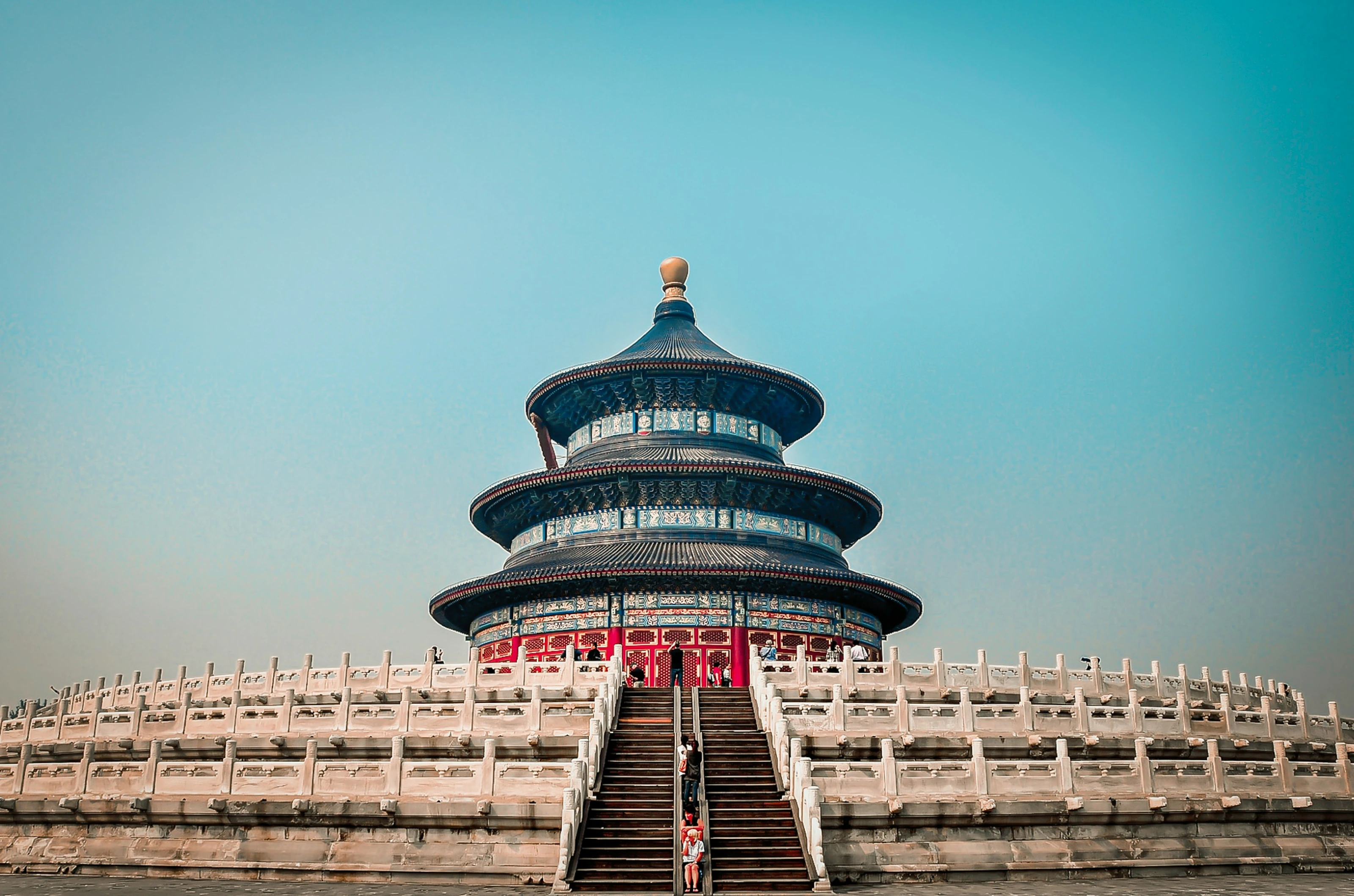
The Forbidden City demands advance booking; entering at early morning opening offers quiet courtyards and gentle light. Mount Jingshan's Wanchun Pavilion provides a bird's-eye view of the golden roofs and the full axis. The Temple of Heaven's circular blue glazed tiers rise serenely amid century-old junipers, while the Shichahai lakes are ideal for dusk walks beneath weeping willows.
What to eat
Mutton hotpot in glowing copper cauldrons marks the arrival of northern winter, relying on hand-sliced fresh lamb and thick sesame sauce. Peking duck requires fruitwood roasting for crisp, paper-thin skin, while morning alleys serve hot millet tea, sesame biscuits, and crisp fried dough rings.
Getting here & around
Daxing and Capital international airports are both linked to town by express rail, while four primary high-speed stations serve regional lines. The subway network reaches every corner, but renting a shared bicycle remains the finest way to navigate the hutong alleys of Dongcheng and Xicheng.
Choose a neighbourhood
Each area offers a different side of the city. Pick one to explore at your own pace.
Dongsi Hutongs & Shijia Lane
Running east from Dongsi, numbered alleys preserve Yuan-dynasty rectilinear street layouts. Ornate carved timber gates hide beneath heavy scholar-tree branches, while courtyards reveal pomegranate trees and grape trellises overhanging grey brick walls as neighbors chat on shaded folding stools.
Wandering intact historic courtyard alleys and feeling the tranquil domestic pace of inner Beijing.
Jingshan & Shichahai Lakes
The artificial summit of Jingshan offers the imperial city's highest vantage point, looking south over the sea of yellow palace tiles. Walking north leads to Yinding Bridge over Shichahai, where willows sweep over green waters against the distant silhouette of the Western Hills.
Panoramic views along the Central Axis followed by waterside alley walks at sunset.
Temple of Heaven & Fayuan Temple
The Hall of Prayer for Good Harvests rises in triple blue-tiled tiers toward the sky, surrounded by hundreds of Ming and Qing ceremonial cypress trees. Farther west, Fayuan Temple's courtyards shelter Tang-dynasty stone steles and blooming lilacs, carrying the memory of classical scholars.
Experiencing imperial cosmological architecture alongside the serene stillness of ancient temple grounds.
Charcoal in beaten copper
An authentic Beijing hotpot broth is austere to the point of transparency: burning fruitwood charcoal glows inside the tall central chimney of a beaten copper pot, while the outer moat holds only clean spring water with two slices of scallion, a few goji berries, and ginger. Heat rises violently as the chimney draws drafting air.
The lamb must be sliced entirely by hand from fresh cuts. The master butcher's knife moves rhythmically, creating ribbons so uniform and dry that the ceramic plate can be turned completely upside down without a single morsel sliding off. A quick swirl through rolling boiling water cooks the meat in seconds, leaving it tender and sweet. The bowl of stone-ground sesame paste, blended with fermented bean curd and salty chive flower puree, cradles the rich mutton fat with deep nutty warmth.
Twilight along the axis
Looking south from the summit of Jingshan, the Forbidden City reveals itself like an immense open volume of classical geometry. Crimson gates, white marble terraces, and golden glazed hips align with absolute precision, with not a single beam drifting from the invisible meridian line.
Yet descending into the neighboring residential alleys of Caochang or Yu'er Hutong, imperial austerity dissolves into domestic comfort. Stone door-drums guard grey-brick archways, elderly women hull celery in the afternoon sun, and children ride bicycles past corner corners. When pigeon whistles trail musical notes across the tiled eaves, one feels the human life that has outlasted emperors.