Chaozhou
No matter how many guests pull up chairs, the wooden tea tray presents only three tiny porcelain cups: the care lies in the rolling boil and the cyclic courtesies of sharing.
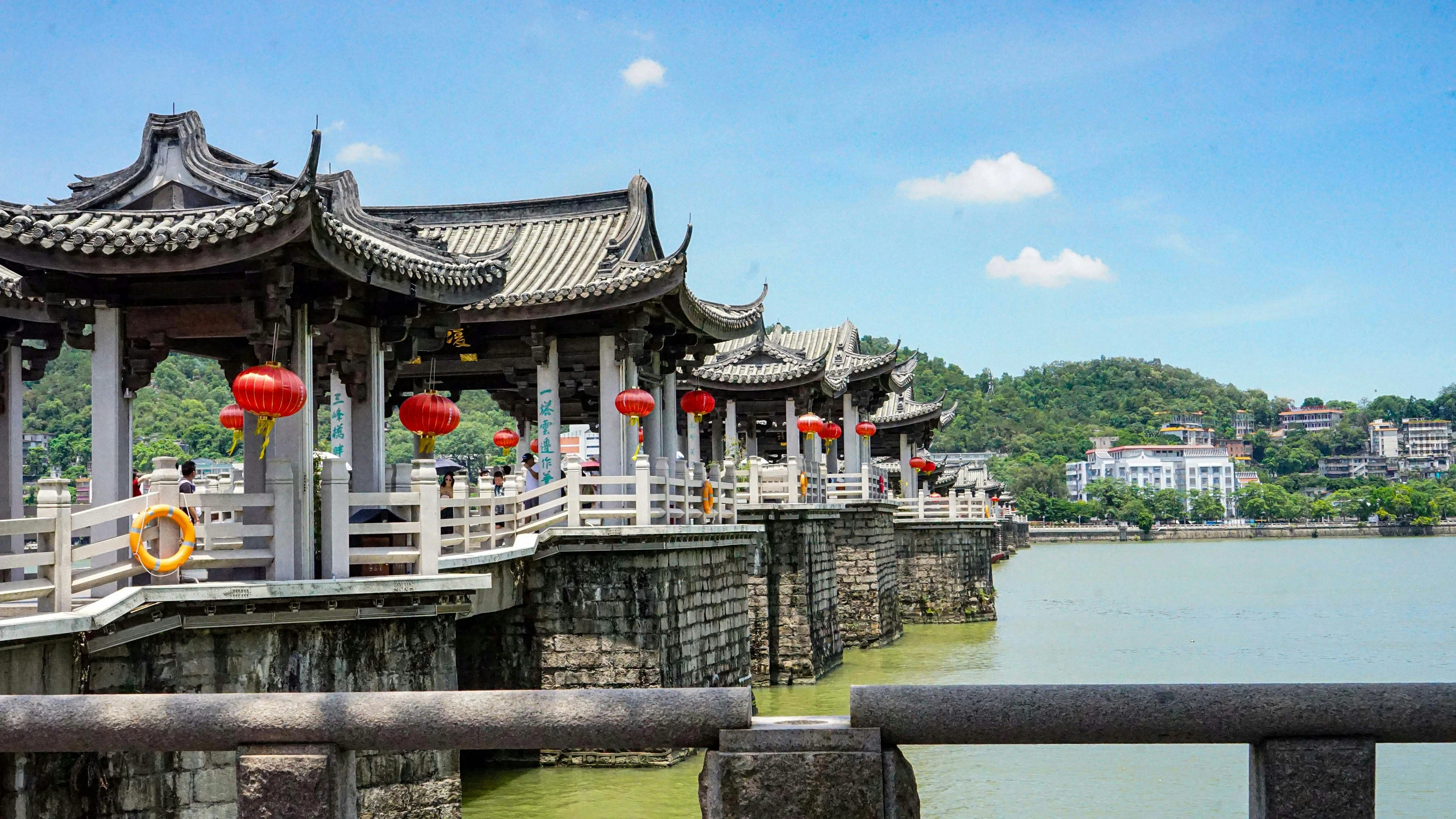
The Han River rushes down from the northeastern highlands before slowing past the ramparts of Chaozhou, spanned by the Guangji Bridge with its central floating pontoon of eighteen lashed timber skiffs. Chaozhou is an ancient walled redoubt permeated by the ritual of gongfu tea: from counters in open shophouses to deep threshold flagstones in residential lanes, one hears the gentle crackle of olive-pit charcoal burning in terracotta stoves and the bubbling of rolling water hitting red-clay teapots. Elegance here avoids showy grandeur; it thrives in rigorous attention to seasoning, fermentation, and texture: three-year-aged pickled turnip darkens to amber in glazed jars, aged gander heads steep for hours in galangal-scented master brine, and beef paste beaten with heavy square steel bars bounces like rubber.
What to see
Guangji Bridge combines stone beam piers, pavilions, and a floating pontoon; its eighteen midstream skiffs disconnect at dusk to let river barges pass. Paifang Street presents twenty-two granite commemorative arches flanked by continuous shophouse arcades. Kaiyuan Temple, dating to the Tang dynasty, preserves ancient dhvaja pillars carved with celestial apsaras, while across the river, the Memorial Temple to Han Yu commemorates the Tang poet who shaped local cultural identity.
What to eat
Chaozhou cuisine celebrates marine freshness and pristine balance. Lion-head geese from Chenghai braise in herbal brine, yielding tender breast meat, gelatinous skin, and prized chewy webbed feet. Mornings call for flat rice noodles in clear beef bone broth topped with flash-scalded beef neck slices and savory satay dip. Night brings cold fish stalls where sea fish poached in salt brine rest in round bamboo flats, served chilled with pungent Puning fermented bean paste.
Getting here & around
Chaoshan Railway Station serves as the regional high-speed rail hub, with frequent shuttle buses directly reaching the old walled quarter. The historic core is pedestrian-friendly, ideal for exploring on foot or by trishaw, pausing whenever a tea table beckons along the street.
Choose a neighbourhood
Each area offers a different side of the city. Pick one to explore at your own pace.
Paifang Street & Jiadi Lane Courtyards
The historical artery of the ancient walled city. Twenty-two commemorative stone arches span the central street, flanked by shophouses harboring woodcarvers, embroiderers, and red-clay teapot makers. Turning into Jiadi and Yijing lanes reveals grand four-point-gold courtyard residences, their ceramic-sheathed ridgelines gleaming against azure skies.
Studying monumental stone arches and intricate ceramic roof ridge inlay, visiting hidden residential lanes and clay teapot ateliers.
Guangji Bridge & the Han River Front
The riverfront promenade bordering the east wall. First constructed in the Song dynasty, Guangji Bridge links Mount Bijia with the imposing Guangji Gate Tower; unique pavilions top stone piers, connected across mid-channel by eighteen moored timber pontoons. Walking the flood wall ramparts at sunset offers panoramic vistas over slow, silted waters.
Crossing the floating pontoon bridge and climbing Guangji Gate Tower for dusk panoramas.
Xima Road Food Stalls
The lively pedestrian food lane favored by local connoisseurs. Narrow stone alleys steam with fresh bamboo shoot dumplings and fermented rice cakes; confectioners stretch sesame sugar rolls with crisp sugar scallions, while oil-bubbling pans produce golden, flaky Chaozhou spring rolls stuffed with seasoned mung beans and pork.
Sampling authentic Chaozhou savory dumplings and time-honored handmade confections in an everyday market environment.
The cyclic rite of three tea cups
In Chaozhou, tea drinking is referred to as eating tea, a structured daily ritual governing domestic and commercial life. The traditional gongfu quartet includes the red-clay charcoal stove, the unglazed clay kettle, the miniature Mengchen Yixing pot, and featherweight Ruochen porcelain cups. Charcoal pressed from olive pits burns cleanly without smoke, heating spring water until micro-bubbles resemble crab eyes, avoiding overboiling.
Pouring follows rigid spatial protocol. Water hits the leaves from high above to aerate the fragrance, before the pot is lidded and bathed in boiling water. When pouring into the three adjacent cups, the spout stays millimeters above the porcelain rims, swinging rapidly in continuous circular sweeps known as Lord Guan patrolling the ramparts, guaranteeing identical flavor and strength. The final concentrated droplets are flicked in rapid succession into each cup as General Han counting troops. Guests take turns sipping, rinsing cups in boiling water before the next pour, enjoying lingering floral honeysuckle notes and throat-coating sweetness.
The master brine of the lion-head gander
The fertile alluvial floodplains of the Han River estuary breed the colossal Chenghai lion-head goose. Fully grown ganders reach over twenty pounds, crowned with prominent black cranial fat wattles. In braising shops, the master brine is a treasured legacy, built on pork bone stock infused with galangal, star anise, Chinese cinnamon, coriander seeds, and licorice.
Master cooks practice three lifts and three hangs: the massive bird is submerged in simmering broth, raised to drain trapped inner cavity liquid, and returned to the boil to allow deep convective saturation. After two hours over gentle charcoal heat, the goose emerges glistening like dark amber. Prized for gelatinous wattles and muscular webbed feet, thick slabs of juicy breast meat are splashed with hot brine and paired with crushed garlic in white rice vinegar to cut through rich fat.
Fish rice without a grain of rice
Browsing evening cold counters in Chaozhou, towers of shallow circular bamboo baskets display glistening sea fish. Despite its name, fish rice contains no cereal grains. Boat dwellers along the coast, limited by onboard firewood, preserved fresh hauls of mackerel, bigeye, and scad without gutting or scaling, arranging them in concentric rings salted with coarse sea brine in bamboo flats.
Submerged entirely in cauldrons of rolling saline water, the fish cooks rapidly before air-drying in maritime sea breezes, causing muscle proteins to set firm under a shimmering film of natural gelatin. Eaten at room temperature, diners flake meat straight from the spine, dipping it into pungent, umami-dense fermented Puning bean paste. The clean sweetness of ocean fat explodes against the tongue, preserving a centuries-old maritime survival craft.