Dujiangyan
The entire system operates without a single mechanical sluice gate; floodwaters spill away automatically, turning the Chengdu plain into the Land of Abundance.
Dujiangyan commands the gorge where the torrential Min River breaches the Longmen Mountains of the Tibetan Plateau to enter the Chengdu Plain. In 256 BC, Qin governor Li Bing harnessed fluid dynamics and topography to build the Yuzui dividing dike, Baopingkou rock channel, and Feishayan spillway, establishing the world's oldest functional dam-free irrigation infrastructure. From Erwang Temple looking over divided green waters to Mount Qingcheng's Taoist sanctuaries tucked within emerald mountain peaks, Dujiangyan exemplifies living ecological engineering.
What to see
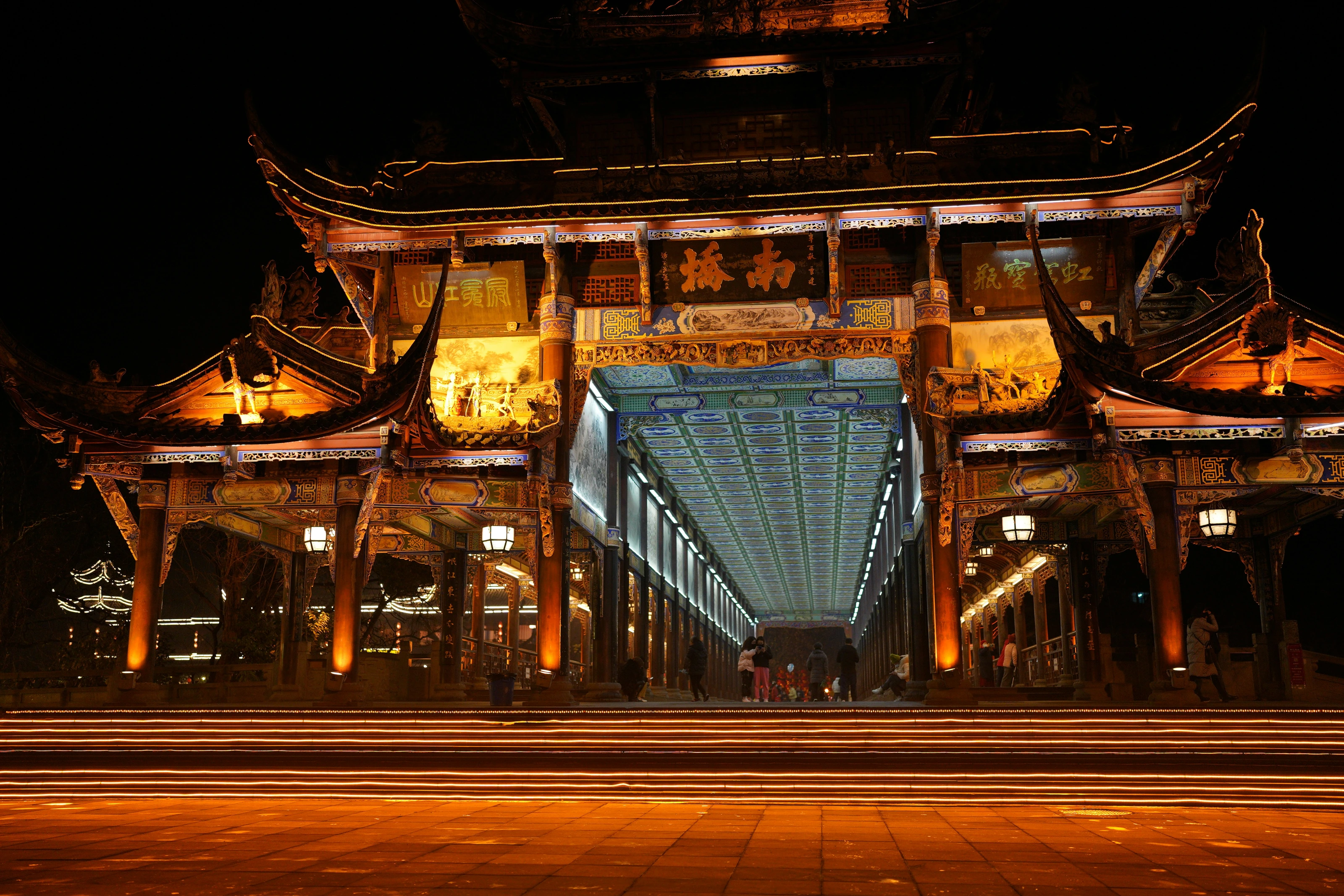
The core Dujiangyan Irrigation System features the Yuzui bypass dike, Feishayan spillway, and the hand-chiseled Baopingkou channel; Erwang Temple crowns pine ridges above the gorge; Mount Qingcheng stands as a birthplace of Taoism with Tianshi Cave and Shangqing Palace nestled in ancient cedar groves; Guanxian Old Town's Nanqiao Bridge spans the roaring inner river canal.
What to eat
Local cooking pairs western Sichuan abundance with Taoist mountain balance: Qingcheng free-range chicken stewed with ginkgo nuts in golden broth; cured pork belly smoked over mountain cypress needles; spicy stewed rabbit heads (Yutou); enjoyed beside riverbanks with covered-bowl jasmine tea and steamed sticky rice cakes (ye'erba).
Getting here & around
The Chengguan High-Speed Intercity Railway operates trains between Chengdu Xipu Station and Dujiangyan or Mount Qingcheng in twenty minutes. City buses connect to the waterworks and Guanxian Old Town; regular shuttles link Qingchengshan Front and Back mountains.
Choose a neighbourhood
Each area offers a different side of the city. Pick one to explore at your own pace.
Dujiangyan Waterworks & Erwang Temple
The core World Heritage monument: cross the historic Anlan suspension bridge to stand at the Yuzui dike dividing the Min River, descending past ancient timber temples honoring Li Bing.
Marveling at the 2,200-year-old damless engineering feat, walking swaying cable suspension bridges, and panoramic river vistas.
Mount Qingcheng Front Peak & Taoist Temples
The emerald cradle of Taoism, where thirty-six forested peaks shelter mossy stone stairs winding past thousand-year-old ginkgoes at Tianshi Cave and mountaintop shrines.
Hiking quiet flagstone stairways under thick rain forest canopies, exploring Taoist timber halls, and breathing fresh mountain air.
Guanxian Old Town, Nanqiao & River Teahouses
The historic city at the mouth of the irrigation canal, centered on the carved timber Nanqiao Bridge spanning the torrent, with rows of bamboo armchairs lining the river.
Watching night floodwaters illuminated in sapphire light below Nanqiao, sipping covered-bowl jasmine tea on bamboo chairs, and evening snacking.
Hydraulic Harmony Without Dams
The brilliance of Dujiangyan lies in its complete absence of mechanical dams or sluice gates. Taking advantage of the Min River's natural bend, Li Bing constructed a midstream stone dike shaped like a fish's snout. During dry winter months when water levels are low, sixty percent of the flow is guided into the deeper, narrower inner canal to sustain farming across the Chengdu Plain, while forty percent continues into the outer channel. During summer torrents, rising floodwaters automatically surge along the straighter outer bed, while excess volume and gravel spin harmlessly across the Feishayan spillway through centrifugal force, protecting the downstream plains.
Bamboo Sausage Cages and Timber Tripods
Dujiangyan's enduring operation over two millennia owes much to regular seasonal maintenance using biodegradable materials. Historical builders split strong local moso bamboo into coarse slats, weaving cylindrical sausage-shaped baskets two feet wide and dozens of metres long, known as zhulong. Packed with hard granite river cobbles and submerged in stacked tiers along the riverbed, these cages formed permeable, flexible revetments that absorbed kinetic energy without eroding. During low-water winter months, teams erected three-legged timber tripods called macha draped with bamboo matting and clay to divert water, clearing accumulated gravel from the channel bed.
Covered Bowl Tea Over the Torrent
Crossing from the waterworks into Guanxian Old Town, Nanqiao Bridge spans the roaring inner river canal. Beneath the painted timber corridor, glacial snowmelt roars across river stones in a flurry of white spray. Along the shaded banks of the willow-lined canal, hundreds of low bamboo armchairs stand packed together. A tea waiter pours boiling water in a long silver arc from a copper kettle into porcelain covered bowls. Pushing aside floating jasmine petals with the porcelain saucer lid, guests sip fragrant tea while damp river mists cool the air, enjoying the unhurried ease of western Sichuan.