Jiajiang
The Qingyi River rushes against cliffside carved Buddhas; beside village paper troughs, craftsmen lift bamboo screens from white pulp with flicking wrists.
Jiajiang straddles the Qingyi River in the southwestern fold of the Sichuan Basin, backed by the foothills of Mount Emei. Extensive groves of tender ci bamboo flourish in the humid subtropical air, sustaining handmade bamboo papermaking traditions active since the Tang and Song dynasties. From seventy-two rigorous manual stages in mountain hamlets of Macun to over two thousand Tang-dynasty rock-cut Buddhist figures gazing over rushing emerald waters at Qianfoyan, Jiajiang balances the rhythmic clatter of water-powered stamp mills with ancient stone craftsmanship.
What to see
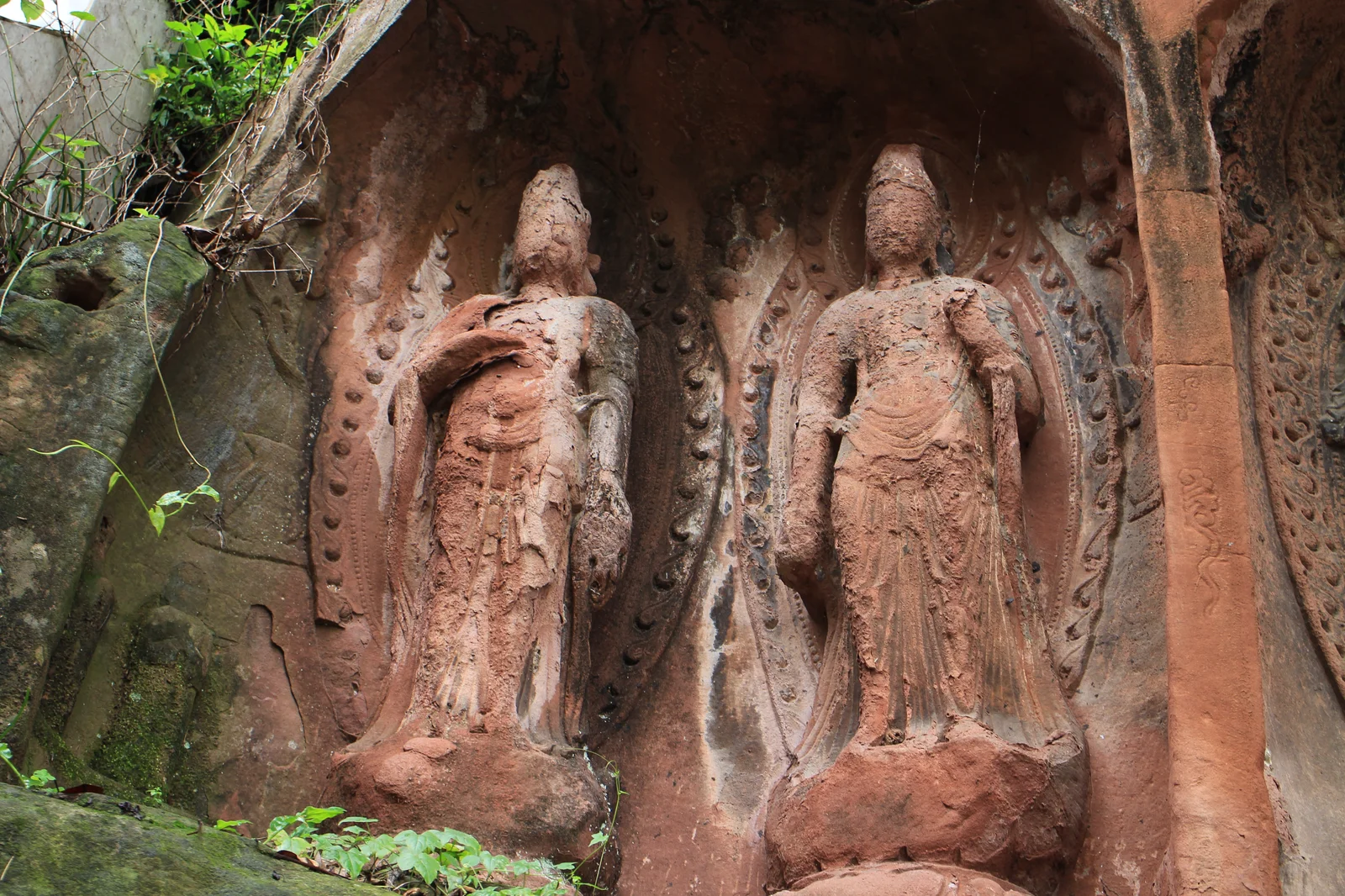
Qianfoyan preserves over two thousand Tang cliffside Buddhist carvings etched into red sandstone cliffs directly above the Qingyi River; Macun village gathers operational handmade paper mills using waterwheel-driven trip hammers; the Dongfeng Weir stands as a UNESCO World Heritage Irrigation structure diverting river runoff for two centuries; Jinhuadu retains ancient stone ferry landings under banyan shade.
What to eat
Local cuisine reflects Sichuan basin water-town flavors: soft douhua silken tofu glistening with spiced chili oil, scallions, and crisp soybeans; river fish poached with tart pickled greens and fermented wild chilies; paired with baked flatbread sandwiches (guokui) and hot fresh soy milk.
Getting here & around
The Chengdu-Guiyang High-Speed Railway serves Jiajiang Railway Station, reaching Chengdu East or Leshan in thirty minutes. Local minivans and buses run regularly from the county bus station to Qianfoyan and Macun paper mills; renting a local car allows easy access along both banks of the Qingyi River.
Choose a neighbourhood
Each area offers a different side of the city. Pick one to explore at your own pace.
Macun Bamboo Paper Mills & Museum
The historical heart of handmade Chinese bamboo paper, where dozens of traditional family mills operate waterwheels, lime fermentation ponds, and heated drying brick walls.
Observing the seventy-two steps of handmade papermaking, trying the bamboo screen scooping technique, and purchasing artist-grade calligraphy paper.
Qianfoyan Cliff Carvings & Riverside Paths
A national historic monument where over 2,400 Tang dynasty Buddhist sculptures adorn sandstone bluffs alongside ancient stone planks of the Shu postal road above jade river pools.
Admiring Tang Buddhist relief sculpture, hiking ancient riverside stone towpaths, and scenic cliff photography.
Dongfeng Weir & Jinhuadu Quays
A heritage irrigation network engineered in the Qing dynasty, featuring rock-cut canals diverting mountain water past ancient banyan-shaded ferry landings.
Walking along ancient irrigation canal paths, learning Sichuan hydraulic heritage, and sipping green tea by the river.
A Screen Lifted from White Slurry
Transforming mountain bamboo into paper requires seventy-two meticulous stages. Around the summer grain season, tender two-year-old ci bamboo is harvested, peeled, and split into ribbons to soak in slaked lime pits for three months. Transferred into massive cauldrons, the fibers boil for days over intense firewood. Water-powered stone trip hammers pound the softened fibers into silky white pulp. The papermaker grips a woven bamboo screen, dipping it diagonally into the vat and gently rocking his wrists to cross the floating fibers into an even mesh. Lifted in a single motion, a translucent sheet of ink-absorbent paper emerges from the water.
Screens of Hair-Thin Bamboo
The uniformity of calligraphy paper depends upon the precision of the dipping screen. Master weavers select dense, straight-grained mature moso bamboo, splitting it into filaments less than half a millimeter thick. The maker draws each strand through calibrated horn die-plates until silky smooth and perfectly uniform. Arranged across a wooden loom, hundreds of bamboo threads are woven with raw-lacquer-treated natural silk thread, framed in hardwood. Perfectly flat, draining water instantly while retaining cellulose pulp, this tool determines the tactile texture of Chinese handmade paper.
Two Thousand Buddhas upon the Bluff
Where the Qingyi River breaches mountain gorges, sheer sandstone bluffs rise straight from the waterline. Across a two-hundred-metre cliff face at Qianfoyan, sculptors began carving more than two hundred niches and 2,400 figures during the High Tang. Suspended from ropes, artisans worked the fine-grained red sandstone with curved chisels. The central Maitreya exudes serene confidence, flanked by bodhisattvas whose carved scarves seem to flutter in river breezes. For centuries the jade current has echoed at their feet while the carved deities gaze over passing rafts with timeless calm.