Kaiping
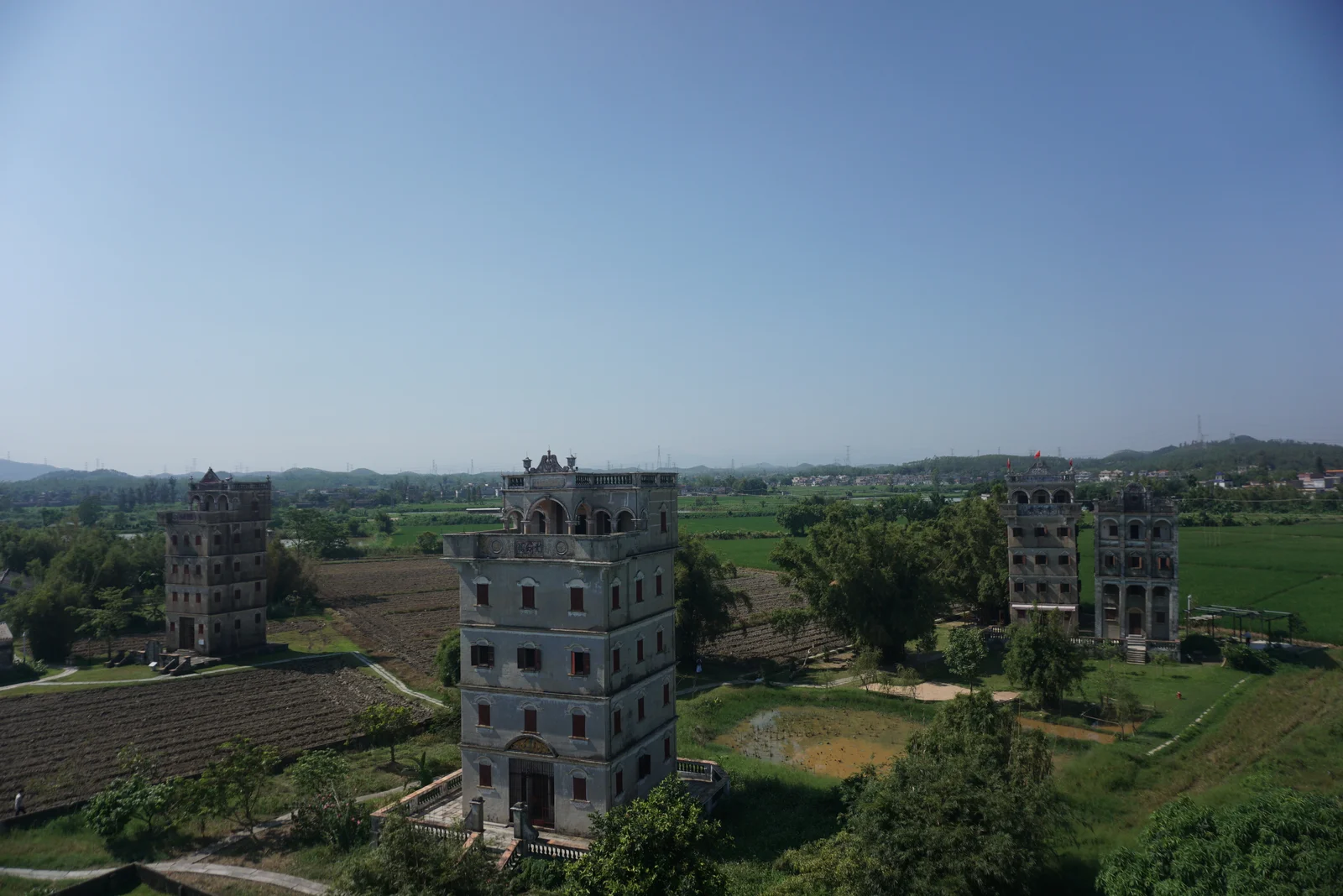
Watchtowers were built with remittances sent back from across the Pacific: steel-reinforced concrete for defense, topped by Roman loggias crowned with Chinese hip-and-gable roofs.
The Tan River weaves through the alluvial plains of Siyi, flanked by vivid green rice paddies and swaying banana groves. Rising unexpectedly from these rustic waters stands one of the world's most singular architectural marvels: more than eighteen hundred fortress-like watchtowers known as Kaiping Diaolou. In the late nineteenth and early twentieth centuries, thousands of local men crossed the Pacific to dig gold mines and lay transcontinental rails, enduring systemic discrimination to remit earnings home to protect families against rampant river piracy and seasonal flooding. Ancient Roman colonnades, Baroque scrolled pediments, and Gothic pointed arches merge effortlessly with Lingnan grey-mortar reliefs and terracotta roof tiles. Each tower is a fortress inscribed in iron and cement: steel blast shutters shield narrow loopholes, while upper residential suites shelter ancestor altars and lacquered shrine alcoves.
What to see
Zili Village concentrates fifteen distinct watchtowers scattered across lotus ponds and rice paddies; Mingshi Tower preserves intact century-old gramophones, stained-glass casements, and imported European furniture. Majianglong Village hides its fortress towers deep inside bamboo groves and fruit orchards. In Jinjiangli, the nine-story Ruishi Lou stands as the tallest watchtower in Kaiping, crowned with ornate Baroque flourishes. Chikan Old Town stretches three continuous kilometers of arcaded shophouses along the Tan River.
What to eat
Local cooking highlights the rustic wok cuisine of the overseas Chinese villages. Mornings call for Chikan tofu squares: fresh bean curd stuffed with springy dace fish paste, griddled on flat iron pans until both faces turn blistered and golden, seasoned with scallions and white pepper. Chikan claypot rice simmers fragrant long-grain rice over charcoal coals topped with local cured sausages and wild yellow swamp eels, yielding crisp, golden crusts. Magang goose yields dense, savory breast meat braised in spiced master stock.
Getting here & around
Kaiping South Railway Station reaches Guangzhou South in one hour via high-speed rail. Because historic villages like Zili, Majianglong, and Jinjiangli are scattered across rural townships, renting a car or boarding regional rural shuttle buses along scenic country roads is recommended.
Choose a neighbourhood
Each area offers a different side of the city. Pick one to explore at your own pace.
Tangkou Zili Village & Li Garden
The core UNESCO World Heritage settlement. Fifteen towers rise like silent guardians amidst wetland ponds and ripening paddy stalks. Mingshi Tower showcases Victorian mantel clocks, gramophones, and vintage vinyl imported by returning emigrants. Nearby Li Garden, built by Chicago merchant Xie Weili, integrates private canals, arched bridges, and eclectic classical villas.
Climbing Mingshi Tower for sweeping rural panoramas and strolling through private canal gardens.
Baihe Majianglong & Xiagang Jinjiangli
Deep rustic enclaves cradled by dense bamboo forests and river bends. Majianglong's seven fortress towers appear like hidden medieval strongholds enveloped by starfruit orchards and giant timber stands. In Jinjiangli stands nine-story Ruishi Lou, renowned as Kaiping's finest tower with flamboyant Byzantine domes and Baroque fluted stone pilasters.
Discovering secluded forest watchtowers and admiring the monumental plasterwork of Ruishi Lou.
Chikan Heritage Town & Tan Riverfront
A monumental river port lined with overseas Chinese arcaded architecture. Historic commercial avenues stretch three uninterrupted kilometers along water basins, characterized by eclectic pediments and wrought-iron balconies. Clan libraries built by the rival Guan and Situ lineages crown the riverbend with imposing clocktowers.
Wandering riverfront colonnades and enjoying local charcoal claypot rice along the water.
Castles built on transpacific remittances
During the late Qing dynasty, low-lying Kaiping was battered by seasonal deluges from the Tan River, compounded by clan wars and rampant piracy along water highways. Men fled across the Pacific to build the Central Pacific Railroad and work gold claims, enduring winter blizzards and lethal mine shafts to remit earnings home through trusted family courier letters.
These hard-won remittances paid for chartered river barges shipping imported building materials up the Pearl River. Bypassing traditional sun-baked mud, villagers imported Portland cement from Britain and corrugated steel bars from Germany, casting walls two feet thick capable of deflecting cannonades. Heavy steel shutters sealed gun embrasures, while cantilevered turret pods hung from upper corners to allow defenders to fire vertically downwards. Built to shelter entire lineages from floods and bandits, these sentinels secured clan survival across decades of upheaval.
The cosmopolitan skyline of Roman loggias
The genius of Kaiping watchtowers lies in their uninhibited vernacular hybridity. Ground levels resemble austere medieval keeps, designed with impenetrable masonry to survive siege. Yet as towers ascend into the southern sky, architectural vocabulary becomes flamboyant and celebratory.
Emigrants handed foreign postcards and lithographs of Western cities to village bricklayers. Guided by traditional Lingnan lime-plaster techniques, local craftsmen cast Ionic capitals, broken Baroque pediments, and Gothic lancet arches directly into concrete. Yet at the highest pinnacle, owners invariably installed a classical Chinese timber pavilion topped with emerald ceramic tiles and flying swallow-tail eaves. Standing beneath a Roman arcade with subtropical rice paddies murmuring below, this audacious fusion creates an architectural testament to transpacific resilience.
The charcoal blister of Chikan claypot rice
Along the old riverfront of Chikan, charcoal braziers maintain constant heat. Kaiping cooks insist on coarse, unglazed earthenware pots with tight-fitting lids, using aged long-grain Simiao rice prized for its thirst for broth.
Over intense charcoal flames, water reaches a rapid boil until the grain swells, venting steam through micro-holes. Just before the surface dries, the cook arranges sliced wind-cured pork sausages, preserved belly, and shredded swamp eel over the rice. Secured with the heavy lid, the pot is tilted at angles over glowing coals, rotating every few minutes to scorch the base and inner walls evenly. Rendered animal fat trickles down the searing pottery, hissing as it fries the bottom grain. A final splash of peanut oil along the rim produces an unbroken, translucent amber rice crust that crunches like brittle caramel beneath sweet scallion soy sauce.