Kashgar
A mud-brick oasis on the western edge of the Taklamakan, where earthen dwellings scale loess cliffs and century-old teahouses hum to rawap lutes and saffron tea.
Kashgar flourishes in an alluvial oasis at the eastern foot of the Pamir Mountains, where the Taklamakan Desert ends and historic overland trade arteries diverge. Positioned at Eurasia's geographic pole of inaccessibility, it served for two millennia as the Silk Road's busiest crossroads, gathering caravans from Samarkand, Kashgar, and Chang'an. At Gaotai, vernacular earthen homes cling to natural loess cliffs, built of sun-dried clay mixed with straw and wool, stacking vertically across generations with shaded overpass tunnels forming a living labyrinth. Daily life carries the perfumes of wood fires and crushed spices: round flatbreads slap against the searing walls of clay tandoors, wafting toasted cumin and onion fragrances into alleys. In century-old wooden teahouses, elders sit cross-legged on woven carpets, stroking white beards to the twang of rawap lutes as bowls of saffron-spiced tea linger through sun-drenched afternoons.
What to see
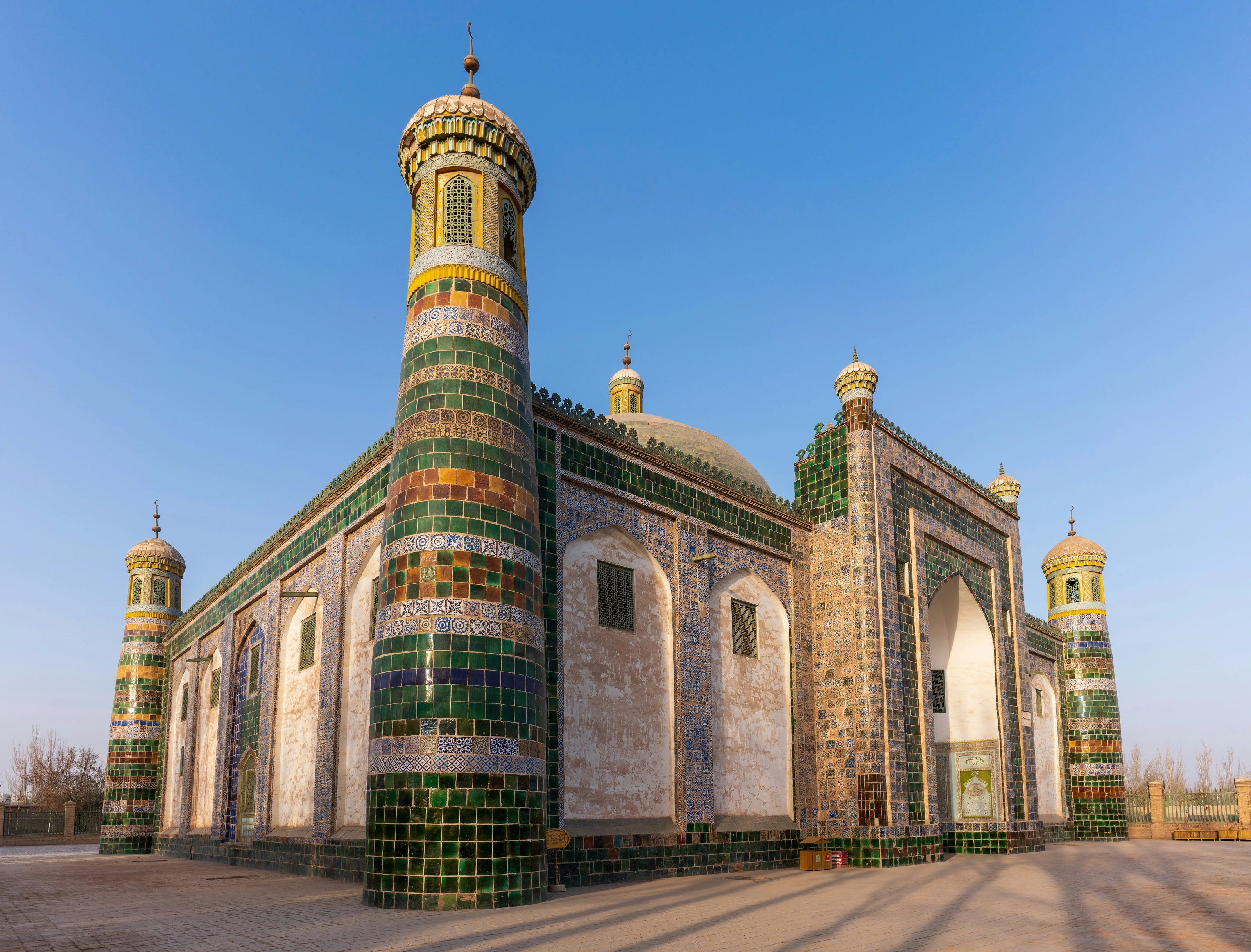
The Ancient City of Kashgar forms one of Eurasia's most intact vernacular earthen urban fabrics, where carved poplar portals, iron grilles, and potted geraniums brighten winding alleys. Id Kah Mosque anchors the civic square with its sunny yellow-brick minarets and tranquil tree-shaded cloister courtyards. Gaotai preserves cliff-face mud dwellings where six-generation potters spin unglazed earthenware flywheels. East of town, the Sunday Livestock Bazaar gathers thousands of shepherds trading fat-tailed sheep and camels in dusty open corrals.
What to eat
Oasis dining showcases pristine mutton and desert grains. Roast whole lamb and tamarind-skewer kebabs alternate lean muscle with savory fat, seasoned simply with coarse desert salt, crushed cumin, and chili flakes. Plov simmers long-grain rice in rendered mutton fat with sweet yellow carrots, lamb ribs, and sun-dried raisins. Enamel mugs of gangzirou stew mutton shanks with turnips over embers into clear, restorative broth. Golden, blistered naan bread pairs with hot brick tea mixed with fresh goat milk or freshly pressed pomegranate juice.
Getting here & around
Kashgar Laining International Airport offers direct links to major Chinese hubs and Urumqi, while Kashgar Railway Station terminates the Southern Xinjiang trunk line. The old town is best explored on foot; reaching the Sunday Livestock Market is easy by city taxi, while driving the Karakoram Highway toward Baisha Lake and Karakul Lake requires a rented SUV or private driver.
Choose a neighbourhood
Each area offers a different side of the city. Pick one to explore at your own pace.
Old City Core & Wustangboye Lane
The historical craft and gathering artery of the oasis. Copper smiths, blacksmiths, embroidered cap tailors, and unglazed pottery stalls line granite-paved alleys with the ring of hand hammers. At the main crossroads, the two-story Century Teahouse features carved poplar pillars where locals play chess, sip saffron infusions, and perform traditional Muqam songs.
Browsing traditional copper and pottery artisan alleys, and experiencing live lute music in the Century Teahouse.
Gaotai Loess Cliff Enclave
An authentic vernacular earthen cliff settlement rising above the Tuman River. Multi-generational families added mud-brick chambers over centuries, building overpass bridges and cantilevered lofts over narrow dirt passages. The cliffside shelters multi-generational pottery families shaping clay vessels on kick wheels.
Observing vertical earthen cliff architecture and watching master potters turn traditional terracotta ware.
Huangdi Sunday Livestock Bazaar
The largest open-air animal trading market in Central Asia. Thousands of herdsmen arrive every Sunday with sheep, horses, camels, and donkeys. Buyers test wool quality and negotiate prices silently inside coat sleeves, surrounded by open-air charcoal ovens turning out hot samsa pastries and cauldron plov.
Experiencing an authentic Silk Road livestock market and savoring fresh tandoor baked meat pies.
The sun-baked clay of overpass alleys
In the dry, desert climate along the Tarim Basin's western fringe, sun-baked earth provides natural thermal defense. Kashgar masons dig fine loess subsoil, combining it with chopped straw, cotton stalks, and sheep wool fibers before tamping the mud into timber brick moulds. Earthen walls measure up to two feet thick; their slow thermal conductivity keeps interiors cool when desert sun pushes temperatures past forty degrees, while retaining stove warmth through freezing winters.
Dwellings expand vertically as lineages multiply. When courtyard plots can no longer accommodate married sons, families construct another floor above flat roofs or lay heavy poplar logs across narrow lanes, suspending entire residential chambers over street traffic. These covered alleys, known as overpass tunnels, baffle summer heat, admitting cool drafts through high lattice casements. Plastered with pale straw-flecked mud, the undulating facades possess the serene, golden hue of the surrounding desert.
The tandoor sparks of golden naan
In Kashgar, bread is the primary foundation of survival. At busy corners, hemispherical clay tandoor ovens glow with fruitwood embers, radiating heat over two hundred degrees Celsius.
The baker stretches proofed wheat dough into wide disks with thick, raised rims. A wooden bread stamp studded with fine brass pins punches concentric geometric vents into the center, preventing steam blisters from inflating during baking. Brushing the bottom with light brine, the baker drapes the raw round over a convex cotton pad and plunges his bare arm deep into the fiery oven, slapping the dough flat against the searing masonry. Moisture flashes into steam, adhering the bread instantly to the clay wall. Within minutes, the dough puffs and blisters with charred amber freckles, releasing the rich fragrance of toasted sesame and wild onion seeds. Dry and light, this flatbread remains edible for months, sustaining caravans crossing the Taklamakan dunes.
Saffron tea and the rawap lute
Ascending the wooden staircase into the Century Teahouse on Wustangboye Lane, city dust dissolves into herbal warmth. Carved poplar columns support expansive ceiling joists, over floors layered in geometric hand-knotted wool rugs from Hotan.
Regulars slip off boots and recline cross-legged on carpets. A miniature white porcelain pot arrives alongside a tulip-shaped glass, steeping infusions of saffron, green cardamom pods, cinnamon, and brick tea. In the corner, an octogenarian rests a snake-skin-faced rawap lute across his knee. Long fingers flick across five silk strings, releasing clear, rapid tremolos that tumble like mountain snowmelt. He raises his chin, chanting centuries-old ballads of desert travelers and parted lovers. Time ceases to press; over small sips of amber tea sweetened with crystallized sugar rocks, the deep serenity of oasis life endures.