Longyan
A colossal ring of rammed earth stands two stories high with only a single iron-plated gate; hundreds of clan members dwell in concentric harmony under the gaze of the ancestral hall.
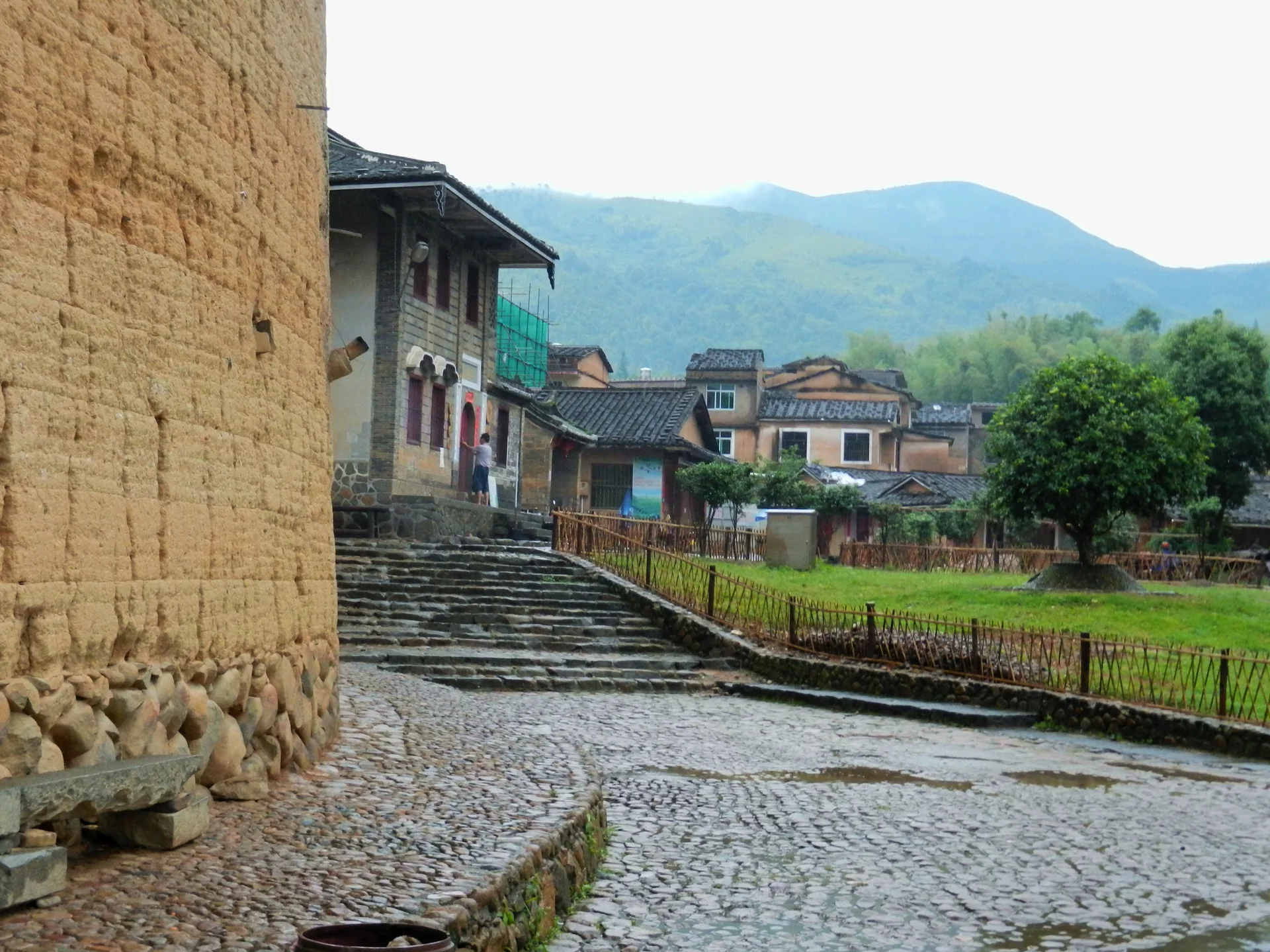
The rugged mountain ranges of western Fujian are deeply incised by the rushing headwaters of the Jiulong and Ting rivers. Longyan preserves the highest expression of Hakka earthen architecture: the Fujian Tulou. To safeguard kinship lines amidst mountain bandits and predator-haunted wilderness, Hakka settlers blended native red clay, river grit, and slaked lime with brown sugar and sticky rice broth, reinforced with split mountain bamboo rebar and compacted by heavy stone tampers into colossal walls two meters thick. A single tulou functions as an impenetrable sovereign clan world: entering through a lone ironwood portal, the open skywell centers upon the lineage ancestral hall. Ground levels house domestic hearths, second floors store grain, and upper rings provide living quarters ringed by defensive gunports. Life here retains the elemental rhythm of mountain sun and hearth smoke: Liancheng sweet potato chews turn tender and red in autumn sun, Changting dried bean curd yields deep herbal soy savor, and earthen pots of winter rice wine bubble over pine embers.
What to see
The Yongding Tulou cluster forms the core of this UNESCO World Heritage landscape. Chuxi Tulou steps gracefully along terraced mountain streams. In Hongkeng, Zhencheng Lou, dubbed the Tulou Prince, blends neoclassical balconies with a Bagua cosmological layout across two concentric rings. Gaobei's Chengqi Lou, the Tulou King, features four concentric residential circles comprising four hundred rooms that once housed over eighty families. Changting Ancient City preserves ancient city walls and river water gates, serving as the cultural prefecture of the Ting River basin.
What to eat
Local cuisine reflects western Fujian's mountain heritage, excelling in preserved root vegetables and wood-fired stews. The Eight Great Dried Foods of western Fujian lead pantry traditions, alongside Liancheng white duck soup, prized for its sweet, clean broth and restorative medicinal properties. Changting braised tofu rolls wrap delicate soy skins around pork and shiitake. Yuzibao dumplings mash mountain taro with tapioca flour into chewy, translucent skins stuffed with winter bamboo shoots. Bowls of beef broth scald fresh yellow beef slices in boiling stock laced with cracked white pepper and wild basil.
Getting here & around
Longyan Railway Station links high-speed trunk lines, reaching Xiamen in one hour. Traveling from urban Longyan to the Yongding Tulou valleys takes around ninety minutes by highway. Because historic clusters like Chuxi, Hongkeng, and Gaobei are situated across separate ravines, renting a car or booking guided regional transport is recommended.
Choose a neighbourhood
Each area offers a different side of the city. Pick one to explore at your own pace.
Gaobei & Hongkeng Tulou Clusters
The most iconic World Heritage earthen keeps. Gaobei features colossal Chengqi Lou, measuring over seventy meters across with four nested concentric rings forming a self-contained fortress town. In Hongkeng, Zhencheng Lou incorporates western cast-iron balcony balustrades and Doric columns, adorned with eloquent classical couplets praising scholar-farmer virtues.
Marveling at the monumental concentric rings of Chengqi Lou and Zhencheng Lou's architectural synthesis.
Chuxi Terraced Mountain Tulou
A pristine village where round and rectangular keeps follow cascading rice terraces and mountain streams. Free of intrusive commercial stands, five circular and dozens of rectangular keeps step up the slope. Jiqing Lou preserves an unusual plan where every family possesses its own private vertical stairwell from ground to roof.
Climbing scenic terraced viewpoints and experiencing quiet, agrarian mountain life without commercial crowds.
Changting Hakka Capital Old Town
The historical administrative seat along the Ting River. Tang-dynasty brick ramparts cling to Wolong Mountain; Sanyuan Pavilion and Jichuan Gate overlook the river, their crimson lanterns mirrored in clear water. Deep flagstone lanes harbor centuries-old clan halls, apothecaries, and fragrant dried bean curd stalls.
Climbing Jichuan Gate for panoramic night views of the river ramparts and exploring Hakka cultural archives.
The compaction of earthen fortresses
Fujian earthen keeps appear composed of simple mud, yet they represent a sophisticated mastery of historic composite materials. Masons first dug deep beds of sticky red and yellow subsoil, spreading it in open fields for months of weathering to eliminate clods. Slaked lime was sieved and mixed with soil and river sand to create cohesive mortar, enriched with cauldrons of boiled glutinous rice slurry and dark brown sugar.
Staging heavy wooden formwork atop granite rubble footings two meters thick, workers poured the damp composite within. Into the core they embedded split mountain bamboo poles, fire-tempered to eliminate sap and moisture, acting as natural tensile rebar. Teams of laborers raised fifty-pound granite tampers, compacting the layers to rhythmic work songs until earth vitrified into iron density. Each course cured for months before the next was tamped above. Requiring up to five years to complete, these ramparts have shrugged off centuries of monsoon floods, typhoons, and major earthquakes.
Concentric democracy of the great ring
The circular tulou represents the physical manifestation of an egalitarian clan ideal. The circular floor plan is divided by radial rammed-earth firewalls into dozens of identical wedge-shaped bays. Crucially, families do not occupy single horizontal levels; instead, each household receives an identical vertical column spanning from ground to roof.
The ground floor functions as the kitchen hearth and wash basin; the windowless second floor serves as a cool granary storing rice, dried ham, and seeds; the third and fourth floors house bedrooms, with the topmost level pierced by narrow defensive gunports. Regardless of branch wealth, room dimensions and sunlight exposure are identical. Continuous wooden cantilevered verandas link all rooms together: children play along perimeter balconies while elders converse across balustrades. At the exact geometric center sits the ancestral hall, ensuring every resident passes before the lineage tablets on daily domestic errands.
Sun and salt across the mountain larder
Facing cold, damp winters in landlocked mountain valleys, Hakka households relied on dehydration crafts known collectively as the Eight Great Dried Foods of western Fujian. Liancheng produces sweet, red-fleshed sweet potatoes. Steamed whole and sliced into thick wedges, they dry in crisp autumn mountain winds. Steamed again each morning and returned to the sun, this triple-steam and triple-sun cycle transforms starches into natural caramelized fructose, turning the flesh into chewy, translucent amber jewels.
Changting dried bean curd begins with dense mountain tofu, pressed under heavy stones to squeeze out every drop of moisture. Simmered in fragrant broths of star anise, fennel, and gardenia seed, the slabs are roasted slowly over smoking charcoal grates. Dehydrated until tough as leather, the curd bends without snapping, yielding deeply savory soy umami when slivered into woks with cured pork belly and garlic scapes.