Nanjing
Six-hundred-year-old kiln stamps survive in the fortress bricks, while the Qinhuai River washes away the rise and fall of dynasties.
The Yangtze curves gracefully around its western flank, Purple Mountain rises in dragon-like majesty to the east, and Xuanwu Lake rests serenely against the northern walls. Nanjing's composure stems from centuries of dynastic glory and catastrophic renewal. Mature plane trees form vaulted green canopies over wide boulevards, while over thirty kilometers of Ming stone ramparts still guard the core city. People move without haste: morning starts over a steaming bowl of duck-blood vermicelli, afternoons are spent watching willow boughs sweep across lake waters, and evening lantern lights still dance across the Qinhuai River.
What to see
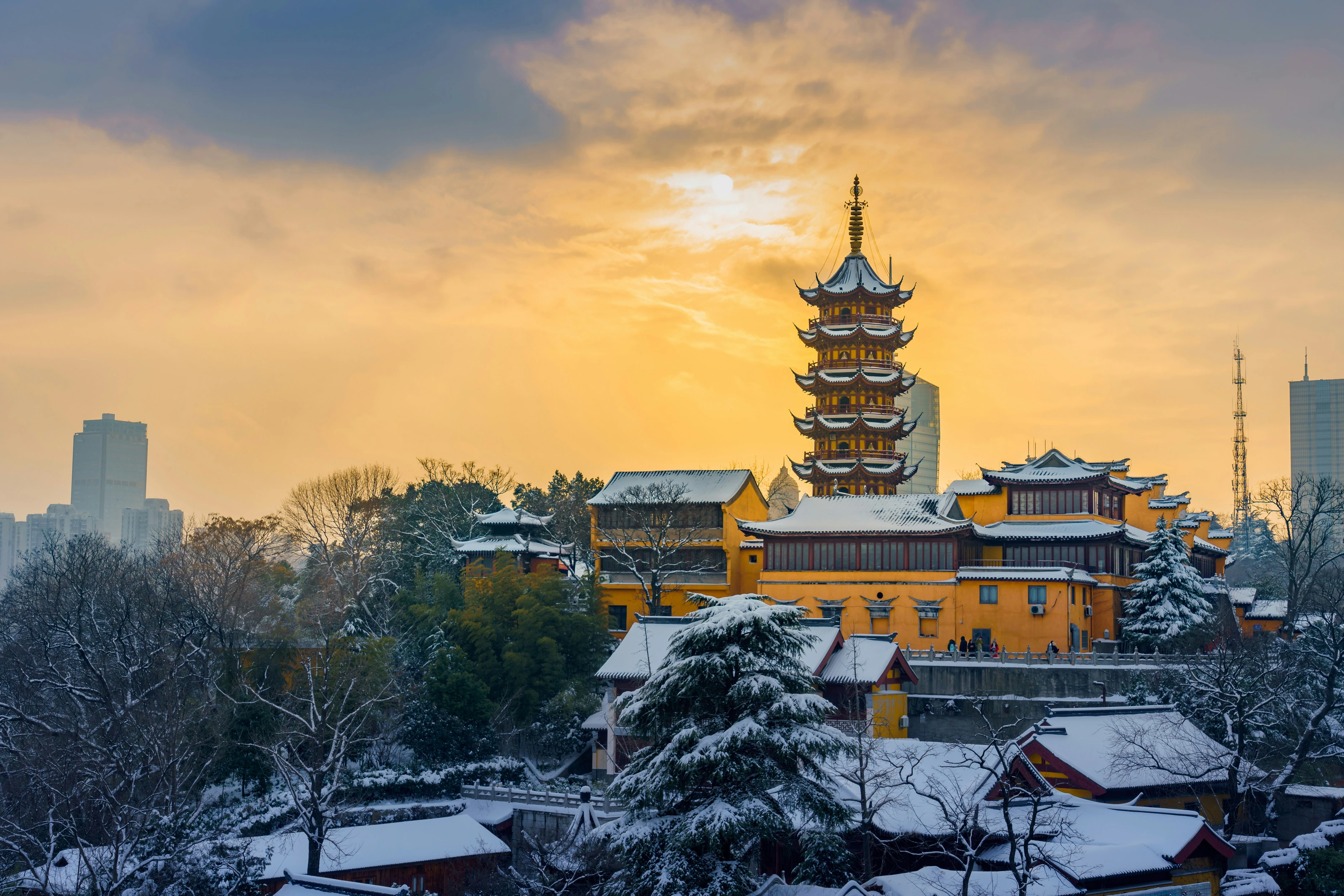
The Ming dynasty city wall is the finest way to gauge the city's scale; walking the Taicheng section looks across Xuanwu Lake, Jiming Temple, and Purple Mountain simultaneously. Dr. Sun Yat-sen's Mausoleum and the Ming Xiaoling tomb rest deep inside dense mountain forests. Adjacent to the massive Zhonghua Gate barbican, the alleys of Laomendong preserve quiet residential life.
What to eat
Nanjing cuisine centers unreservedly on duck. Salted duck achieves pure, fragrant delicacy with pale tender skin, while roast duck arrives in crisp amber slices doused in warm, sweet-savory broth. Duck blood glass noodle soup pairs with flaky pastries brushed in rendered duck fat, and Muslim diners fry golden beef potstickers brimming with piping-hot sweet juice.
Getting here & around
Lukou International Airport connects via express metro, while Nanjing South Railway Station serves as a primary high-speed crossway. Subways connect all major districts, though cycling beneath plane-tree boughs around Yihe Road offers unmatched pleasure.
Choose a neighbourhood
Each area offers a different side of the city. Pick one to explore at your own pace.
Laomendong & Zhonghua Gate
The immense Zhonghua Gate barbican guards the southern boundary with triple defensive courtyards. Directly adjacent, Laomendong preserves traditional grey-brick and black-tiled lanes. Winding through San Tiaoying reveals historic tea parlors and artisan ateliers along the Qinhuai River.
Marveling at early Ming defensive architecture and walking tranquil historic lanes.
Taicheng Wall & Xuanwu Lake
Stepping onto the lakeside wall at Jiefang Gate reveals wide water on one side and the saffron walls of ancient Jiming Temple on the other. Cherry blossoms bloom in spring and golden maples turn in autumn, looking out toward Purple Mountain.
Experiencing the quintessential scholarly vista of lake, temple, and mountain combined.
Yihe Road Mansions
Planned in the 1930s as an elite diplomatic enclave, hundreds of ochre-walled Western villas sit among private gardens. Towering plane trees intertwine overhead into a verdant ceiling, filtering gentle sunlight onto quiet asphalt lanes free of car noise.
Peaceful tree-shaded walks and exploring early twentieth-century residential architecture.
Handprints and inscriptions on kiln brick
Walking along the perimeter of Nanjing, one instinctively reaches out to touch the massive blue-grey bricks. These are not standard building blocks; they measure over forty centimeters long and weigh ten kilograms each. Look closely, and neat vertical columns of Chinese characters appear pressed into the clay: prefectures, overseers, kiln masters, and individual brickmakers.
When the founding Ming emperor Zhu Yuanzhang built the capital, he instituted strict accountability: if a brick crumbled, officials and artisans along the supply chain were punished. Stretching over thirty-three kilometers, the walls consumed over three hundred million bricks. Running fingers over the recessed seals feels like making contact with the laboured breaths of hundreds of thousands of Yangtze workmen who baked and ferried these stones six centuries ago.
The depth of bone and marrow
The art of duck in Nanjing lies in coaxing maximum clarity from meat and bone without heavy masking sauces. Salted duck uses pristine birds rubbed with roasted salt, cured in aged brine, then gently poached in water held just beneath a boil. Sliced cold, the skin is pale and taut over delicate fat, yielding tender meat infused with a clean aroma reminiscent of sweet osmanthus blossoms.
Roast duck offers a crisper counterpoint. Hanging in wood-fired ovens until the skin gleams like polished mahogany, it is cleaved into thick, juicy slices and served swimming in warm, spiced duck jus. The crispy skin absorbs the subtle sweetness of the broth, melting effortlessly on the tongue.