Yan'an
Loess ravines yield to spade and pick; cave dwellings tunnel straight into vertical cliffs, staying warm in winter and cool in summer with wheat fields atop the roof.
The Yan River cuts through the deeply eroded ravines of northern Shaanxi's Loess Plateau, carving a river valley between Pagoda Hill and Mount Qingliang. Beyond its historic mantle as the cradle of modern China's revolution, Yan'an is an ancient settlement rooted in loess geology and vernacular cave engineering. Silt deposits run hundreds of meters deep, possessing vertical cleavage that holds sheer cliff faces without collapsing. Following contour ridges, settlers carved arched yaodong cave homes straight into cliffside strata; meters of dense earthen overburden insulate interiors, defying thirty-degree summer heat and twenty-below winter blizzards. Life here carries stark emotional resonance: breakfast griddles steamed potato shreds tossed with lard and scallions, iron cauldrons simmer golden northern millet into thick puddings, and the thunderous beat of Ansai waist drums echoes across windswept loess ridges, giving voice to raw, unadorned life.
What to see
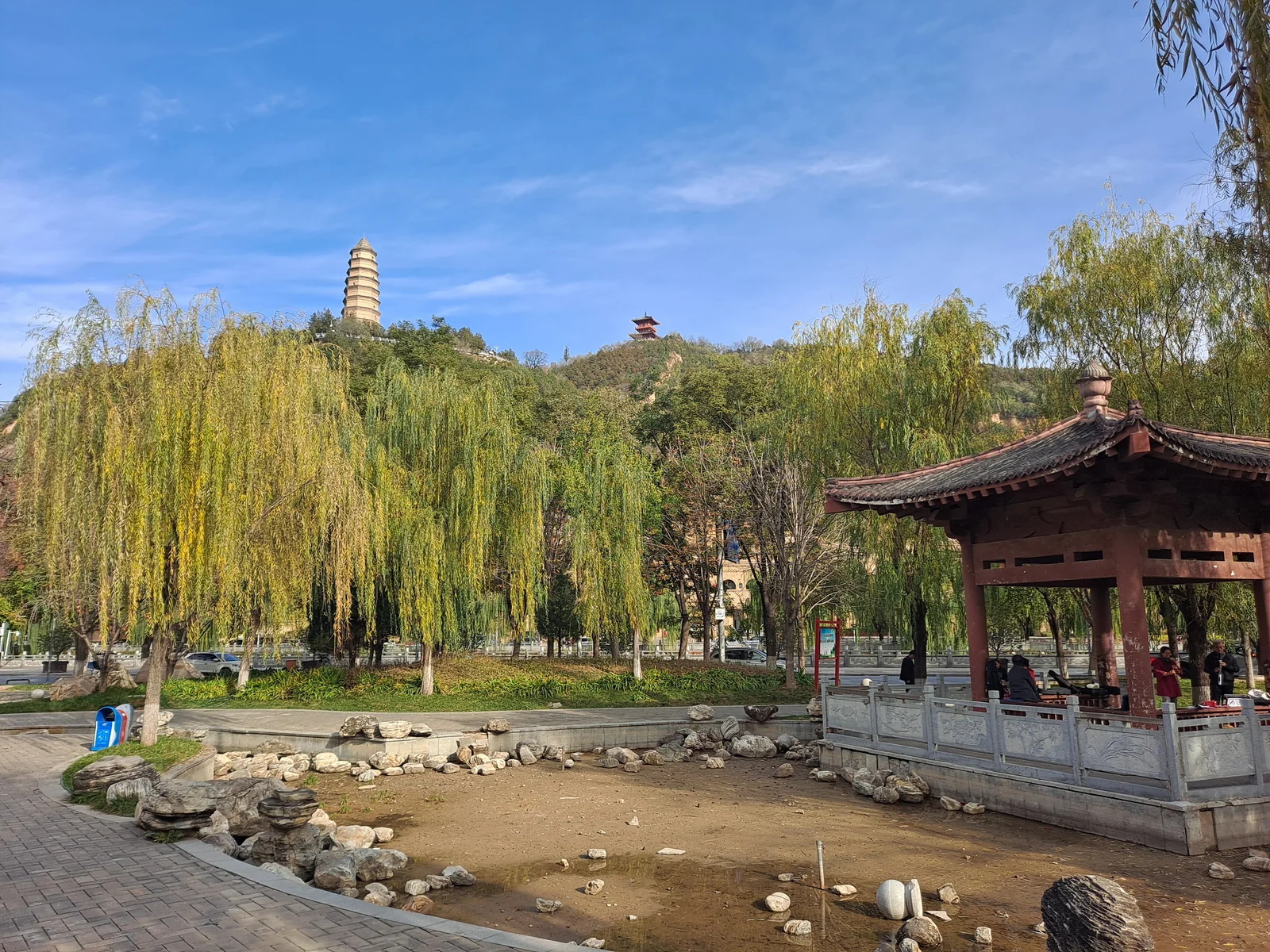
Pagoda Hill rises above the Yan River, its Tang-dynasty octagonal brick pagoda standing as the iconic beacon of the valley. Zaoyuan and Yangjialing preserve stone and earth-cut yaodong clusters where pear trees and stone grain mills recall historic decades. The Yan'an Revolutionary Memorial Hall documents modern history. Farther south, the Yellow River crashes into Hukou Waterfall, pouring roaring muddy torrents into a narrow granite canyon, while Ansai and Ansai hills shelter masters of papercutting and waist drumming.
What to eat
Local cooking celebrates coarse northern grains, highland potatoes, and mountain goat. Yangyu caca shreds raw potatoes, coats them in wheat flour, steams them, and flash-fries the ribbons with pork lard, scallions, and dried chilies to create crisp, chewy clusters. Fried millet cakes wrap sweet red bean paste inside sticky yellow proso millet dough, frying into golden, puffed pastries. Qianqianfan presses black soybeans flat like ancient coins, simmering them with yellow millet into comforting porridge. Stewed mountain goat and spicy sheep offal provide hearty warmth against northern chills.
Getting here & around
Yan'an Naniwan Airport links major hubs, while Yan'an Railway Station sits on lines reaching Xi'an in two hours. Sites around the urban core are easily traversed by taxi; reaching Hukou Waterfall or the terraced ridges of Ansai is best managed with rented vehicles or regional coaches.
Choose a neighbourhood
Each area offers a different side of the city. Pick one to explore at your own pace.
Pagoda Hill & Yan Riverfront
The visual anchor of the loess river valley. An octagonal brick pagoda rises above cliffside Song dynasty stone inscriptions. Ascending trails wind through drought-hardy cypresses, opening onto views of the river corridor squeezed tightly between yellow loess cliffs. At night, illuminated amber ramparts reflect across river currents.
Climbing Pagoda Hill for panoramic views of loess valley geology and walking evening river bridges.
Zaoyuan & Yangjialing Cave Compounds
The historical administrative sanctuary of the twentieth century. Zaoyuan's leafy orchards shelter arched stone cave dwellings alongside murmuring mountain rills; Yangjialing features cliff-cut yaodong terraces where papercut window screens, heated kang platforms, and timber trestle desks are preserved intact.
Studying traditional cliff-cut and stone-arched yaodong architecture and exploring modern revolutionary history.
Ansai Loess Ridges & Folk Arts
The quintessential rugged topography of the Loess Plateau. Ravelled hills and deep gorges conceal troglodyte farming villages where waist drumming, papercutting, and peasant painting originated. During festivals, crimson sashes snap against dust clouds as drum rhythms roll across open ridges.
Witnessing primeval loess plateau ridge formations and experiencing live Ansai waist drumming.
The arched vaults cut into loess cliffs
Deposited over millions of years by glacial winds, northern Shaanxi's loess plateau features deep, cohesive silt beds with pronounced vertical jointing that allow clean vertical excavations without cave-ins. The yaodong represents humanity's most environmentally harmonious troglodyte architecture.
To dig a cliff-face cave, masons chisel a sheer vertical facade against the terrace. Laborers wield iron picks to burrow horizontally seven to nine meters deep and three meters wide. The ceiling follows a semicircular barrel vault, converting the immense overburden of twenty tons of soil into lateral compression distributed evenly across the cliff walls. Portals are sealed with poplar lattice screens and white mulberry paper decorated with scarlet papercuts. Within, a raised brick kang platform connects directly to the cooking stove, warming the interior through sub-zero winter nights, while remaining naturally air-conditioned through blistering summer days.
Yellow millet in the cast-iron cauldron
Across arid, eroded plateau slopes, delicate paddy rice cannot survive; hardy, drought-tolerant foxtail millet and proso broomcorn have sustained civilization here since Neolithic times. Northern Shaanxi millet grows plump and dense in mineral-rich yellow silt.
At dawn, earthen hearths crackle to life as mountain spring water heats in wide cast-iron cauldrons. The cook scatters double handfuls of golden grain into early boils, sending sweet nutty steam curling against vaulted cave ceilings. Once grains swell and bloom, the burning logs are raked away, allowing embers to simmer the porridge for thirty patient minutes. Unlidded, a thick, glistening skin of golden cereal oil sets across the surface. Velvety, smooth, and naturally sweet, this humble porridge nourished generations of mountain families through severe frontier winters.
The thunder of Ansai waist drums
Across the eroded gullies of Ansai, the first drumbeat transforms silent scrubland into an arena of volcanic vitality. Originating as garrison defense signals along ancient frontier outposts, the Ansai waist drum evolved across two thousand years into the plateau's most electrifying communal dance.
Drum bodies carved from paulownia timber are double-headed with taut yellow oxhide and slung across the dancer's hips. Performers bind white towel turbans around their heads and scarlet sashes at the waist, wielding twin hardwood mallets trailing ribbons of crimson silk. Dozens of dancers leap in unison, stomping heavy boots into the yellow silt to raise clouds of dust. Rhythms fall like desert squalls; drummers twist, drop, kick, and leap, shouting raw calls into the wind to celebrate life wrung from harsh clay.