Chongqing
Chongqing has no flat ground: every street is a flight of stone steps, and every meal sits beneath a lake of boiling beef fat.
Chongqing rises along hillsides above two rivers. Bridges, slopes and stairways connect its neighbourhoods, with noodle shops and hotpot restaurants woven into the mountain city.
What to see
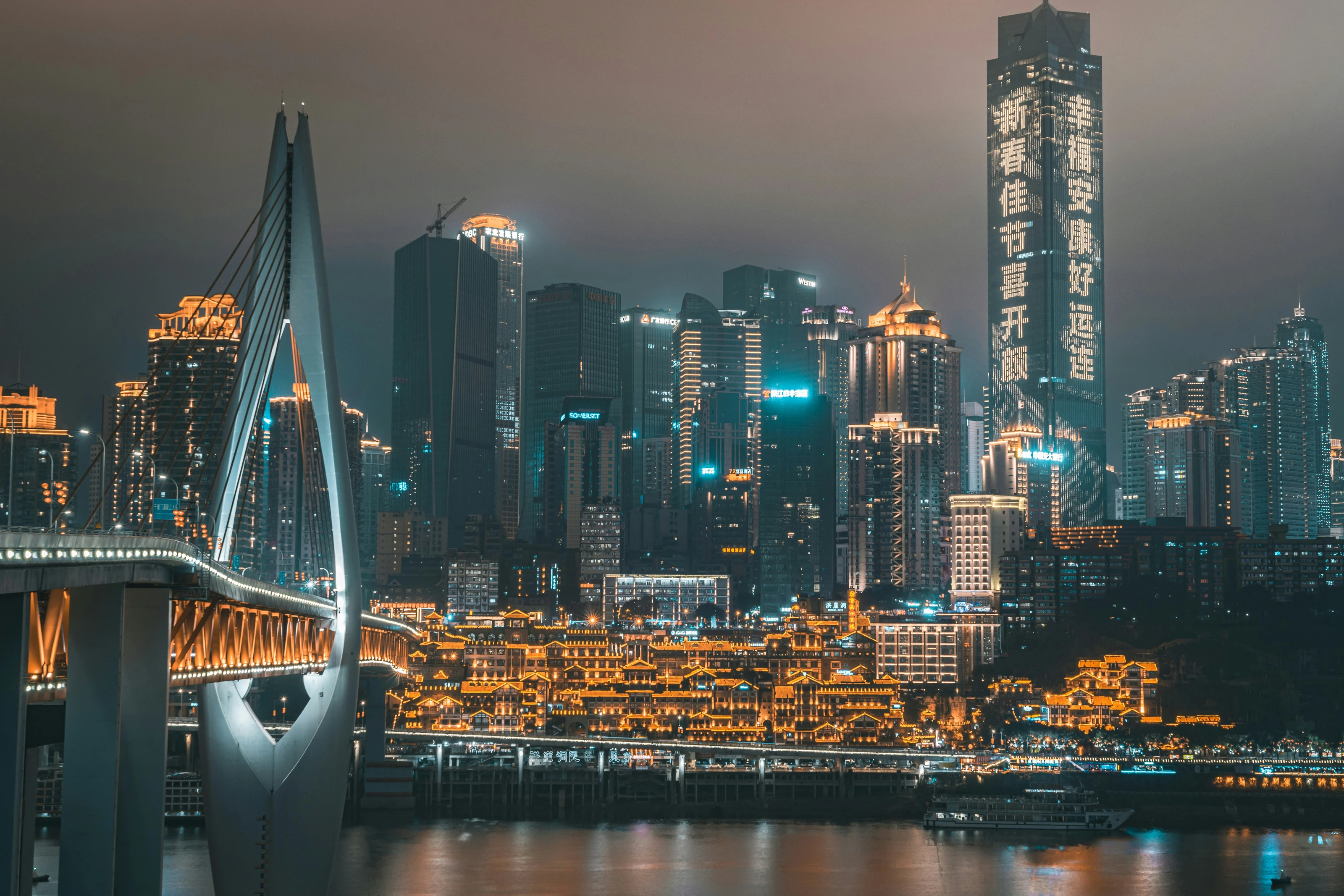
The city clings to parallel mountain ridges split by two mighty river gorges. Across the Yuzhong Peninsula, highway overpasses, aerial cable cars, and wartime air-raid shelters carve through the same bedrock. View the city at twilight from the heights of Eling Park or the southern riverbank, as stacked towers illuminate the water like a vertical metropolis.
What to eat
Nine-grid hotpot relies on heavy beef fat to lock in boiling heat against the river breeze, while sidewalk noodle vendors layer a dozen seasonings in the bottom of each bowl. Dine inside former bomb shelters on spring chicken, cool down with iced fermented rice dumplings, and taste bold river-cuisine driven by flash flames and handfuls of ginger.
Getting here & around
The topography defies standard maps. Monorail Line 2 hugs cliffs and passes straight through apartment blocks, while the Yangtze River Cableway spans the gorge. Walking in the historic center means climbing endless stairways; mapping apps frequently lose orientation, so ask shopkeepers for directions.
Choose a neighbourhood
Each area offers a different side of the city. Pick one to explore at your own pace.
Yuzhong Peninsula & Lower Town
From Jiaochangkou, steep stone walkways cling to sheer cliff edges above the old city walls. A building's ground floor opens onto the riverside highway while its tenth floor steps out onto a bustling hilltop road. Banyan roots split the rock joints, framing noodle stalls tucked into cave entrances.
Experiencing three-dimensional cliffside paths and traditional residential life.
Nan'an, Xiahao & Huangjueya
The winding mountain paths behind the southern waterfront, where century-old foreign trading houses and stilt dwellings hide among dense ficus groves. Climbing the stone steps to Huangjueya reveals an unmatched nighttime panorama of the Yuzhong skyline rising like a floating mothership.
Sweeping skyline views across the river and the quiet atmosphere of early port-era corridors.
Jiulongpo & Huangjueping
An industrial heritage district along the original Chengdu-Chongqing rail line. Historic tea dens serving tea in enamel mugs, the deep rumble of freight trains, and painted murals along the old art academy campus preserve the grit of Chongqing's working-class waterfront.
Finding old Chongqing's industrial roots and raw, riverside tea stalls.
Tallow and grids
Late in the nineteenth century, dockworkers along the Yangtze could not afford whole cuts of beef. Instead, they collected whatever slaughterhouses threw away — tripe, duck intestines, and aorta — boiling them in clay pots filled with spicy beef tallow over wood embers. Beef fat solidifies below forty degrees Celsius. Once melted, it forms a thick seal across the surface, trapping the steam and the perfume of roasted peppercorns like a tight lid. No matter how hard the river wind blows, the broth underneath never stops boiling.
The iron grid was added later to divide the pot into nine separate pockets. The center pocket sits right over the coal fire and boils violently; tripe and duck intestines go in for ten or fifteen seconds until they snap between your teeth. The cross sections hold a gentle simmer for meatballs and marinated beef slices. The four corners barely ripple, giving duck blood curd and pork brain a quiet bath where they can steep for ten minutes without falling apart.
Noodles on steps
Most noodle stalls in the old quarter sit on flights of limestone steps too steep to hold a four-legged table. Stall keepers leave stacks of cheap plastic stools outside the door. Customers grab two: the taller one holds the bowl, the shorter one is your seat. When the steps get packed, people simply plant one foot on a step and crouch with one knee touching the damp stone. That crouch comes from dock porters who had to wolf down breakfast before cargo boats docked.
You cannot wait around when eating Xiaomian. Before the water boils, the cook has already flicked a dozen seasonings into the dry bowl: roasted chili oil, Sichuan pepper oil, soy sauce, garlic water, lard, vinegar, sesame paste, and preserved mustard greens. Fine alkaline noodles spend barely thirty seconds in boiling water before landing on the seasonings. The moment the bowl hits your hands, you have to plunge your chopsticks to the bottom and toss hard. The heat of the fresh noodles whips the starch and the heavy oils into a glossy sauce that clings to every strand.
Cliff stairs
Upper and Lower Chongqing look close on a map — barely a four-hundred-metre walk — but they sit thirty storeys apart. The old Shibati path climbs over a thousand rough stone steps. In a place shaped like this, bicycles were completely useless, and handcarts could not turn on the tight bends.
That physical barrier created one of China's most famous trades: the Bangbang porters. Carrying five-foot poles of tough mountain bamboo with hemp ropes knotted at each end, they wait outside ferry gates, bus stops, and vegetable markets. Five-hundred-pound bags of cement, double-door refrigerators, and entire household wardrobes all climb the cliff face on one flexed pole and a calloused shoulder. Even with monorails cutting through buildings today, the bamboo pole still carries the last hundred metres up the stone steps.
Cliff bacon
Right after the November frosts, balconies across Yuzhong — whether modern forty-storey towers or old brick walk-ups — fill with hanging slabs of pork belly, links of peppercorn sausage, and cured pig jowls. Winter here is damp, grey, and bone-chilling, with sunlight disappearing for weeks at a time, but the deep river gorge acts like a natural wind tunnel. Pork rubbed with coarse salt, roasted peppercorns, and strong sorghum liquor cures for a week, then hangs fifty metres above the water for three months until the white fat tightens into translucent amber.
Before going out onto the balconies, families smoke the meat in sheltered courtyards over smouldering cypress branches, rice husks, and dried orange peels. The fire is kept low with no open flame, letting the sweet pine smoke seep deep into the skin to keep pests away. Sliced thin and steamed over rice, the fat melts on your tongue without feeling greasy, carrying the taste of mountain smoke and winter river wind.