Dunhuang
Wind reshapes the knife-edge dunes of Echoing Sand Mountain, while painted mud plaster in cliffside grottos guards sixteen centuries of mineral pigment.
Fed by glacial meltwater descending from the Qilian Mountains, the Dang River carves an oasis basin between the Badain Jaran and Kumtag deserts. At this historic junction where the northern and southern Silk Roads branched, caravans once sorted Chinese silk, Persian silverwork, and Indian spices. Inside honeycomb sandstone cliff faces, alluvial mud mixed with chopped wheat straw formed the ground layers for Buddhist frescoes that survived centuries of arid dark; at dusk, mutton sizzling on tamarix twigs and fragrant pulled noodles at the Shazhou Night Market lend tangible warmth to desert nights.
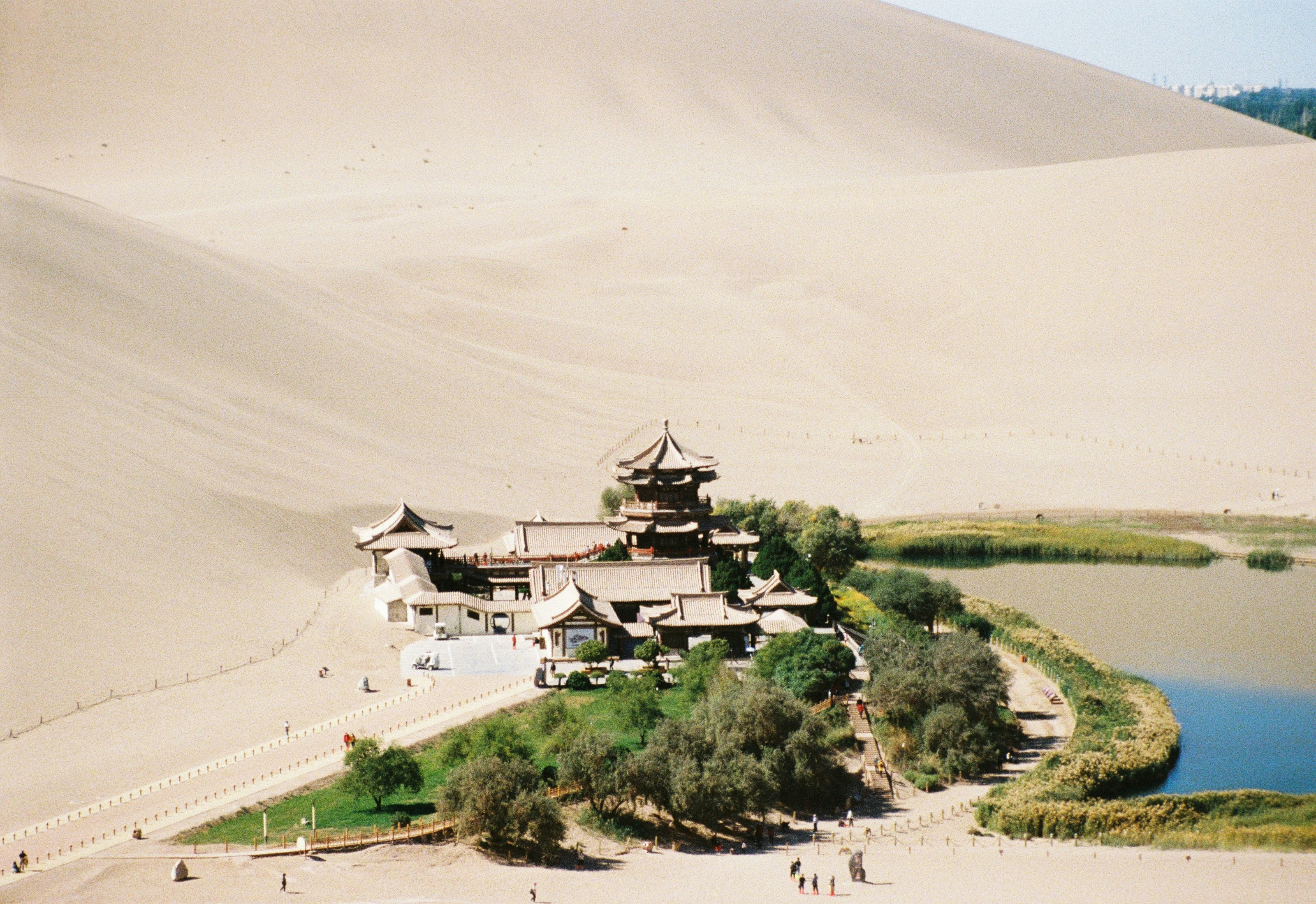
What to see
The Mogao Caves house hundreds of hand-carved grottos along sandstone cliffs, their Buddhist statuary and mineral murals opened selectively by licensed guides; Crescent Lake rests enclosed within massive rolling dunes where visitors climb ridgelines to watch sunsets over the desert; the rammed-earth frontier watchtowers of Yangguan and Yumen Pass stand weathered but unyielding across gravel plains.
What to eat
Shunzhang donkey meat served over yellow pulled noodles features braised savoury cuts ladled over chewy wheat ribbons with minced garlic; fresh lamb skewers skewered on fragrant red tamarix branches sizzle over charcoal sprinkled with ground cumin and dried chilli; iced apricot peel tea offers sweet-tart refreshment; hezhi soup simmers sliced mutton, meatballs, and fried tofu in steaming bone broth.
Getting here & around
Dunhuang Mogao International Airport connects directly to Beijing, Shanghai, Xi'an, and Chengdu; Dunhuang Railway Station and nearby Liuyuan South high-speed station link the Lanzhou-Xinjiang corridor; public buses run between the downtown center, Mogao Visitor Center, and the sand dunes; local taxis provide reliable transport.
Straw-Clay Ground Layers of Mogao
Along the western cliff of the Daquan River, the conglomerate bedrock is too loose and crumbly for direct sculptural relief. Ancient craftspeople harvested fine alluvial silt from the riverbed, kneading it repeatedly with finely chopped wheat straw and sheep hair to create an adhesive clay plaster. Applied in two progressive coats over rough stone, the mud layer smoothed irregularities before a thin white chalk wash received ink outlines. Guild painters ground lapis lazuli, malachite, cinnabar, and orpiment with hide glues, applying mineral washes across the earthen walls. The flexible straw-and-clay substrate absorbed climatic swelling and contraction across fifteen centuries, preserving brilliant Tang dynasty pigments within the cave recesses.
Dang River Channels and Oasis Hydrology
Dunhuang's enduring survival within arid badlands depends entirely on the Dang River, flowing outward from high Qilian glaciers. Meltwater reaches peak volume under midsummer heat, flowing into storage dams and branching irrigation flumes across the valley. Masonry diversion weirs and flagstone sluice gates regulate seasonal allotments by timed turns, watering fruit groves and wheat fields before excess moisture infiltrates the subterranean water table. These hidden aquifers seep upward in lowland desert depressions, perpetually feeding Crescent Lake among shifting sand mountains. Community irrigation compacts enforced by water stewards outlasted dynastic changes, anchoring the oasis against shifting desert sands.
Hearth Fires at Shazhou Market
As twilight settles over the sand peaks, smoke rises through the covered arcades of the Shazhou Night Market. Stallholders slice desert tamarix branches to skewer cuts of grass-fed lamb, roasting them across open charcoal troughs where sizzling drippings release fragrant resinous smoke. Heavy iron cauldrons bubble with star anise and clove aromatics, while braised donkey meat is chopped fine on butcher blocks. Travellers sit around narrow wooden benches, slurping supple hand-pulled noodles, crunching charred lamb skewers, and washing down spice with bowls of chilled wild apricot tea. This market of glowing embers and hot wheat has provided warmth to travellers concluding long desert crossings for centuries.