Foshan
Raw silk dyed in mountain yam juice is coated in iron-rich river silt; tannins oxidize into glossy jet black on top while the underside stays deep terracotta.
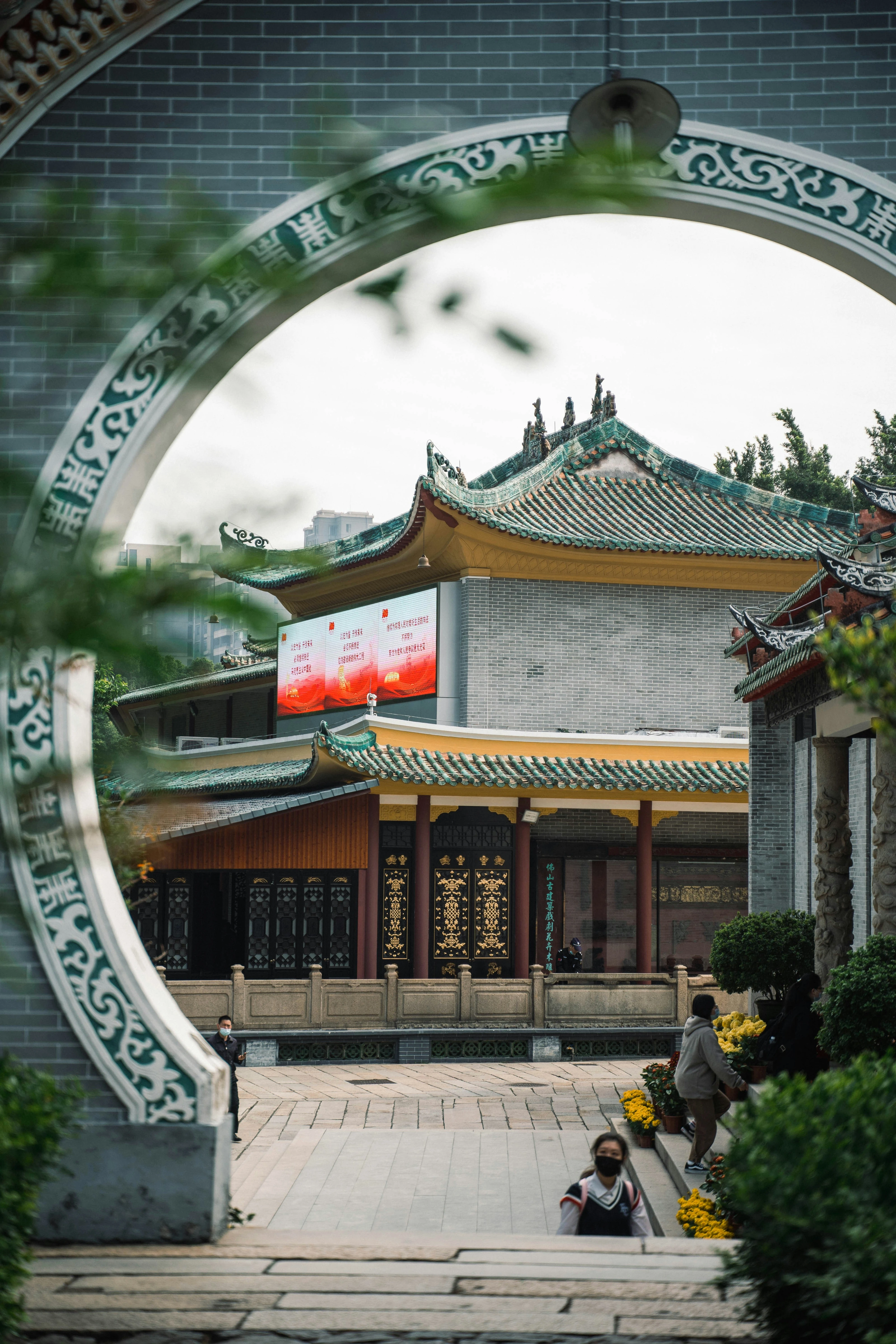
Known alongside Hankou, Zhuxian, and Jingdezhen as one of imperial China's four great commercial centers, Foshan anchored the Pearl River Delta's artisanal manufacturing, martial arts, and lion dance traditions. The Fen River meanders past the Ancestral Temple, where sweeping gables support elaborate shiwan ceramic ridges alive with miniature opera scenes and mythical beasts. Beyond the rhythmic clatter of Wing Chun wooden dummies in courtyard dojos, Foshan's heart is shaped by kiln fire and river mud: Shiwan pottery sculptors press expressive creases into clay figurines before firing in wood-stoked dragon kilns, while across riverside drying grounds, silk saturated in wild yam juice stretches across emerald lawns, coated in river silt to oxidize into gambiered Guangdong gauze, gleaming black on one side and terracotta beneath, rustling like soft paper in tropical breezes.
What to see
The Foshan Ancestral Temple, founded in the Northern Song dynasty to venerate the water god Xuanwu, concentrates the finest Lingnan architectural crafts across carved stone, brick reliefs, and glazed ceramic roof ridges; daily southern lion dance and martial arts exhibitions animate the main courtyard. Nanfeng Ancient Kiln has stoked continuous wood firings since 1506, its stepped dragon kiln scaling the slope like a resting beast beside contemporary artisan pottery lanes. Liang's Garden displays delicate miniature rockeries and winding lotus ponds.
What to eat
Local cooking highlights the savoury heritage of old Canton. Zhuhou paste was invented here, braising beef brisket and duck into rich, caramelized umami. Nine-layer steamed rice cakes separate into delicate sheets, offering chewy springiness. Blind Man's biscuits combine roasted glutinous rice, crushed peanuts, sesame seeds, and cured pork fat into brittle, savory rounds. Mornings center on scholar's congee simmering with pork liver and tripe, served alongside crisp fried dough crullers.
Getting here & around
The Guangfo Metro and Foshan Metro Lines 2 and 3 seamlessly connect downtown Guangzhou with central Foshan in forty minutes. Municipal buses and taxis operate widely; visiting Mount Xiqiao or outlying silk workshops is best served by regional express coaches or rental cars.
Choose a neighbourhood
Each area offers a different side of the city. Pick one to explore at your own pace.
Ancestral Temple & Lingnan Tiandi
The historical origin of Foshan civic identity. The Northern Song Ancestral Temple features deep brick compounds topped by continuous glazed Shiwan pottery ridges depicting classical dramas. Adjoining Lingnan Tiandi revitalizes the Donghuali merchant quarter, lining granite alleys with preserved wok-ear gables, independent craft shops, and herbal oil dispensaries.
Studying temple roof ceramics, watching live kung fu lion exhibitions, and strolling through restored grey-brick mansion quarters.
Shiwan Nanfeng Kiln & Ceramic Quarter
The living heart of south China's pottery industry. Operational since the Zhengde era of the Ming dynasty, the Nanfeng and Gao stepped dragon kilns stretch over thirty meters uphill under centuries-old banyan canopies. Surrounding lanes shelter dozens of ceramic studios, ancestral craft stores, and contemporary clay galleries.
Touring five-hundred-year-old wood-fired dragon kilns and watching master figurine modelers at work.
Lunjiao Gambiered Silk Dyeing Grounds
The world's center for gambiered Guangdong silk production. Broad riverside lawns turn into open-air tapestries as bolts of hand-dyed gauze dry beneath azure skies. Beside canal banks, workers tend bubbling vats of crushed forest yam, coating fine textiles with rich estuarine silt to trigger natural black oxidation.
Witnessing traditional botanical dyeing and river mud coating across green riverside drying meadows.
The sun and river mud of gambiered gauze
Gambiered Guangdong silk represents a rare union of botanical dye and mineral metallurgy. Weavers begin with raw mulberry silk woven into lightweight jacquard gauze. Harvesters dig wild yam roots in mountain ravines, crushing the fibrous tubers into an astringent reddish juice packed with condensed tannins. Bolts of raw silk undergo thirty to forty cycles of dipping, wringing, and sun-drying until they turn rich mahogany.
The alchemy concludes with river silt. At dawn, workers shovel fine black mud enriched with ferrous ions from the bed of unpolluted Shunde canals. Working swiftly beneath midday sun, artisans spread the mud evenly over the upper face of the taut silk, dragging bolts into open meadows. Tannins react instantaneously with iron, curing the top surface into an impenetrable, lacquer-black shell while leaving the reverse side soft, breathable terracotta. Washed clean in river currents and dried, the resulting textile feels cool against skin, rustling softly with every stride.
Ceramic operas on the temple ridgelines
Approaching the main sanctuary of the Foshan Ancestral Temple, eyes are drawn to sweeping roof ridges densely crowded with miniature ceramic statuary. Because coastal typhoons and termites quickly destroyed painted timber eaves, Foshan guilds turned to local refractory Shiwan clays to sculpt dynamic scenes from classical drama.
Master artisans modelled battle scenes from the Romance of the Three Kingdoms and the Water Margin, angling each figure slightly forward so worshippers looking up from courtyard flagstones could read facial expressions clearly. Glazed with wood-ash suspensions colored with cobalt, iron, and copper, pieces were fired in high-heat dragon kilns. Pigments fused into brilliant jewel-toned glazes that have resisted three centuries of torrential monsoon downpours and blazing southern sun without fading.
Wong Fei-hung and the southern lion
In Lingnan folklore, no milestone passes without the awakenings of the southern lion. Unlike northern acrobatic lions, Foshan lions demand rigorous martial arts conditioning from southern kung fu lineages like Hung Gar and Wing Chun. Heads are framed with split bamboo, lined with layers of tough gauze, and painted with ferocious auspicious patterns, crowned with a convex mirror to ward off ill fortune.
Two performers operate as one: the head handler controls blinking eyelids, moving ears, and mouth flaps, while the rear athlete leaps and lifts from behind. Staged across rows of two-meter-high steel poles, percussion thunders like mountain storms as the lion tests shaky planks, hesitates, shakes morning dew from its fur, and leaps across chasms to pluck hanging green lettuce. The performance merges heavy ground stances with airborne grace, embodying southern China's proud civic spirit.