Fuzhou
Encircled by mountains and opening to the sea: summer humidity leaves condensation on whitewashed walls, the exact season raw lacquer cures fastest.
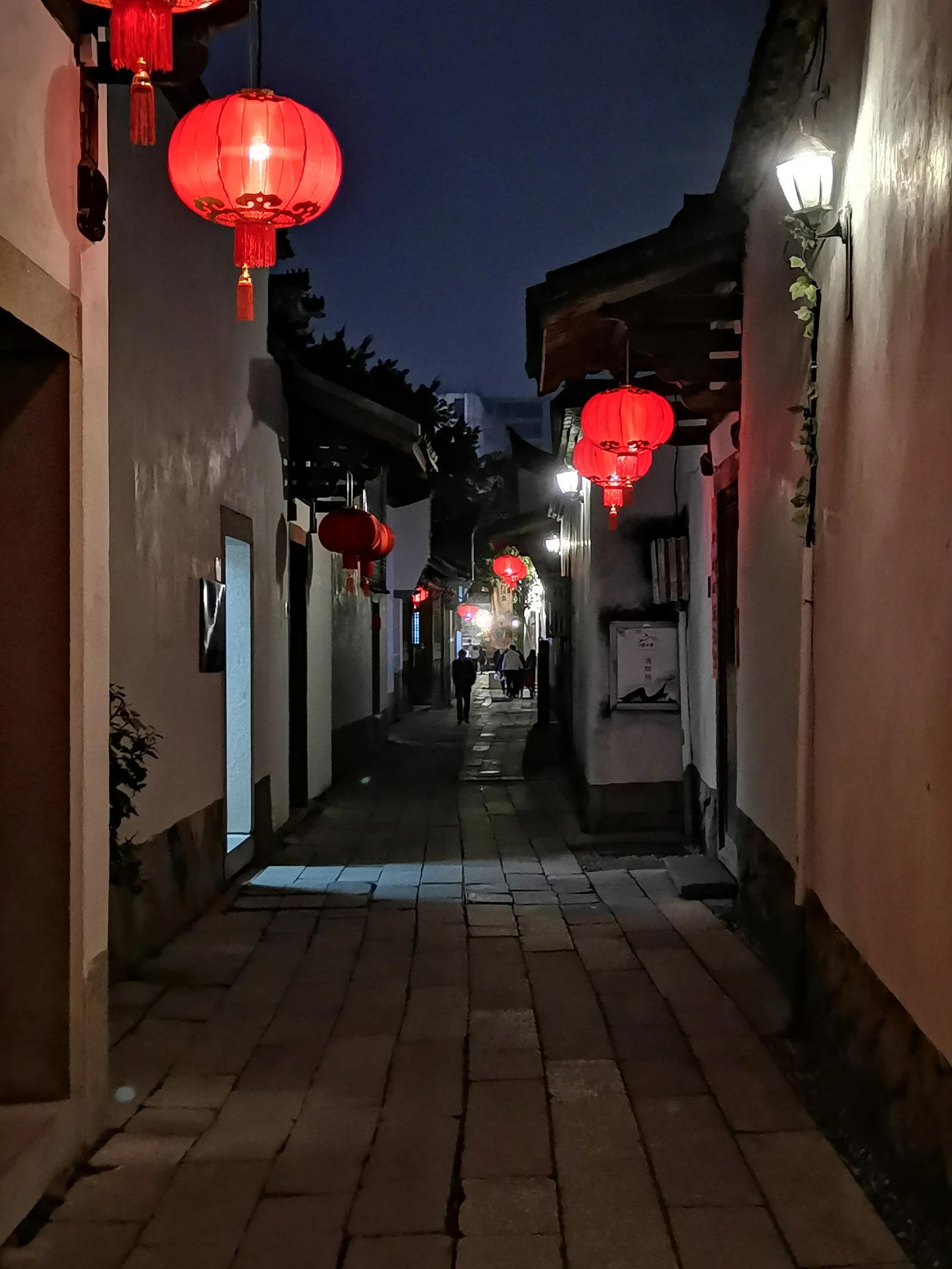
The Min River flows through mountain passes before emptying into the East China Sea, sheltering Fuzhou within an amphitheater of forested ridges. The classical urban grid laid out in the Tang dynasty survives inside Sanfang Qixiang (Three Lanes and Seven Alleys), China's best-preserved residential quarter of Ming and Qing patricians. Plastered fireproof walls curve like ocean swells into unique saddle-shaped parapets, while ancient banyan canopies drape aerial roots over mossy courtyards. Fuzhou nurtured the intellectual architects of modern China, from Lin Zexu to Yan Fu. In secluded ateliers, lacquer masters apply raw Urushi resin layer upon layer over hemp gauze and paper armatures, wet-grinding and hand-polishing until vessels emerge light as silk ribbons yet resilient as bronze, glowing with quiet, subterranean depth in the city's perpetual coastal humidity.
What to see
Sanfang Qixiang spans three lanes and seven alleys paved in smooth granite, preserving over two hundred Ming and Qing clan mansions with carved courtyards and water pavilions. The White and Black Pagodas on Mount Yu and Mount Wu gaze across the historic basin. Downriver at Mawei, the historic naval shipyards and Luoxing Pagoda chronicle nineteenth-century maritime modernization and coastal defense.
What to eat
Classical Fujian cuisine emerged from Fuzhou, famed for consummate knife skills and broth craftsmanship that changes ten times over a meal. Mornings call for laohua: fine rice vermicelli scalded with tender pork cuts in boiling bone broth, and dingbianhu, where rice slurry is splashed against wok rims to scorch into thin curls before sliding into clam and shiitake soup. Banquets culminate in Buddha Jumps Over the Wall, braising abalone, sea cucumber, fish maw, and tendon in Shaoxing wine jars. Rouyan wraps pork stuffing inside wrappers beaten from fresh lean pork muscle, yielding dumpling skins that crunch delicately like swallows' nests.
Getting here & around
Fuzhou Changle International Airport provides direct airport express buses downtown. Fuzhou and Fuzhou South Railway Stations anchor high-speed rail lines, linked to Sanfang Qixiang and major sites by Metro Lines 1, 2, and 4. Bicycles and walking are ideal for exploring historic alleyways.
Choose a neighbourhood
Each area offers a different side of the city. Pick one to explore at your own pace.
Sanfang Qixiang & South Back Street
The premier living enclave of imperial scholar-officials in southern China. South Back Street branches into tranquil lanes preserving historical residences of thinkers like Yan Fu, along with the Xiaohuanglou library and waterside opera pavilion. Curved white firewalls frame tranquil courtyards where miniature grottoes and sweet osmanthus trees shade scholar studios.
Studying classical Minnan timber carvings, waterside pavilions, and residences of modern intellectual reformers.
Cangshan Yantai Mountain Consular Enclave
A breezy hillside diplomatic quarter overlooking the Min River. Shaded beneath giant banyans and gingko trees, colonial consulates, Victorian stone churches, and mission hospitals form an open-air museum of nineteenth-century brick architecture. Quiet slopes feature contemporary art spaces, teahouses, and river overlooks.
Strolling shaded colonial avenues and enjoying sunset river vistas from historic consular gardens.
Mawei Naval Shipyard Historical Quarter
The birthplace of China's modern naval engineering, shipping science, and aviation experiments. The nineteenth-century ironworks, machine halls, and Naval Academy retain industrial steel trusses designed by French engineers. Looking out from the South Song Luoxing Pagoda captures broad estuary tides.
Exploring early modern industrial maritime heritage and surveying the dramatic Min River mouth.
The featherweight strength of bodiless lacquer
Natural Chinese lacquer tree resin withers and cracks in dry climates; only in the humid, warm coastal air of Fuzhou can the enzyme laccase cure the resin into insoluble poly-lacquer chains. During the Qianlong era, Fuzhou artisan Shen Shao'an revived and perfected the craft of bodiless lacquerware.
Artisans begin by sculpting an armature in clay or plaster. Over this core, they wrap layers of gossamer-fine summer linen gauze, saturating each sheet with raw tree sap mixed with pulverized roof tile ash. When the shell cures into stone-like hardness, the piece is submerged in water tanks until the inner clay softens and washes completely away, leaving behind a featherweight husk of pure lacquered textile. Months of wet grinding with charcoal and oilstones follow, concluded by polishing the surface with bare palms dipped in camellia seed oil and fine ash. The finished vessel is impervious to boiling water and strong acids, light as silk yet shatterproof.
Beating pork into translucent dumpling skins
Walking along South Back Street in Sanfang Qixiang, the rhythmic thud of heavy wooden mallets echoes off granite flagstones. Fuzhou's renowned rouyan dumplings appear delicate as wontons, yet their wrappers contain no wheat flour; they are made almost entirely of pure muscle meat.
Master butchers select pristine lean pork hindquarter, free of fat and sinew, placing it on heavy blocks carved from seasoned lychee timber. Two workers wield solid timber mallets, striking the meat thousands of times until the cellular grain breaks down into a sticky, elastic paste. Fine mountain sweet potato starch is folded in before the dough is repeatedly folded and rolled with long dowels into paper-thin, translucent sheets measuring less than half a millimeter. Sliced into squares and filled with minced pork and crunchy water chestnuts, the swallow-tail parcels boil in clear broth to deliver crisp, savory snap.
Saddle-shaped walls and weeping banyans
The defining skyline of Fuzhou architecture is the undulating saddle firewall found throughout Sanfang Qixiang. While Jiangnan horse-head walls step down in rigid right angles, Fuzhou walls sweep in sweeping double-curved waves, dipping low in the center like a horse saddle and soaring upward at the corners topped with plaster dragons and chimera beasts.
Beyond echoing the waves of the Min River, these massive whitewashed mud walls served as vital firebreaks. In a densely packed timber city, walls rising ten feet above tiled roofs prevented sparks from jumping between adjacent courtyards. Within, centenary Chinese banyans spread colossal emerald umbrellas across skywells; their curtain-like aerial roots absorb heavy seasonal humidity, keeping central verandas cool, shaded, and filled with gentle breezes.