Jingdezhen
Lumps of white earth spin into form on timber flywheels; pine-wood fires at thirteen hundred degrees burn raw clay into jade-like translucent bone.
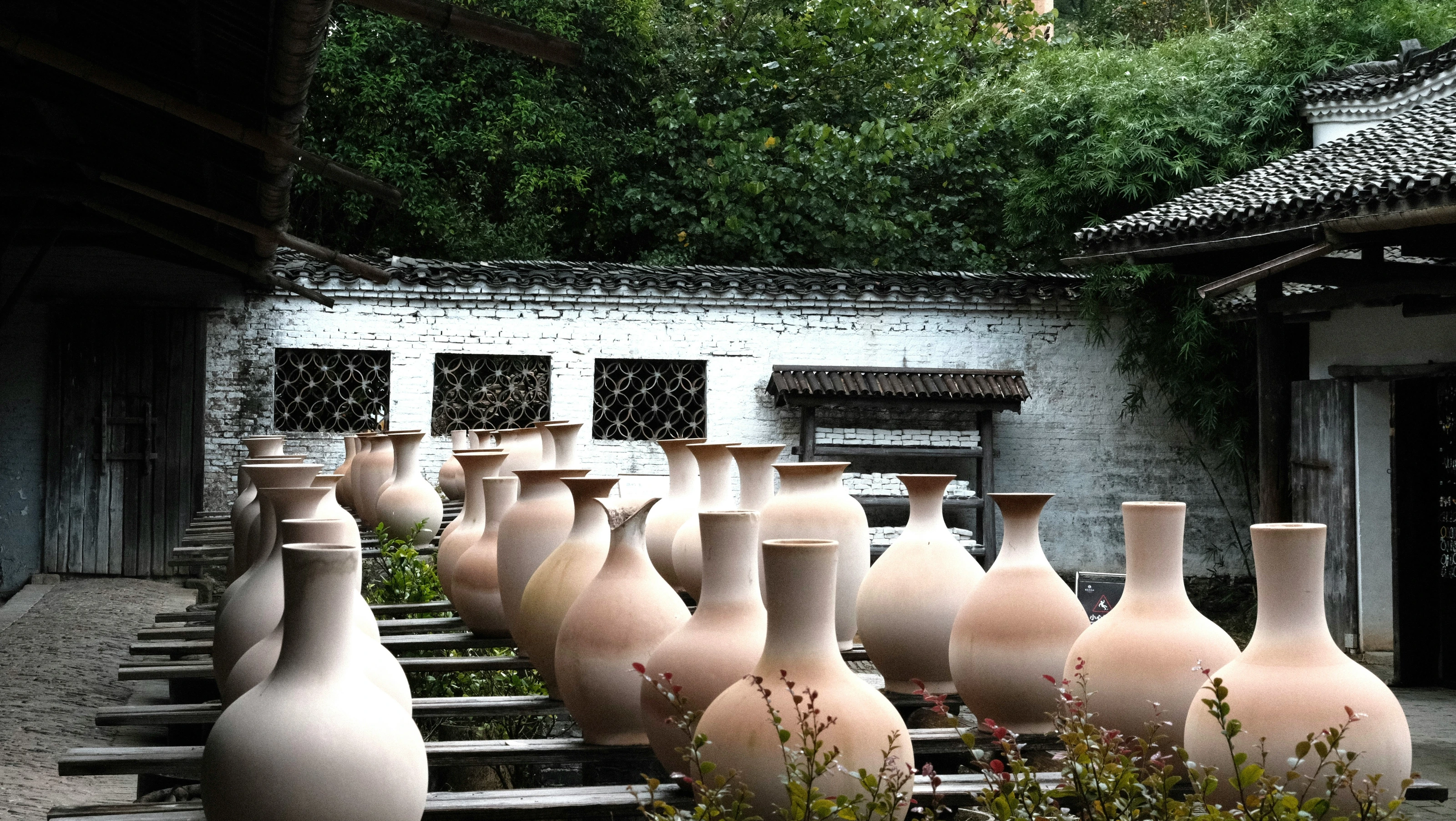
The Chang River tumbles out of the deep mountain ravines of Yaoli, cutting past Mount Gaoling where the world's purest porcelain clays lay hidden. For over a millennium, Jingdezhen's urban heart has pulsed to the cadence of kiln fire: centuries-old narrow lanes are paved with discarded saggar bricks and broken shards of blue-and-white porcelain, and the morning air holds the faint, resinous perfume of burned horsetail pine. Across seventy-two specialized crafts, master throwers draw hollow cylinders from rotating clay slip while carvers wield ribbon-thin steel knives to shave leather-hard walls into translucent sheets. Porcelain here is not cold tableware; it is the vital meeting of river silt, mountain water, human fingertips, and white-hot flame.
What to see
The Imperial Kiln Archaeological Site and Taoyangli quarter anchor the history of Ming and Qing imperial porcelain, with historic alleys harboring multi-generational artisan workshops. Sanbaopeng Art Valley stretches along a mountain brook, while the Old Sculpture Porcelain Factory and the Saturday Mufei Market gather hundreds of independent contemporary potters. Farther northeast, Yaoli ancient town and Mount Gaoling offer intact water-powered stone crushers and the historic quarry pits that supplied global ceramic history.
What to eat
Porcelain-town cooking carries the bold, rustic heat of northeastern Jiangxi. Morning begins with a bowl of lengfen: thick, udon-gauge rice noodles tossed with beef gravy, preserved orange peel, pickled mustard greens, and crushed dried chilli. Mud-baked chicken wraps whole birds in lotus leaves and local kiln clay before roasting in embers, while fried rice cakes with cured ham provide instant nourishment for kiln workers.
Getting here & around
Jingdezhen North Railway Station on high-speed trunk lines reaches Huangshan and Wuyuan in under thirty minutes. The Imperial Kiln Site, Sculpture Factory, and Sanbaopeng are easily linked by local taxis, while reaching Yaoli ancient town is best managed with rented vehicles.
Choose a neighbourhood
Each area offers a different side of the city. Pick one to explore at your own pace.
Imperial Kiln Archaeological Site & Taoyangli
The historical inner precinct reserved for imperial court porcelain production. Red-brick vaulted galleries of the Imperial Kiln Museum mirror still waters, surrounded by ancient lanes like Pu'an Alley paved entirely with refractory kiln firebricks and porcelain shards. At night, elderly painters sit by open windows tracing cobalts onto raw bisque.
Tracing imperial porcelain history and walking centuries-old alleys built of recycled kiln materials.
Sanbaopeng Valley & Sculpture Factory
A creative epicenter nestled inside a bamboo ravine. Rushing mountain brooks flank rammed-earth studios and contemporary ceramic galleries; the nearby Sculpture Porcelain Factory preserves mid-century sawtooth brick industrial sheds now housing independent ceramic ateliers and bustling weekend craft markets.
Browsing independent artisan markets and relaxing in mountain valley ceramic tea lounges.
Yaoli Ancient Town & Gaoling Quarry
A pristine Huizhou-style river village nestled at the headwaters of the Chang River. Intact timber homes with white stepped gables line rushing waters where waterwheels drive stone trip-hammers crushing porcelain stone. Hiking Mount Gaoling leads directly to the white clay cliffs that revolutionized world ceramic science.
Visiting the geological source of porcelain and walking an unhurried, untouristed mountain stream village.
Pressure upon the spinning wheel
The master thrower sits over the wheel pit, kicking the heavy wooden flywheel below into blur. Slipping wet hands over the rotating mound of clay, thumbs sink into the core while palms cup the rising column; in seconds, dense white mud heaves upward into a hollow, slender vase.
Yet the true character of the piece is defined by the trimming blade. After days of drying in shade to a leather-hard state, the raw form is inverted onto a spinning wooden chuck. The artisan holds a flexible, leaf-thin iron scraper gently against the rotating wall. Ribbons of clay curl away like wood shavings. Guided solely by delicate resistance felt through the fingertips, the carver shaves the clay until it achieves absolute balance. Held against afternoon sky, the vessel walls are so thin that shadows of fingers show clearly through the unfired earth.
The celadon sky of pine embers
The celebrated bluish-white qingbai and celadon glazes of Jingdezhen owe their clarity to native horsetail pine forests. Pine timber is saturated with natural resins that burn with long, clean flames, raising chamber temperatures evenly without introducing destructive sulphur impurities.
Unfired pieces are sealed inside thick refractory clay saggars and stacked to the vaulted roof of the wood kiln. Once lit, stoking never halts for days. Fuel is added according to draft rhythms; the chief firing master peers through tiny spyholes into blinding white light, judging solely by flame hue and chimney smoke whether the furnace has reached 1,300 degrees Celsius. In the oxygen-starved reducing atmosphere, trace iron in the glaze reduces to pure ferrous ions, cooling into that translucent, pale-blue jade luster that mimics rain clearing over distant peaks.