Longyou
Underground red sandstone caverns reveal mysterious chisel marks, while Qu River wharves once shipped fermented rice cakes and merchant mansions.
Positioned at the western end of the Jinhua-Quzhou basin where the Qu River meets the Lingshan River, Longyou was an essential shipping nexus linking four interior provinces with coastal trade. Hidden beneath red sandstone bluffs in Xiaonanhai lie the Longyou Grottoes, over twenty cavernous subterranean chambers carved with uniform diagonal striations whose exact origins remain one of China's great engineering riddles. Above ground, merchant clans accumulated wealth across river networks, leaving behind grand timber compounds at Phoenix Mountain, while street stalls steam porous Longyou fermented rice cakes sweetened with natural rice wine yeast.
What to see
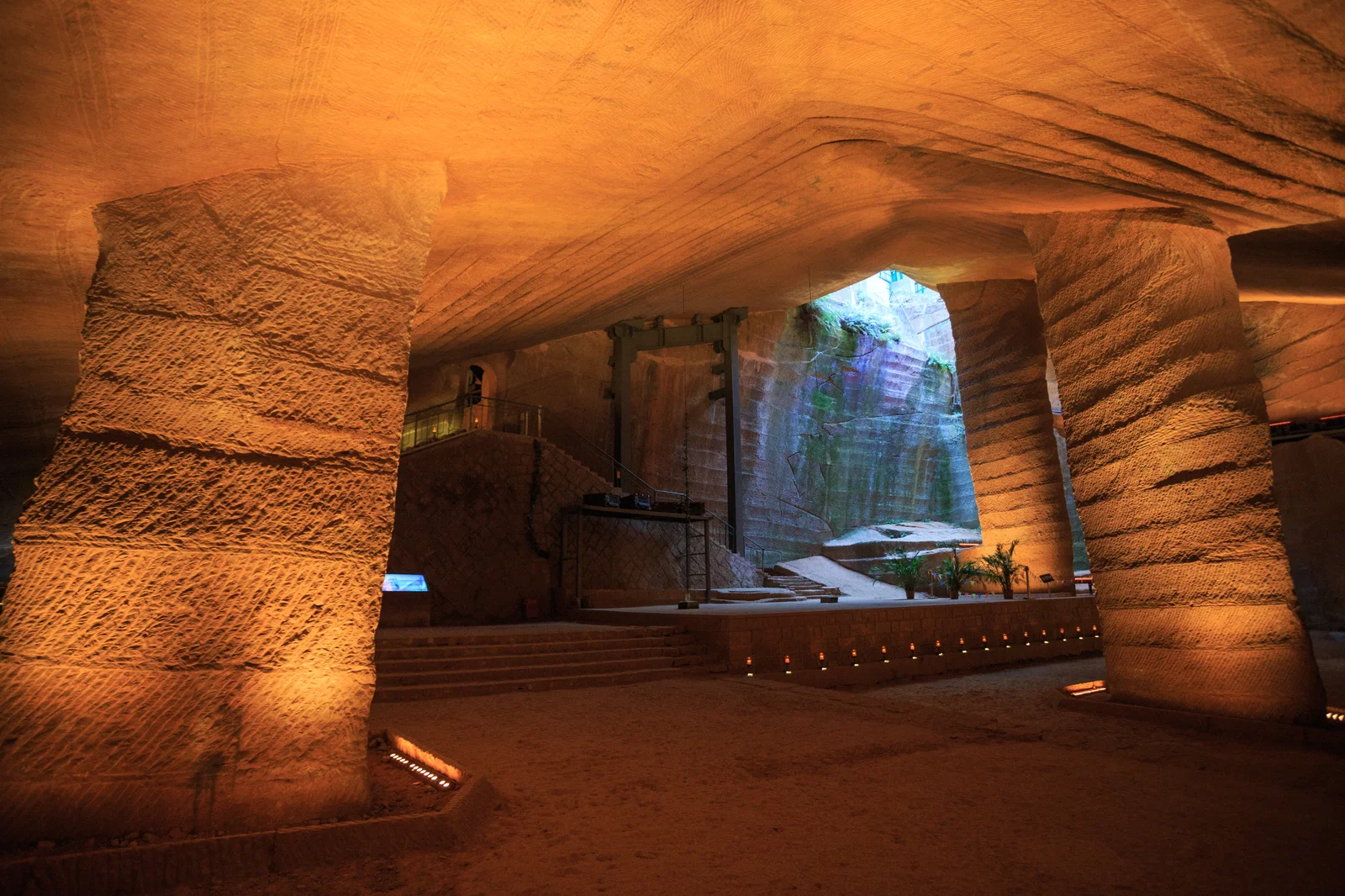
Longyou Grottoes feature subterranean sandstone halls with fish-tail support pillars and uniform chisel marks; Phoenix Mountain Heritage Park preserves relocated Ming-Qing merchant compounds and clan stages; Jiangxiyan Ancient Weir functions as an operating six-hundred-year-old irrigation barrage; Sanmenyuan Ye Clan Mansion showcases ornate brick and timber carvings; Jiming Mountain Pagoda commands panoramic river views.
What to eat
Longyou fagao steamed cakes ferment late japonica rice with sweet rice wine yeast, producing a spongy, sweet cake dotted with red dates; scallion steamed buns pack fresh chives, winter bamboo shoots, and pork into soft yeasted dough; savoury starch meatballs combine sweet potato flour with diced pork and bamboo shoots into chewy translucent spheres; dried country sausages offer savory, pepper-spiced warmth.
Getting here & around
The Shanghai-Kunming High-Speed Railway serves Longyou Station, reaching Hangzhou in fifty minutes and Shanghai in one hundred minutes. Direct city buses and tourist shuttles connect the station to the Longyou Grottoes and Phoenix Mountain in fifteen to twenty minutes.
Choose a neighbourhood
Each area offers a different side of the city. Pick one to explore at your own pace.
Longyou Grottoes & Qu River Sandstone Bluffs
An underground engineering marvel along the 30th parallel north, where cavernous subterranean chambers feature rhythmic diagonal chisel striations.
Descending into subterranean halls to examine uniform chisel patterns and fish-tail stone pillars that defy easy explanation.
Longyou Residential Heritage Park
An open-air architectural museum at Phoenix Mountain preserving relocated Ming and Qing merchant halls, academies, and clan stages.
Admiring brick carving on monumental courtyard entry gates and examining timber corbels depicting folklore tales.
Jiangxiyan Ancient Irrigation Weir
A World Heritage irrigation structure utilizing stone-and-gravel barrages to divert river water naturally across agricultural fields.
Walking the cobblestone river embankment observing ancient hydraulic flow channels and scenic bamboo-lined streams.
Phoenix Mountain Ming-Qing Ancestral Halls and Carved Corbels
Ascending Phoenix Mountain in Longyou, dozens of Ming and Qing compounds saved from rural neglect form an open-air museum. From the mid-Ming dynasty onward, Longyou merchant syndicates dominated trading routes across interior waterways. Returning merchant patriarchs poured capital into clan halls that balanced Hui-style whitewashed walls and fire-step gables with the virtuosity of western Zhejiang woodcarving. Stepping into Zifu Hall, heavy post-and-beam frameworks soar without decorative paint, relying instead on multi-tiered corbel brackets carved from nanmu and ginkgo wood. Operatic scenes and mythical beasts emerge from the hardwood with startling depth.
Subterranean Sandstone Caverns and Chiseled Striations
Descending the stone stairs into Grotto No. 3 at Longyou, air cools abruptly and a cavernous hush envelops the visitor. Soaring up to thirty meters high, the chambers were excavated entirely out of Cretaceous red sandstone bedrock, with sloping ceilings held aloft by massive fish-tail pillars. Most striking are the marks covering every ceiling, wall, and pillar: uniform diagonal striations incised at a precise sixty-degree pitch, with constant depth and spacing across hundreds of square meters. Despite removing hundreds of thousands of cubic meters of stone, no mention of this monumental undertaking exists in imperial records.
Rice Wine Fermentation and Steamed Spongy Rice Cakes
Walking Longyou's riverside lanes in the morning mist, the aroma of sweet steam marks the lifting of bamboo lids. The magic of Longyou fagao lies in natural fermentation. Local cooks soak late-harvest japonica rice before grinding it into silky milk, inoculating the batter with homemade sweet rice wine fermented with wild smartweed herbs. Resting overnight in wooden tubs, natural yeasts generate millions of uniform bubbles. Poured over fresh reed leaves inside woven bamboo steamers and studded with diced jujubes, intense steam cooks the batter into a white, spongy cake filled with elastic cellular pores that yield soft floral sweetness.