Luoyang
Thirteen dynasties etched their faces into riverside limestone and simmering soup cauldrons: twenty-four courses of the Water Banquet all come as soups, leaving not a dry dish on the table.
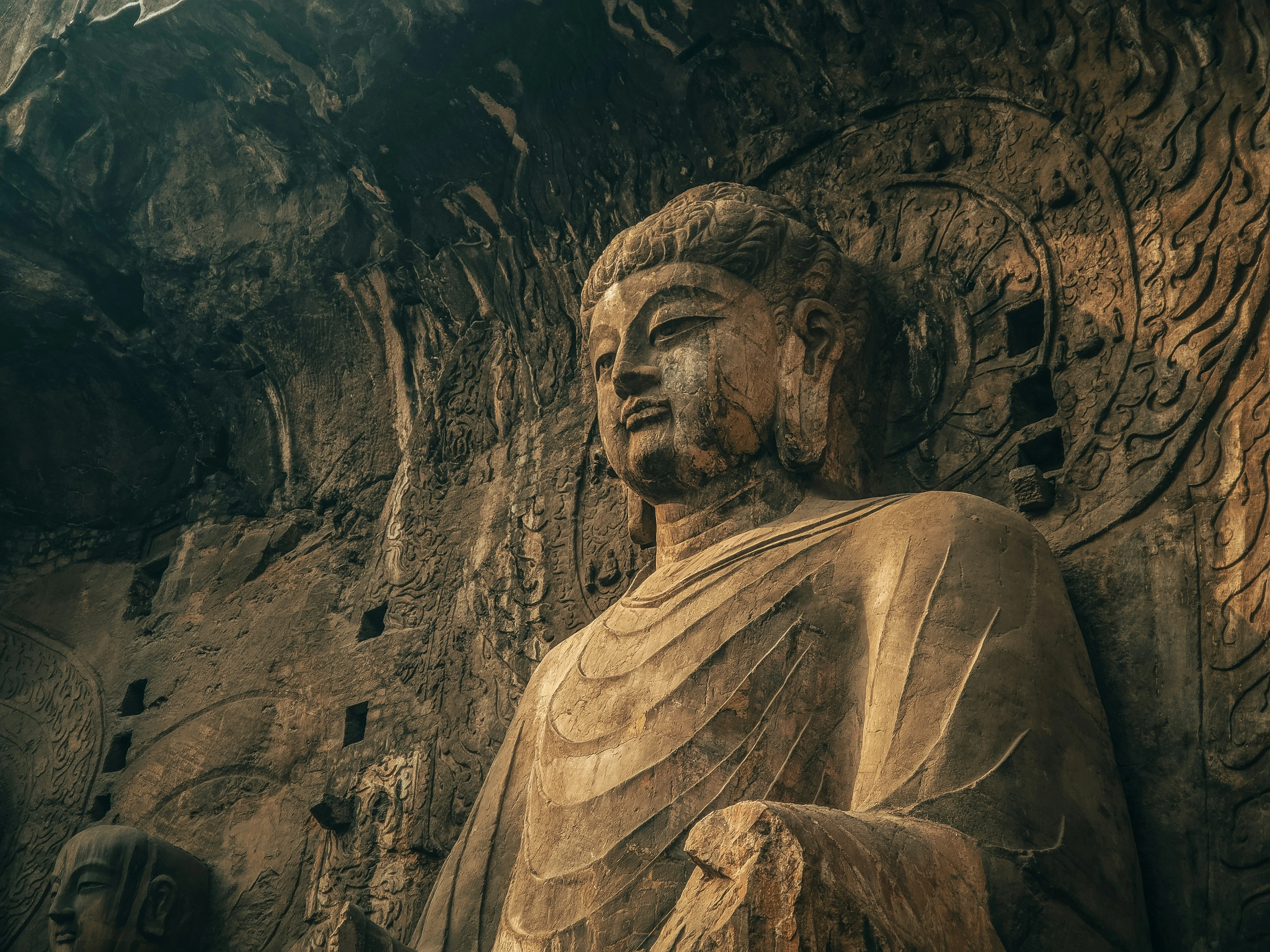
Ringed by mountains in the Yiluo River basin south of the Yellow River, Luoyang served as the capital of thirteen dynasties from the Bronze Age through the Tang. The Yi River cuts between twin limestone bluffs at Longmen, where thousands of grotto niches pit the rock faces: the ascetic slenderness of Northern Wei carving gazes across the water at the monumental serene countenance of the Tang Vairocana Buddha, an imperial testament to cosmopolitan confidence. At White Horse Temple, ancient Indian brick stupas and Han dynasty timber sanctuaries stand together, marking the arrival of Buddhism in China. City life revolves around simmering cauldrons: dawn brings the savory steam of beef, lamb, and tofu broths, into which paper-thin green bean crepes called bufan are submerged into peppery broth. Banquets culminate in the Luoyang Water Banquet, a twenty-four-course feast where every offering is a soup served in continuous flow, turning humble shredded radish into delicate bird's nest soup.
What to see
Longmen Grottoes stands among the highest achievements of Chinese rock-cut art; the seventeen-meter-tall Vairocana Buddha in Fengxian Temple radiates serenity, while Guyang Cave preserves classical Northern Wei stelae calligraphy. White Horse Temple, founded in 68 CE, represents China's earliest official Buddhist sanctuary, integrating Chinese, Indian, Thai, and Burmese styles. The Sui-Tang Luoyang Relics Park reconstructs Empress Wu Zetian's grand Yingtian Gate and Mingtang Hall, while Lijing Gate anchors Ming-Qing pedestrian food alleys.
What to eat
Luoyang dining is defined by soup culture and the ceremonial Water Banquet. The banquet progresses through eight cold platters followed by sixteen hot soups; the signature Peony Swallow Dish shreds white daikon into hair-thin threads that steam into translucent filaments resembling bird's nest, ladled with tart, peppery broth. At street stalls, locals gather for rich bone broths of beef and lamb simmered overnight, torn with unleavened baked guokui bread. Bufan soup drops flash-cooked mung-bean crepes into peppery broth studded with wood ear mushrooms and dried shrimp.
Getting here & around
Luoyang Beijiao Airport operates domestic flights, while high-speed trains at Luoyang Longmen Station reach Xi'an in ninety minutes and Zhengzhou in thirty. Metro Lines 1 and 2 link the high-speed rail hub with the historic walled quarter and Sui-Tang archaeological parks.
Choose a neighbourhood
Each area offers a different side of the city. Pick one to explore at your own pace.
Longmen Grottoes & Yi Riverfront
The peak of imperial stone sculpture in China. The Yi River bisects limestone cliffs where the Western Hill preserves Fengxian Temple's monumental Vairocana Buddha, carved with supple, cascading robes and an enigmatic smile. Across the river, the Eastern Hills house Xiangshan Temple and the pine-shaded tomb of Tang poet Bai Juyi.
Marveling at the monumental Tang Buddha carvings of Fengxian Temple and walking riverfront cliff paths.
Old Town Cross Street & Lijing Gate
The atmospheric heart of old city market life. Massive Lijing Gate opens onto flagstone-paved pedestrian alleys lined with calligraphy mounting shops, peony pastry bakeries, and heritage water-banquet dining halls. At night, scarlet lanterns illuminate steaming soup cauldrons and sizzling street griddles.
Ascending Lijing Gate ramparts and tasting authentic Water Banquet dishes in the bustling night market.
White Horse Temple & Qiyun Pagoda
The official cradle of Buddhism in China. Red-walled Han-dynasty courtyards shade ancient cypresses and rare Yuan-dynasty dry-lacquer arhat statues. Adjoining precincts feature contemporary Buddhist halls constructed in authentic Indian, Thai, and Burmese architectural traditions.
Visiting China's earliest Buddhist sanctuary and exploring multicultural Buddhist architecture.
The Tang serenity on the face of Vairocana
In 672 CE, Empress Wu Zetian contributed two myriad strings of her personal rouge money to sponsor the carving of the great Buddha at Fengxian Temple on Longmen's western bluffs. Rising over seventeen meters tall, with a head measuring four meters, the central Vairocana Buddha looks downward with heavy-lidded eyes and a subtle, knowing half-smile.
Working in dense native limestone, Tang sculptors carved drapery that cascades in soft, water-like concentric ripples across the massive shoulders. The gaze converges precisely upon human pilgrims looking up from riverbank flagstones. Flanked by aged Kashyapa, youthful Ananda, crowned bodhisattvas, and fierce armored guardians, the tableau unites courtly hierarchy with transcendental peace. Weathering thirteen centuries of mountain winds, the serenity upon the stone face remains unchanged, anchoring the cosmopolitan confidence of the Tang imperium.
The radish threads of the Peony Water Banquet
Originating in the Tang court, the Luoyang Water Banquet takes its name from its twenty-four courses, every one served in broth, brought to the table and cleared in continuous succession like flowing water. Its opening centerpiece is the Peony Swallow Dish.
The heart of this imperial course begins with winter daikon radish. Chefs wield razor knives to slice radish into filaments as fine as silk threads, soaking them in spring water to draw out sharp bitterness before dusting them in mung-bean starch to steam. Cooked, the radish turns translucent, glossy, and springy, mimicking bird's nest in delicate texture. Plated beneath a carved floral peony of steamed egg yolk and cured ham, boiling broth seasoned with white pepper and dark vinegar pours over the bowl, releasing sharp, savory steam that awakens the palate.
The boiling broth of dawn soup parlors
In Luoyang, mornings commence with the greeting: Have you drunk soup yet? By five in the morning, giant iron cauldrons along Old Town alleys steam with boiling broth. Old Bai beef soup, Tiexie mutton soup, tofu soup, and bufan soup draw snaking queues in the morning chill.
Cauldrons burn continuously, boiling hundreds of pounds of beef and mutton marrow bones day and night until lipids and water emulsify into opaque, ivory broth. Diners order meat by weight; the cook scalds sliced cooked beef in wire strainers inside the bubbling cauldron, ladling hot broth over the bowl with handfuls of fresh garlic shoots and coriander. Diners tear unleavened, crusty guokui flatbreads into bean-sized crumbs, scattering them into the broth to soften without losing chew. A spoonful of dark red chili oil cuts through the rich marrow fat, warming the body to its core.