Meizhou
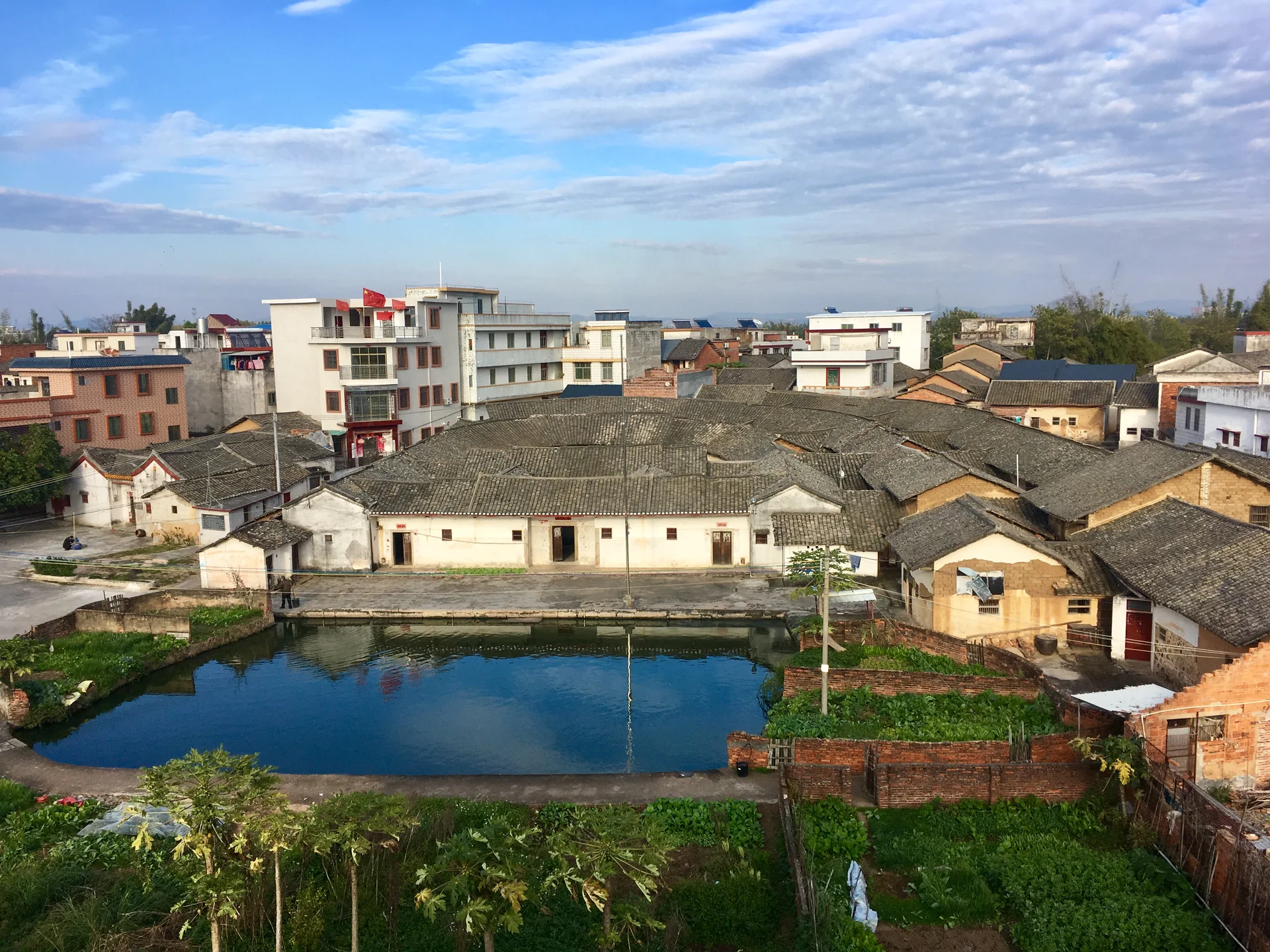
A semicircular pond mirrors the threshing yard; the ancestral shrine anchors the exact center, while curved rear dormitories embrace the clan like sheltering arms.
The Mei River threads through the layered hills of northeastern Guangdong, where Meizhou stands as the cultural heart of the global Hakka diaspora. Descendants of northern Han migrations who fled successive dynastic collapses settled inside this rugged mountainous haven, pouring their reverence for ancestral memory into monumental weilongwu (circular-backed dragon houses). A crescent-shaped feng shui pond faces the front threshing grounds; central courtyard halls house the lineage tablet shrine, while stepped semicircular dormitories wrap around the sloping earthen ridge behind, embracing hundreds of clan kin like sheltering maternal arms. Daily life carries earthy intimacy: mornings begin with oily, garlic-crisped dry noodles paired with flash-boiled pork organ soup; earthen hearths bury fermenting sticky rice jars under smouldering rice husks to roast golden, honeyed niangjiu wine. Weeds sprout from sacred earthen mounds behind ancestral altars, and bamboo drying racks hold sun-dried mustard greens and citrus peels, exuding quiet domestic resilience.
What to see
The Renhou Wen Clan Ancestral Hall in Bingcun preserves an immense Ming-dynasty layout with triple central halls and three concentric semicircular dragon wings. Songkou Ancient Town along the Mei River marks the primary departure wharf where hundreds of thousands of Hakka emigrants boarded steamships for Southeast Asia, its waterfront quays and arcades retaining poignant nostalgia. The China Hakka Museum documents migration history, while Hua'e Lou in Dapu stands as Guangdong's oldest circular earthen fortress.
What to eat
Hakka cooking centers on deep savory richness, thorough cooking, and aromatic fat. Breakfast pairs yanmian—flat noodles tossed with lard, fragrant fried garlic, and fish sauce—with sanjidi soup of flash-poached pork loin, liver, and intestine. Stuffed tofu fills silky mountain curd with seasoned minced pork before pan-searing and braising. Salt-baked chicken wraps free-range birds in greaseproof paper, burying them inside wok-roasted coarse sea salt until meat turns tender with golden, crackling skin. Niangjiu chicken braises chicken in sweet, caramelized rice wine to restore vitality.
Getting here & around
Meizhou West Railway Station links high-speed rail lines to Guangzhou, Shenzhen, and Xiamen. Because rural Hakka villages in Meixian and Dapu are dispersed across rugged river valleys, renting a car is strongly recommended to tour historic villages along the Mei River.
Choose a neighbourhood
Each area offers a different side of the city. Pick one to explore at your own pace.
Meixian Bingcun & Wen Clan Hall
The most monumental surviving Hakka dragon house in Guangdong. Constructed during the Hongzhi era of the Ming dynasty, the Wen Hall encompasses triple central courtyards enclosed by three concentric semicircular dragon wings holding hundreds of chambers. Sloping earthen mounds rise like turtle carapaces behind the shrine, illustrating rigid Confucian hierarchy.
Studying pristine three-ring dragon-house spatial geometry and understanding Hakka lineage architecture.
Songkou Ancient Port & Mei River Quays
The departure point for historic Hakka migrations across the South China Sea. Steamboat stone wharves descend into slow river currents where millions bade farewell to homeland hills. Weathered shophouse arcades along the waterfront preserve Republican-era currency exchanges, apothecaries, and photographic studios.
Walking historic river passenger wharves and exploring evocative riverside commercial arcades.
Dapu Baihou & Hua'e Lou
A cultural enclave of mountain vernacular fortresses. Baihou village preserves over thirty Ming and Qing scholar-official courtyard mansions. Deep in Dadong township stands Hua'e Lou, Guangdong's largest circular rammed-earth fortress, with four-story-high earthen ramparts enclosing two hundred rooms oriented inward toward the ancestral shrine.
Venturing into remote mountain valleys to marvel at solitary circular earthen keeps.
The sacred geometry of the dragon house
Displaced repeatedly by northern wars, Hakka migrants treated collective clan dwelling as an imperative of mountain survival. The layout of a classic weilongwu balances rigorous cosmology with defensive solidarity.
The front of the compound always opens with a semicircular pond, dug to collect seasonal runoff, rear freshwater fish, and provide emergency water during village fires. Between pond and front portal lies a broad stone-paved threshing floor for drying autumn grain and gathering festivals. Inside the central gate, three successive halls align on axis: Lower, Middle, and Upper. The sacred Upper Hall elevates ancestral spirit tablets under open skywell light.
The architectural wonder lies behind the shrine: the huatai, an elliptical mound of packed earth rising gently like a mother's womb, honoring fertile soil. Wrapping tightly around this earthen swelling, rows of concentric semicircular rooms, the weilong, sweep across the terraced slope. Elders occupy inner rings nearest the ancestors, while younger generations expand outward. Front pond and rear wings mirror each other to complete a cosmic circle, anchoring the lineage securely within mountain ravines.
Golden rice wine roasted in smouldering husks
In Hakka valleys, nearly every matriarch masters the alchemy of niangjiu. The craft begins with plump round-grain glutinous rice, steamed thoroughly in wooden vats, cooled to blood temperature, and tossed with botanical yeast balls. Packed firmly into glazed earthen crocks, a hollow nest is scooped into the center.
Within days, fragrant, sweet liquid pools inside the hollow. Yet the true transformation occurs during the subsequent roasting. Raw liquid is strained into clay flagons, sealed with wet river mud, and carried into open yards. Piles of dry rice hulls several feet high cover the jars before being set alight. The husks burn without open flame, smouldering in patient, ember-warm combustion for days. Gentle heat pasteurizes remaining yeasts, preventing the liquor from souring, while caramelizing natural sugars. The wine emerges luminous amber-gold, silky, rich, and deeply warming to throat and chest.
The morning garlic crunch of yanmian
Mornings in Meizhou awaken to the crackle of garlic in hot oil. The character yan in Hakka speech implies not curing, but hot tossed noodles. The dough is pulled into flat, springy alkaline noodles. Dropped into giant boiling cauldrons, the master swirls the basket for thirty seconds before lifting and whipping it vertically with forceful snaps to cast away every drop of boiling water.
Tumbled into a porcelain bowl, the piping-hot noodles meet a spoonful of snow-white rendered pork lard, dashes of fermented fish sauce, and a generous heap of garlic fried into golden, crunchy nuggets. Fast strokes of chopsticks fold the ingredients together: melting lard lacquers every strand while toasted garlic perfumes the air. The bowl is invariably accompanied by sanjidi broth: thin slivers of fresh pork, liver, and intestine scalded for seconds in boiling stock, balancing rich lard with crystal-clear savory sweetness.