Pingnan
Timber lounge bridges span wide enough for village banquets, clear waters skim smooth granite bedrock, and rammed-earth hamlets cling to gorge cliffs.
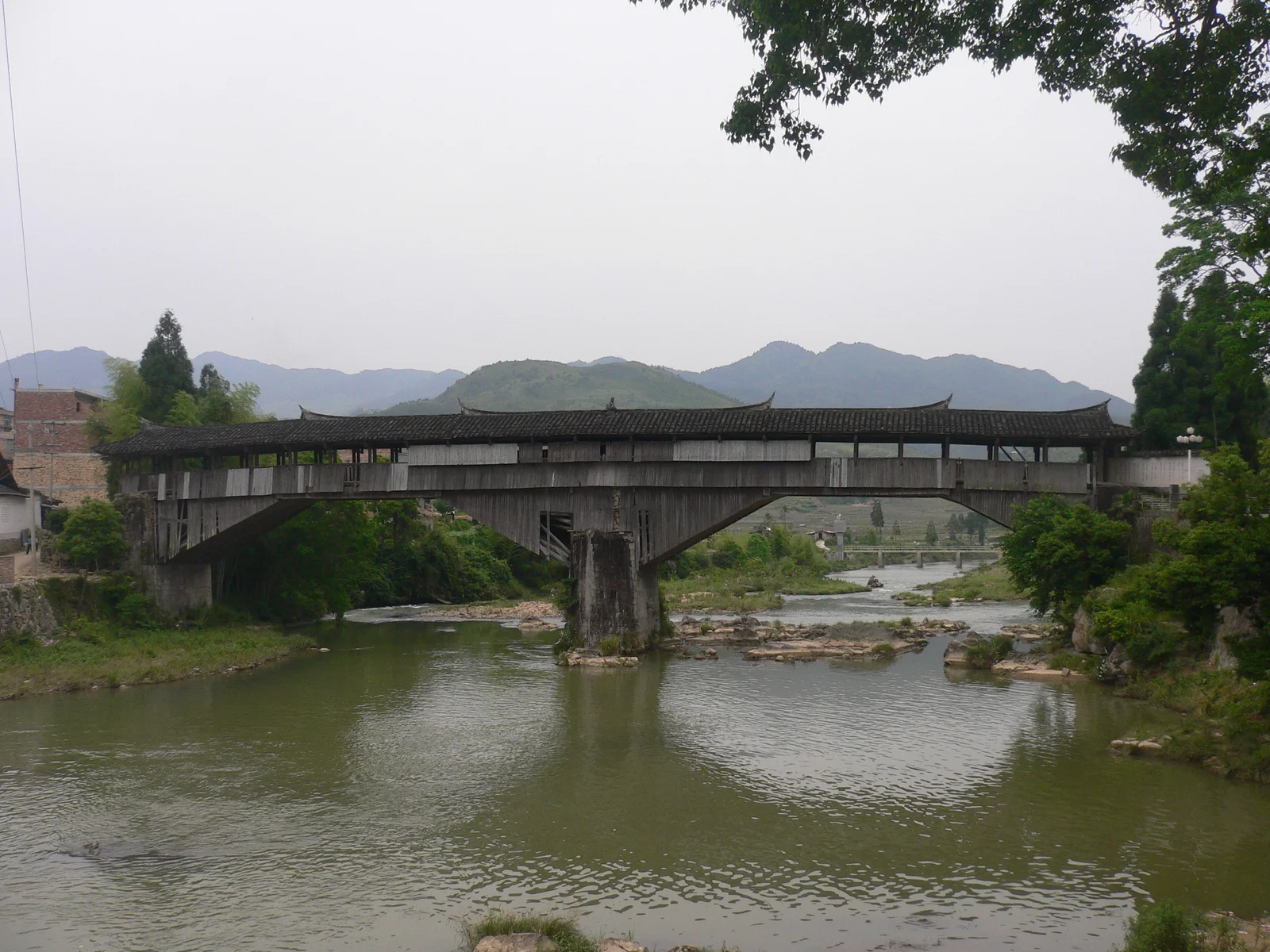
Perched high in the Jiufeng mountains of eastern Fujian, Pingnan was carved out by the Huotong Stream into sheer canyons and cascading tributaries. These rugged torrents compelled local clans to erect covered bridges that served as communal halls; spans like Wan'an Bridge and Qiancheng Bridge cross deep gorges while accommodating banquets, markets, and village councils. At Baishuiyang, an expansive flat granite bedrock creates a natural shallow water square, while villages like Jitou and Longtan terrace their ochre rammed-earth compounds against steep hillsides.
What to see
Qiancheng Bridge in Tangkou stretches over forty meters with an expansive deck hosting village assemblies; Baishuiyang features thousands of square meters of flat granite bedrock washed by ankle-deep currents; Jitou Village holds hundreds of rammed-earth courtyard compounds; Longtan Village revives traditional timber crafts; Wan'an Bridge site preserves ancient bridge-building traditions.
What to eat
Pingnan smoked rabbit braises tender meat before smoking over rice hulls and cypress branches until golden; Jitou bianrou dumplings feature hand-beaten lean pork inside translucent wrappers; seasonal herb rice cakes steam wild cudweed dough filled with sweetened red beans; aged mountain red-yeast rice wine is served warm with mellow depth.
Getting here & around
Take high-speed rail to Ningde or Gutian North station, then transfer by regional coach or car via the Ningshang Expressway to Pingnan in eighty minutes. Local rural buses connect Baishuiyang and surrounding villages, though rental car or chartered taxi offers far greater flexibility.
Choose a neighbourhood
Each area offers a different side of the city. Pick one to explore at your own pace.
Tangkou Qiancheng Bridge & Valley
A twenty-bay single-span covered timber bridge spanning the Tangkou creek, complete with guardian shrines and community seating.
Walking along wide cedar floorboards viewing surrounding rice paddies and terraced rammed-earth homesteads.
Baishuiyang Geological Water Plaza
A massive unbroken sheet of flat granite bedrock over which crystal-clear stream water flows at an even ankle depth.
Wading barefoot across the cool granite stone plane while experiencing natural hydraulic geology.
Longtan and Jitou Rammed-Earth Villages
Ochre rammed-earth courtyard houses lining mountain streams, where restored heritage halls now host artist studios and teahouses.
Wandering flagstone lanes, admiring timber courtyard post-and-beam construction, and chatting with heritage restoration carpenters.
Timber-Arch Galleries and Covered Village Feasts
At the downriver mouth of Tangkou Village, Qiancheng Bridge vaults across the river with stately grace. Transcending the utilitarian purpose of a highway crossing, this timber arch bridge spans over four meters in interior width, partitioned into twenty continuous bays of timber-framed halls. Continuous wooden balustrades and cantilevered benches line both flanks. Shrines dedicated to Guanyin and local guardian deities occupy the central elevated pavilion, flanked by teahouse stools. During clan festivals or weddings, dozens of square tables are joined in an unbroken banquet line. The heavy tile roof shelters the feast from torrential mountain gales.
Terraced Ochre Rammed Walls and Timber Frames
In villages like Jitou and Longtan, homes ascend in tight terraces conforming to ravine topography. Because quarried stone was scarce and winter winds severe, ancestral builders harnessed local sticky red-yellow soil mixed with river gravel. Poured into timber formwork, the earth was pounded by heavy wooden rammers into two-foot-thick walls that keep interiors warm in winter and cool in summer. Exterior ramparts feature minimal window slits for thermal insulation, enclosing a cedar post-and-lintel timber courtyard within. High stepped firewalls cast an earthy ochre glow across misty bamboo groves.
Smooth Granite Bedrock Currents at Baishuiyang
Baishuiyang presents an extraordinary hydrological landscape. Instead of river mud or chaotic boulders, the wide stream bed consists of a single unbroken granite bedrock spanning tens of thousands of square meters. Shaped by prehistoric volcanism and polished by mineral-rich currents over millions of years, the bedrock is smooth and level. Pure mountain water skims uniformly across the stone at a constant depth of ten to fifteen centimeters. Sunlight striking the rippling surface projects golden geometric caustics across the grey granite, allowing visitors to wade comfortably across a natural submerged plaza.