Qingdao
Red tiles and cedar boughs roll along granite hills, where corner groceries fill plastic bags straight from the tap with unpasteurized draft beer.
At the mouth of Jiaozhou Bay on the southern coast of the Shandong Peninsula, undulating granite headlands plunge directly into the Yellow Sea. European villas constructed during the early twentieth century step down forested hillsides toward the water, their terracotta roofs flashing between dark Austrian pines and deodar cedars. On street corners, neighbourhood drink counters fill heavy clear plastic bags straight from stainless draft kegs, while patrons crack open steaming bowls of spicy stir-fried clams amidst sea mist and malty aromas.
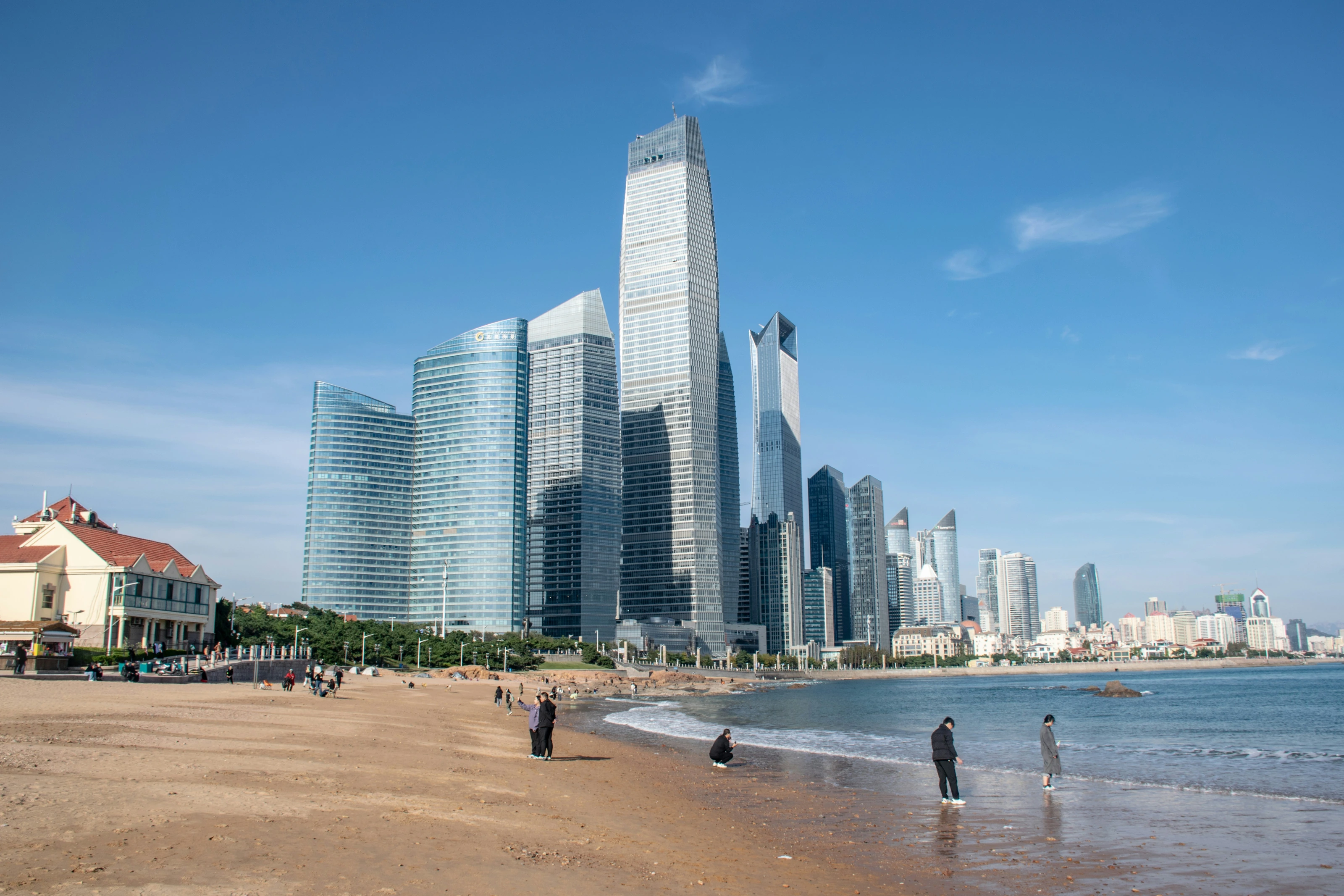
What to see
The Badaguan Historic Quarter features tens of granite residential villas showcasing diverse European architectural styles; Zhanqiao Pier extends over four hundred metres into Jiaozhou Bay terminating at the octagonal Huilan Pavilion; the Tsingtao Beer Museum preserves the original 1903 brewery halls, copper mash tuns, and fermenting cellars; the Little Qingdao white lighthouse looks back across the water to the old city's tiled rooftops.
What to eat
Fresh local clams wok-tossed over high heat with dried chillies, garlic, and scallions; plump mackerel dumplings with tender fish stuffing scented with green chives; unpasteurized draft beer poured straight into plastic bags by weight; refreshing sea agar jelly simmered from seaweed served chilled with minced garlic and sesame oil.
Getting here & around
Qingdao Railway Station borders the front beach and Zhanqiao Pier, while Qingdao North connects high-speed trains reaching Beijing in three hours; Qingdao Jiaodong International Airport serves domestic and international flights; subway lines connect coastal districts directly to the Mount Lao scenic area; continuous coastal walking boards span several scenic bays.
Red Tiles and Ashlar Granite in Badaguan
Nestled between Taiping Corner and Huiquan Bay, Badaguan comprises ten tree-lined avenues named after historic Chinese mountain passes, planted respectively with deodars, crape myrtles, ginkgoes, and flowering peaches. In the early twentieth century, architects quarried local granite from nearby Mount Lao to build massive rusticated foundation plinths and exterior load-bearing walls, topped with steeply pitched red terracotta roof tiles. Shaded behind dense cedar boughs, arched loggias, folding timber shutters, and ashlar masonry coalesce into eclectic German, English, and Mediterranean residential villas. Low stone walls are overgrown with ivy, and oceanic breezes carry the resinous scent of pine needles along the sloped lanes, harmonizing durable mountain stone with temperate coastal greenery.
Malted Aromas on Dengzhou Road
In 1903, British and German merchants founded the Germania Brewery on Dengzhou Road, harnessing the pure mineral waters of Mount Lao to begin a century of brewing heritage. The historic brewery halls preserved within the Tsingtao Beer Museum still house massive red-copper mashing tuns, early Siemens electrical dynamos, and vaulted brick cellars. Yet the city's truest brewing pulse beats in its ordinary neighbourhoods. On summer evenings, insulated beer kegs with draft taps stand outside corner shops. Proprietors hold open thick plastic bags, pull down the brass tap levers, and let golden, foamy unpasteurized beer rush into the bag before tying it tight and weighing it on hanging scales. Locals carry the chilled bags back to plastic tables, cracking steaming clams between their fingers as crisp maltiness balances ocean brine in a timeless coastal pairing.
Tidal Sluices and Stone Piers in Jiaozhou Bay
Zhanqiao Pier was originally constructed in 1892 as a military supply wharf for the Beiyang Fleet, later extended with dressed granite ashlar into a four-hundred-metre pedestrian causeway reaching deep into the bay. The stone flanks are laid dry with enormous granite blocks, featuring sloped seawalls designed to absorb and dissipate the heavy wave energy of Yellow Sea squalls. At high tide, waves crash against the stone steps in white foam; at low tide, expansive beds of dark submerged reefs emerge into the open air. Long-time residents armed with small trowels and plastic buckets navigate the slick weed-covered rocks to pry wild baby oysters from crevasses and gather scurrying hermit crabs. The stone pier remains both an anchor of modern naval hydrology and an accessible doorway to the ocean's twice-daily tidal clock.