Qingyuan
Endangered firs breathe mountain mist atop Baishanzu, while covered timber spans ride torrents and hillside mushroom kilns exhale century-old pine smoke.
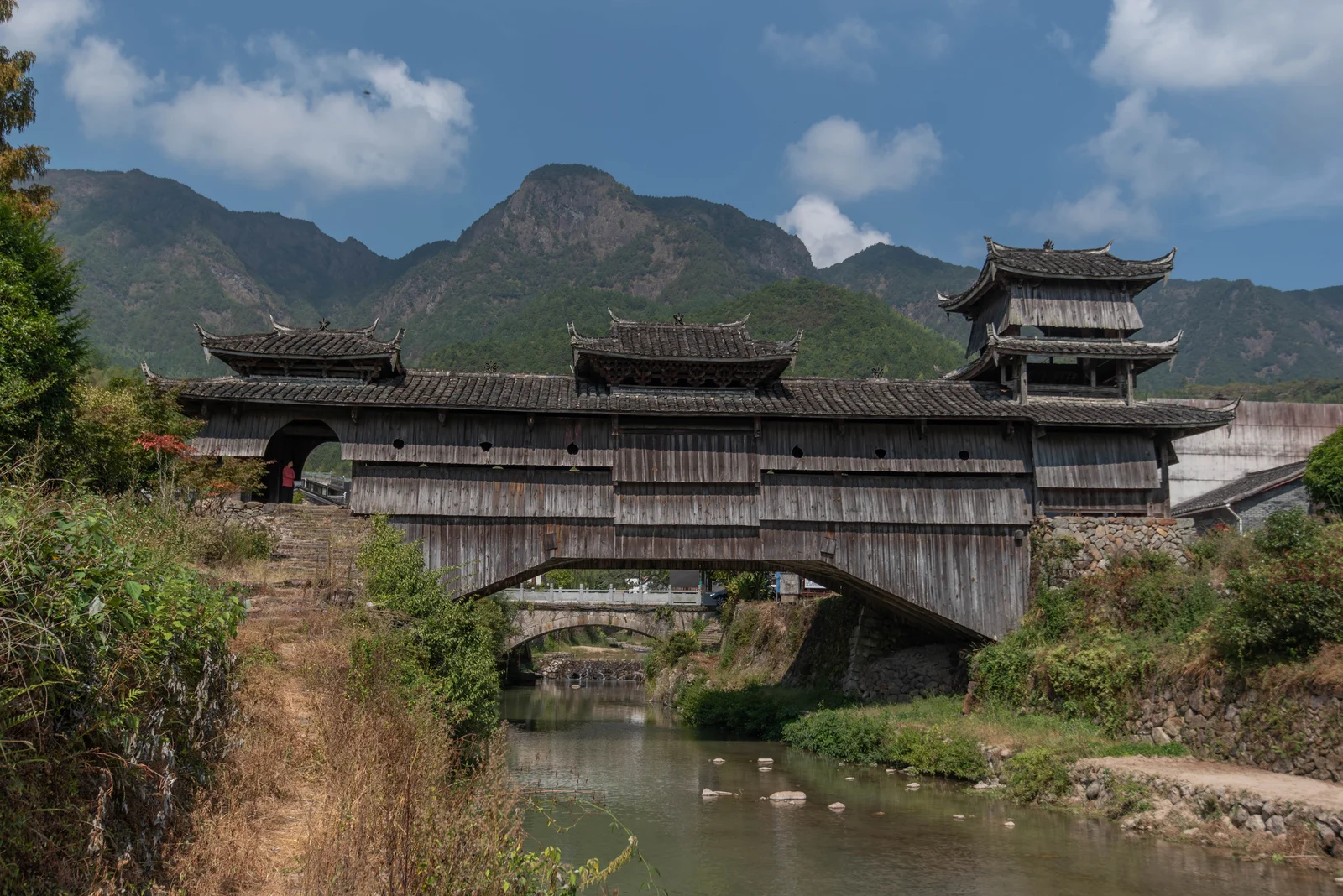
Perched along Zhejiang's highest southwestern escarpments, Qingyuan cradles Baishanzu peak at over eighteen hundred meters, forming the headwaters divide of three major river basins. The county preserves China's most contiguous lineage of wooden arch lounge bridges, epitomized by the four-century-old Rulong Bridge arching across the roaring rapids of Yueshan Village. As the historical cradle of cultivated shiitake mushrooms since the Song dynasty, forest foragers here perfected the chop-and-wait inoculation method, transforming cold temperate woodlands into an aromatic woodland treasury.
What to see
Rulong Bridge in Yueshan Village combines a Song arch structure with Ming-era multi-eaved pavilions spanning crystal mountain rapids; Lanxi Bridge sits beside the ancestral scholar village of Daji; Baishanzu Nature Reserve preserves ancient relict firs from Quaternary glaciations; the Shiitake Museum displays eight centuries of forest cultivation artifacts.
What to eat
Qingyuan shiitake braised chicken combines thick mountain log-grown mushrooms with free-range chicken simmered in spring water; Baishanzu beef is slow-braised with dried wild chilis; herbal wufan rice cakes infuse sweet glutinous rice with native leaf extract, dusted with crushed sesame; sun-dried wild bamboo shoots are stir-fried with cured winter pork.
Getting here & around
Arrive by high-speed rail at Lishui Station, then take an express intercity coach to Qingyuan in approximately two hours and forty minutes. Mountain sites like Baishanzu and Yueshan Village require navigating winding mountain roads, best handled by hired local driver or experienced mountain motorists.
Choose a neighbourhood
Each area offers a different side of the city. Pick one to explore at your own pace.
Yueshan Bridge Cluster & Juxi Gorge
A dense concentration of historic lounge bridges including Rulong, Laifeng, and Buchan spanning mountain rapids between terraced hillsides.
Studying Ming timber inscriptions inside Rulong Bridge and examining intricate bracket cantilevers above the waterfalls.
Baishanzu National Nature Reserve
Zhejiang's second-highest summit, cloaked in endless temperate forests sheltering the world's last surviving wild Baishanzu fir specimens.
Climbing above the sea of clouds at dawn and hiking through pristine needleleaf forest trails.
Daji Scholar Village & Shiitake Shrines
A quiet mountain hamlet that produced more than twenty imperial scholars across dynasties, dotted with ancient flat bridges and ancestral shrines.
Viewing Song-era Jinsha Bridge and learning ancient mushroom-foragers' work songs passed down through generations.
Rulong Bridge: Ruyi Brackets and Eaved Galleries
Spanning the narrowest rocky gap along the Juxi rapids in Yueshan Village, Rulong Bridge lunges across the chasm like a weathered timber dragon. Constructed during the Wanli reign of the Ming dynasty, the twenty-eight-meter span utilizes straight cedar poles wedged diagonally into mortise-and-tenon compression joints. Above the timber deck, nine bays of hip-and-gable eaved pavilions shelter pedestrians, with a central two-story tower lifting gracefully above the roadway. Void of flamboyant ornament, the structure relies on ruyi timber brackets that cantilever outwards to support heavy eaves. Four hundred years of mountain deluges have failed to dislodge this buoyant wooden masterpiece.
Baishanzu Primordial Firs and Highland Flora
Ascending east from Qingyuan along hairpin mountain passes, temperatures drop sharply as dense subtropical broadleaf forest transitions to subalpine conifers. Baishanzu forms an isolated hydrological divide enveloped in Pacific maritime clouds that feed a humid microclimate. High along its northern cliff edge near seventeen hundred meters stand the critically endangered Baishanzu firs. Their dark needles form dense umbrellas above deeply fissured grey bark, persisting through millennia since the last glacial epoch. In May, wild rhododendron groves bloom across the ridges, showering pale petals over damp peat moss.
Chop-and-Wait Inoculation and Charcoal-Dried Aromas
The temperate ravines of Qingyuan are rich in dense hardwoods like sweetgum, blue oak, and chinquapin. Eight centuries ago during the Song dynasty, forest forefather Wu Sangong observed wild mushroom colonization in fallen timber. He began notching felled oak trunks with calculated axe incisions termed duohua (flower chopping), allowing wild mushroom spores drifting on mountain breezes to lodge in the bark. Following autumn frosts, thick umber mushrooms rupture through the cuts. Foragers erect earthen kilns along the creeks to smoke the harvest over hardwood charcoal, imbuing the mushrooms with earthy fragrance shipped downriver to coastal ports.