Quanzhou
Half worldly hearth-smoke and half celestial calm: red-brick swallow-tail eaves tilt toward ocean skies while thousand-year stone pagodas anchor busy neighborhood lanes.
Known in antiquity as Zayton, Quanzhou stood alongside Alexandria as one of medieval Eurasia's two greatest seaports, celebrated in the travelogues of Marco Polo and Ibn Battuta. Along the coastal alluvial reaches of the Jin River, red-brick clan compounds stretch like smouldering coals, their variegated walls assembled through chuzhuan rushi, a vernacular masonry technique combining recycled kiln bricks, broken tiles, and ocean granite. Dramatic swallow-tail roof ridges point toward maritime horizons. The wonder of Quanzhou lies in its tranquil cosmopolitanism: under the brackets of Kaiyuan Temple soar twenty-four carved wooden apsaras showing Hindu origins, while across town, Islamic stone inscriptions at Qingjing Mosque share neighborhoods with maritime temples honoring Mazu. Elderly women pry open fresh oysters along the sidewalk, chanting Buddhist sutras as red-clay braziers simmer dark Anxi Tieguanyin oolong tea.
What to see
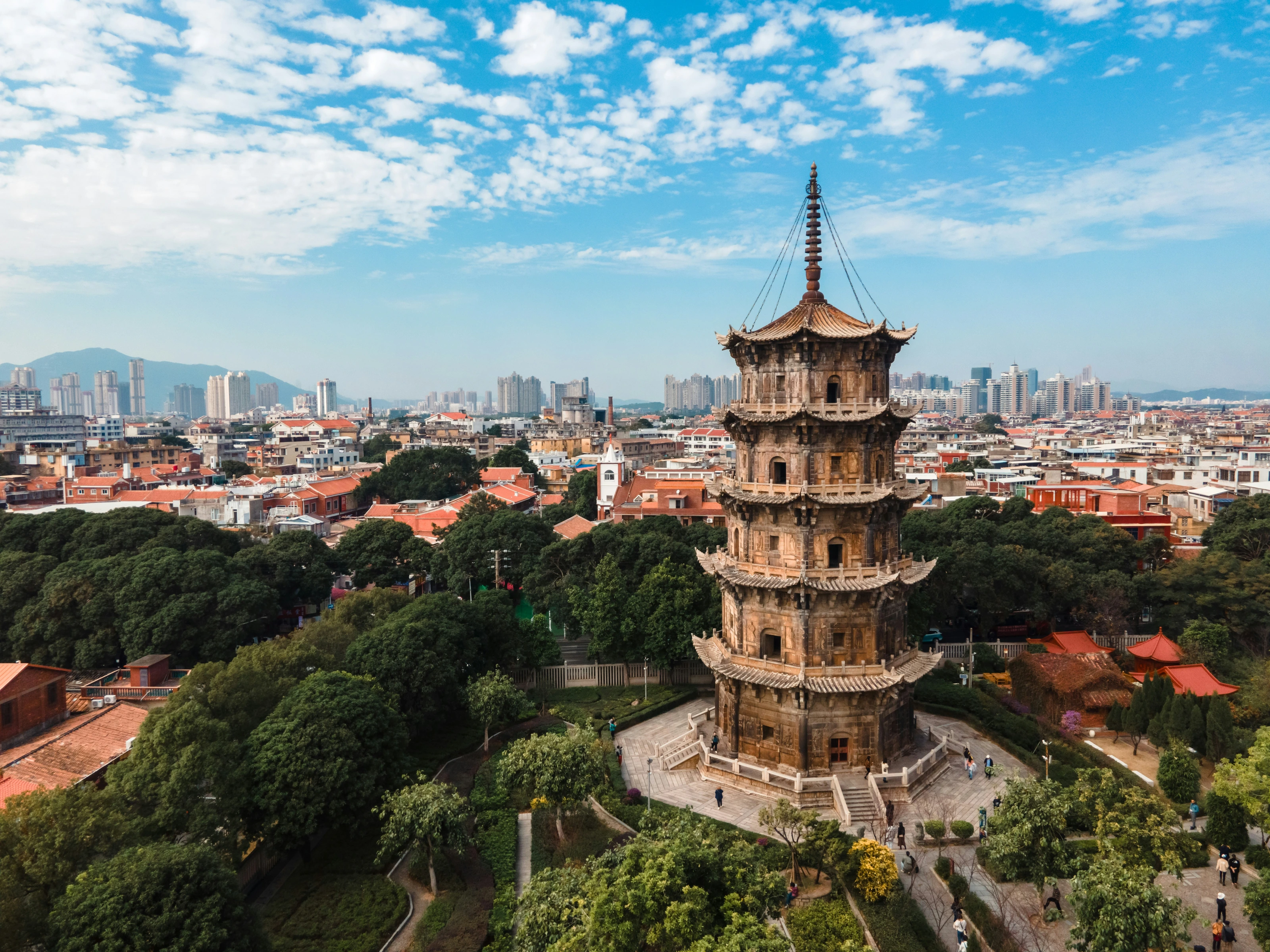
The Twin Stone Pagodas of Kaiyuan Temple represent China's tallest surviving Song granite towers, chiselled with eighty narrative Buddhist reliefs. West Street anchors the urban spine, its covered shophouse colonnades concealing patrician courtyard residences like the Su Tingyu Mansion and historic Quannan Church. Luoyang Bridge spans the estuary on pioneering stone raft foundations cemented by living oyster colonies, guarded by weathered granite lions. Nearby, Qingjing Mosque preserves eleventh-century Islamic ashlar portals and Arabic stone calligraphy.
What to eat
Local cooking combines mountain herbs and marine seafood with nostalgic street intimacy. Mornings begin with mianxianhu: angel-hair wheat vermicelli melting into clear fish bone stock, customized with crispy spiced pork strips, sea oysters, braised pig intestines, and fried crullers. Ginger mother duck slowly braises whole birds with thick slabs of aged root ginger in dark sesame oil and Shaoxing rice wine until meat separates easily from the bone. Tusundong offers chilled, translucent savory jelly naturally set from marine peanut worms, served with wasabi, soy, and crushed garlic.
Getting here & around
Quanzhou Jinjiang International Airport and Quanzhou Railway Station connect across high-speed coastal networks. The old town is compact and level, serviced by convenient bike shares and electric shuttle vans called Xiaobai that stop on demand across historic lanes for minimal fare.
Choose a neighbourhood
Each area offers a different side of the city. Pick one to explore at your own pace.
West Street & Kaiyuan Temple Quarter
The historical axis of medieval Zayton. The soaring twin granite pagodas rise above century-old banyan gardens and the memorial hall of monk Hongyi. Stepping beyond the temple gates, West Street unfolds in red-brick shophouse colonnades; branching side alleys like Jinting and Jinyu lanes reveal ornate Southern Min red-brick clan mansions and Republican villas.
Studying Song granite Buddhist statuary and viewing swallow-tail rooflines from rooftop terraces along West Street.
Zhongshan Road Arcades & Qingjing Mosque
The intersection of global maritime faith and merchant commerce. Neoclassical arches mingle with Minnan exposed brickwork along Zhongshan Road, home to the eleventh-century Islamic ashlar gate of Qingjing Mosque, the bustling Tonghuai Guandi Temple, and the Mazu Celestial Queen Palace.
Tracing Silk Road religious diversity and experiencing incense rituals along lively colonnaded avenues.
Luoyang Bridge & Ancient Harbor
The monumental maritime gateway spanning the Luoyang River estuary. Completed under Song prefect Cai Xiang, the near-kilometer-long granite beam bridge features ship-shaped piers tapered against the tides, where ancient oyster beds still cling to underwater foundations.
Walking China's earliest sea-crossing stone beam bridge and surveying broad coastal wetlands.
The mosaic masonry of broken brick and stone
Wandering through the historic lanes of Quanzhou, travelers encounter an arresting vernacular wall texture: ashlar slabs of grey granite alternated with horizontal and vertical courses of deep-red broken brick, interspersed with fragments of curved clay roof tiles and discarded oyster shells. In Southern Min architecture, this method is known as chuzhuan rushi (interlocking stone and brick).
The practice originated following the catastrophic Quanzhou earthquake of 1604, which flattened large swathes of the city. Unable to afford dressed masonry, impoverished survivors salvaged terracotta rubble from collapsed kilns and paired them with granite boulders scavenged from ocean shorelines. Tough granite resisted compression while porous red brick buffered coastal dampness. Masons fitted stone as bone and brick as flesh, bound with lime-slaked mortar boiled with sticky rice broth. Over centuries, these improvised textural mosaics have become southern Fujian's most poignant architectural signature.
The living oysters of Luoyang Bridge
Where the Luoyang River meets the sea, treacherous currents and shifting silt historically made boat crossings perilous. In 1053, prominent scholar-official Cai Xiang was appointed prefect of Quanzhou and took command of bridging the stormy estuary. Because driving standard timber piles into deep sand was impossible, masons engineered pioneering raft foundations, dropping tons of boulders along the axis to establish a sunken underwater ridge.
To prevent ocean surges from dislodging the riprap, Cai Xiang turned to marine biology, seeding the submerged rock piles with millions of native oysters. As colonies matured across the granite seams, their calcium carbonate secretions cemented the colossal stones into an unbroken monolithic reef far stronger than mortar. This biological foundation technique predated Western equivalents by centuries, securing the massive stone bridge through a thousand years of storm tides.
Morning vermicelli and evening Tieguanyin
Quanzhou's emotional pulse beats through morning bowls of mianxianhu and evening kettles of Tieguanyin. At daybreak along Shuimen Lane, giant aluminum cauldrons steam towards rafters. The wheat noodles are pulled by hand into hair-thin strands, sliding into rolling pork bone and dried seafood stock bound with sweet potato starch until broth and vermicelli merge into silky porridge. Topped with freshly fried vinegar-marinated pork and fried dough crullers, each spoonful slides down effortlessly.
At nightfall, quiet settles over old alleys. Outside guest-houses along West Street and residential thresholds in Tongzheng Lane, small terracotta wind braziers ignite. High-grown Tieguanyin from the Anxi mountains opens in Yixing clay bowls. The second pour yields luminous golden liquor releasing notes of fresh orchid and flinty minerality. Neighbors pull low wooden benches onto granite flagstones, washing away the dust of the day in sweet, lingering aftertastes.