Shaoxing
The entire city steeps inside an earthenware jar of aged rice wine; oars are rowed by foot, food is aged in dark sauce, and calligraphy is brushed with warm drunken grace.
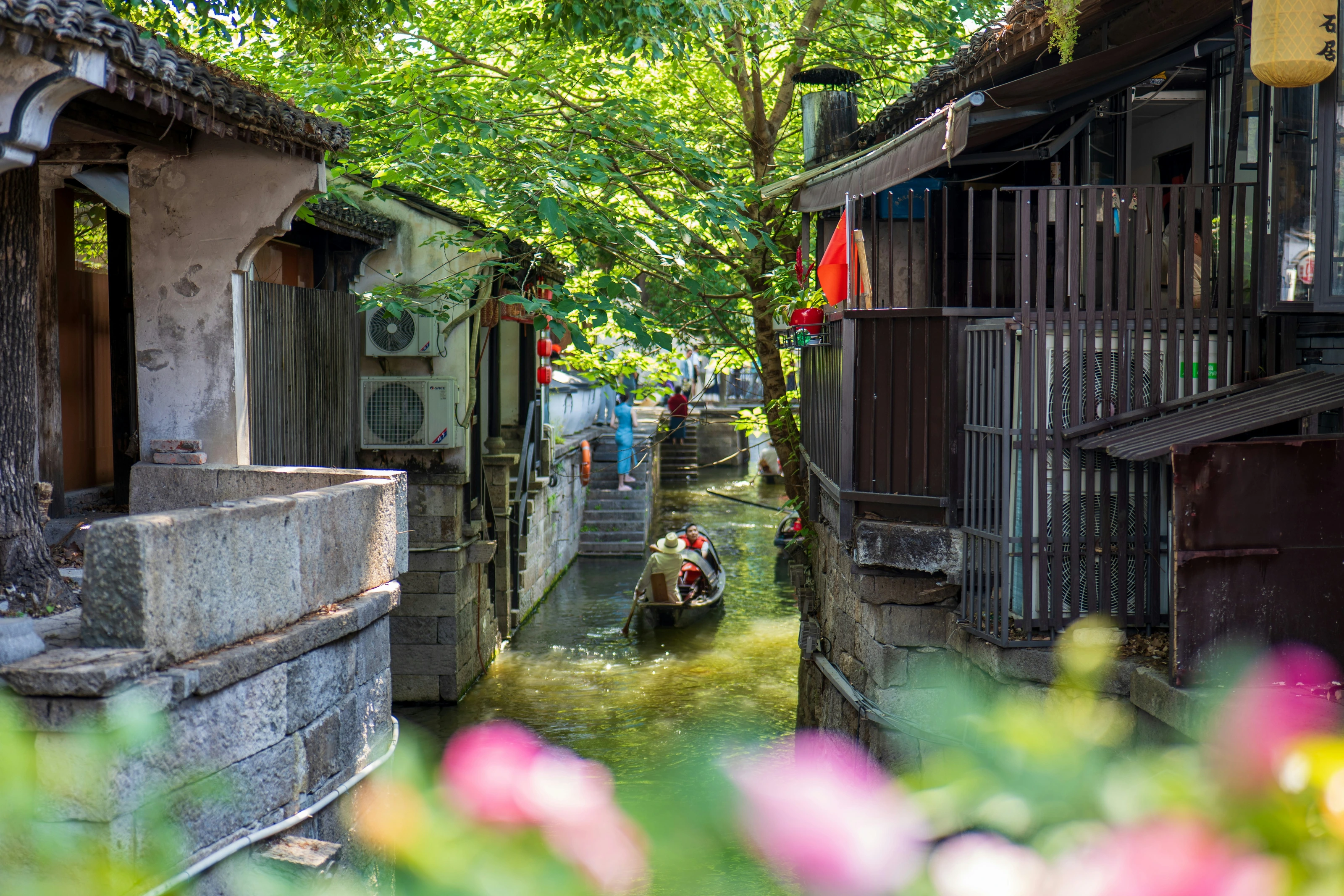
The Kuaiji Mountains form a deep green ridge to the south, feeding the cold waters of Lake Jian into thousands of urban canal veins. Stone bridges here number in the thousands, their semicircular arches riding so low above the water that boatmen wearing black felt skullcaps lean back against wooden bulkheads, sculling massive oar shafts effortlessly with their bare feet while steering with handheld paddles. Shaoxing's rhythm lives on moisture and patient fermentation: stoneware vats bake in summer heat to brew dark soy sauce, winter-brewed glutinous rice rests under sealed clay lids to turn into amber huangjiu, and damp river landings carry the rich, boozy perfume of wine lees.
What to see
The historic core is best traversed on foot along canal towpaths, where Bazi Bridge and Cangqiao Straight Street preserve authentic Song and Yuan water-town fabric. The Lu Xun Native Place brings childhood memories of the Baicao Garden and Sanwei Study to life, while Fushan Hill looks across grey tile roofs and canal grids. Southwest of town lies the Orchid Pavilion, where bamboo groves shade the legendary winding stream where master calligrapher Wang Xizhi composed his immortal preface.
What to eat
Aged yellow rice wine anchors every meal. In winter, warm a pewter kettle of Huadiao wine served alongside spiced fava beans and fried stinky tofu; braised pork belly with dried mustard greens yields glossy, savory richness; and drunken river crab steeps in aromatic wine lees. Duck cures under cold winter winds, developing dark, mahogany-glazed skin from aged soy marinades.
Getting here & around
Shaoxing North Railway Station connects via direct metro Line 1 to the Lu Xun Native Place and the central district. Canals feature stone-stepped footbridges impassable to wheeled vehicles, so walking along flagstones or hiring an awning boat from the Bazi Bridge landing provides the most atmospheric travel.
Choose a neighbourhood
Each area offers a different side of the city. Pick one to explore at your own pace.
Bazi Bridge & Guangning Historic Quarter
The quietest and oldest canal neighborhood in town. The thirteenth-century Southern Song Bazi Bridge spans a three-way canal intersection with stone ramps angled like the character 'eight'. Free of commercial souvenir stalls, elderly residents wash greens at stone steps and dry pickled greens while black-awning boats slip silently beneath ancient arches.
Stepping away from tour groups to touch original Song-dynasty masonry and experience water-town everyday life.
Cangqiao Straight Street & Mount Fu
A canal street following the western inner moat, lined with traditional shophouses, tinsmith workshops, and courtyard residences. Walking to the foot of Fushan leads to ancient fortified hills dating to King Goujian of Yue, where tree-shaded summits look across an ocean of low tile roofs.
Strolling historic canal lanes, tasting rice-wine popsicles, and climbing ancient citadel lookouts.
The Orchid Pavilion (Lanting)
A serene woodland sanctuary nestled beneath the bamboo slopes of Mount Kuaiji. A stone-lined stream winds between mossy boulders where fourth-century Jin-dynasty scholars floated wine cups and composed poetry. Stelae halls house imperial stone rubbings of the world's most celebrated running-script calligraphy.
Immersing yourself in the highest classical calligraphy traditions amid tranquil mountain bamboo.
Lake water into amber wine
The soul of Shaoxing yellow wine belongs to the cold, mineral-rich winter runoff of Lake Jian. At the arrival of winter, traditional breweries steam prime single-crop Taihu glutinous rice over smoking wood fires. The steaming grains drop into earthenware fermenting vats, where wheat starter converts starch to sugars and red yeast inoculates complex aromatics.
Once fermentation finishes, the young wine is pressed clear, poured into heavy pottery jugs, capped with lotus leaves, bound with bamboo reeds, and sealed with dense alluvial clay. Stacked in cool, dark cellars, the liquor matures across decades. When the clay seal is cracked open, the wine pours in a luminous amber-gold, landing on the tongue with mellow warmth, subtle acidity, and lingering bittersweet complexity that radiates through the chest.
Sun-dried mustard greens and dark soy
Under persistent Jiangnan rainfall, fresh greens rot quickly, prompting local farmers to invent preservation through salt, mold, and dark sauce. Harvested mustard greens wither in the shade, are salted, and stomped firmly into stoneware crocks. Weeks of gentle lactic fermentation transform emerald leaves to muted olive, exuding a sharp, appetizing aroma.
The fermented greens are spread on woven bamboo mats beneath blazing sunshine, steamed, and sun-baked repeatedly until black, dry, and fragrant as tea leaves. Layered beneath thick slices of pork belly and steamed together, the dried greens drink in rendered pork fat until they glisten with rich moisture, while the meat melts away on the palate with deep, savory sweetness.
Foot on the oar, hand on the paddle
In a city of tight stone bridges and narrow waterways, horses and carts were useless; life moved on the slender black-awning wupeng boat. Built of flexible fir planks, the vessel tapers like a willow leaf. Arched canopies woven of split bamboo and reeds are lacquered with tung oil and soot, creating a waterproof, insulated black shell.
The boatman's genius lies in his feet. Reclining against a wooden backboard, his bare soles grip the handle of the long sculling oar, driving it back and forth in rhythmic kicks while his hands lightly guide a small wooden steering paddle. Squeezing under ancient stone bridges with mere inches to spare, the black hull shoots through the arch with a rhythmic splash of water, emerging into another quiet corridor of weeping willows and whitewashed walls.