Shaxi
The square at Sideng Street has kept its place for four centuries; horseshoe iron wore deep cups into Yujin Bridge's red stone.
Shaxi lies hidden in a secluded river basin along the Heihui River in southwestern Jianchuan County, celebrated as the sole surviving intact market town on the ancient Tea Horse Road. At the heart of Sideng Street, paved with red sandstone slabs, stands the three-story Kuixing Pavilion stage facing the Ming-dynasty Xingjiao Temple. In dawn mist before daybreak, horses clatter across the stone arch of Yujin Bridge while Bai women spread handmade goat milk cheese beneath ancient locust trees, preserving the quiet heartbeat of historic caravan commerce.
What to see
The Sideng Street core gathers the Kuixing Pavilion timber stage, Xingjiao Temple, and preserved horse-caravan inns around Sifang Square; Yujin Bridge spans the Heihui River as a single sandstone arch; Shibaoshan National Park protects the 8th-century Shizhongshan Grottoes from the Nanzhao Kingdom.
What to eat
Bai mountain cuisine emphasizes pure local products: rubing (firm, unaged goat's milk cheese) sliced thick and toasted over charcoal until blistering, sprinkled with salt or sugar; fragrant cured Shaxi dry ham stir-fried with seasonal wild mushrooms; alongside griddled tofu with mountain roots.
Getting here & around
Access to Shaxi requires buses from Dali or Lijiang to Jianchuan County station, followed by a 40-minute rural minivan connection. The town interior is entirely pedestrian flagstone; bicycles are ideal for exploring surrounding pastoral villages and trailheads.
Choose a neighbourhood
Each area offers a different side of the city. Pick one to explore at your own pace.
Sideng Street & Sifang Square
The historic market square of the Tea Horse Road, framed by the soaring wooden theatre stage, temple gates, and rustic two-story timber caravanserais paved in worn red sandstone.
Admiring Ming timber carpentry, sipping green tea at roadside wooden tables, and inspecting historic caravan post doors.
Yujin Bridge & Heihui Riverbanks
The historical crossing for pack trains heading north toward Tibet, featuring a Qing single-arch sandstone bridge flanked by weeping willows and pastoral grain fields.
Photographing dawn river mist and reflections, cycling riverside gravel tracks, and listening to mountain waters.
Shibaoshan & Shizhongshan Grottoes
A forested sandstone sanctuary in the hills north of Shaxi, sheltering 1,200-year-old rock-cut Buddhist and royal relief sculptures from the Nanzhao and Dali kingdoms.
Exploring rare Tang-Song southwest Buddhist cliff carvings, hiking red-rock pine forests, and encountering wild macaques.
The Last Living Market on the Ancient Road
Sideng Street in Shaxi represents the only market town on the Tea Horse Road whose spatial layout remains fully intact. Sifang Square is paved in broad red sandstone slabs. The three-tiered Kuixing Pavilion stage anchors the eastern edge with an open passageway beneath its stage, gazing west toward the Ming dynasty wooden prayer hall of Xingjiao Temple. Here Tibetan horsemen driving wool and musk met southern Yunnan caravans packing compressed tea cakes and salt, trading thousands of pack mules under mountain stars. Two-story wooden shops retain removable vertical timber shutter-planks, unslotted each sunrise to welcome local trade.
Iron Hoofprints on Yujin Bridge
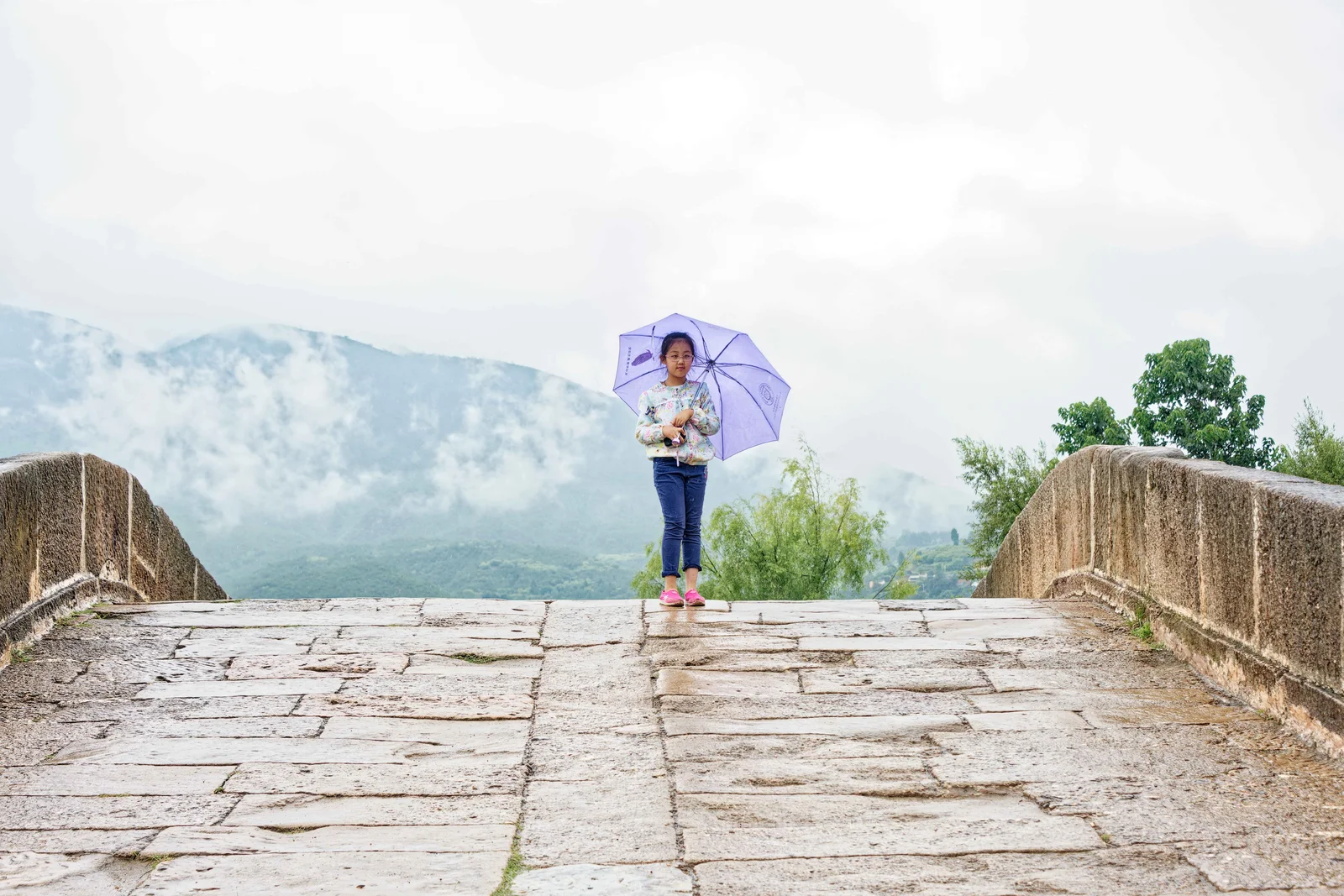
East of Sideng Street, the pristine Heihui River is crossed by the arched silhouette of Yujin Bridge. Constructed from locally quarried red sandstone blocks without mortar, this Qing-dynasty single-arch bridge spans over thirty metres, its reflection forming a complete circle in emerald currents. Walking across the crest, one notices parallel rows of circular hollows worn inches deep into the stone treads. These depressions were etched by iron-shod hooves of countless mules over centuries of mountain crossings, standing as enduring physical testaments to caravan resilience.
Goat Milk Cheese Over Charcoal
In the hearths of Bai stone homes, the fragrant aroma of goat milk never fades. At dawn, women heat fresh mountain goat milk in iron pans, stirring in a splash of natural fermented sour whey to separate the curd. Proteins coalesce into soft, white curds, scooped into cloth bags and weighted under heavy river boulders to press out whey into firm rectangular slabs of rubing cheese. Sliced into fingers and placed over wire grates directly above glowing charcoal embers, the cheese blisters, rendering aromatic milk fats. Eaten hot, it offers a creamy, savory bite.