Shexian
The arch stands at the village threshold and the ancestral hall behind it: from outside you see what the clan produced before you see where it lives.
Shexian served as the historic seat of ancient Huizhou Prefecture, where the Lian and Xin'an rivers merge in mountain gorges. In this land-poor river basin, young villagers were cast out at thirteen or fourteen to trade salt, tea, and pawn across the empire, shipping fortunes back to build high-walled clans, monumental stone archways, and soaring ancestral halls. Walking down Doushan Street or along the Yuliang Dam, whitewashed ramparts keep midday sun off the narrow cobblestones, and monsoon rain cascades from inward-sloping eaves into stone courtyard cisterns. Every timber and brick adheres to strict Confucian decorum, while deep in town, heavy iron mallets thump steadily against dense mixtures of pine soot and bone glue.
What to see
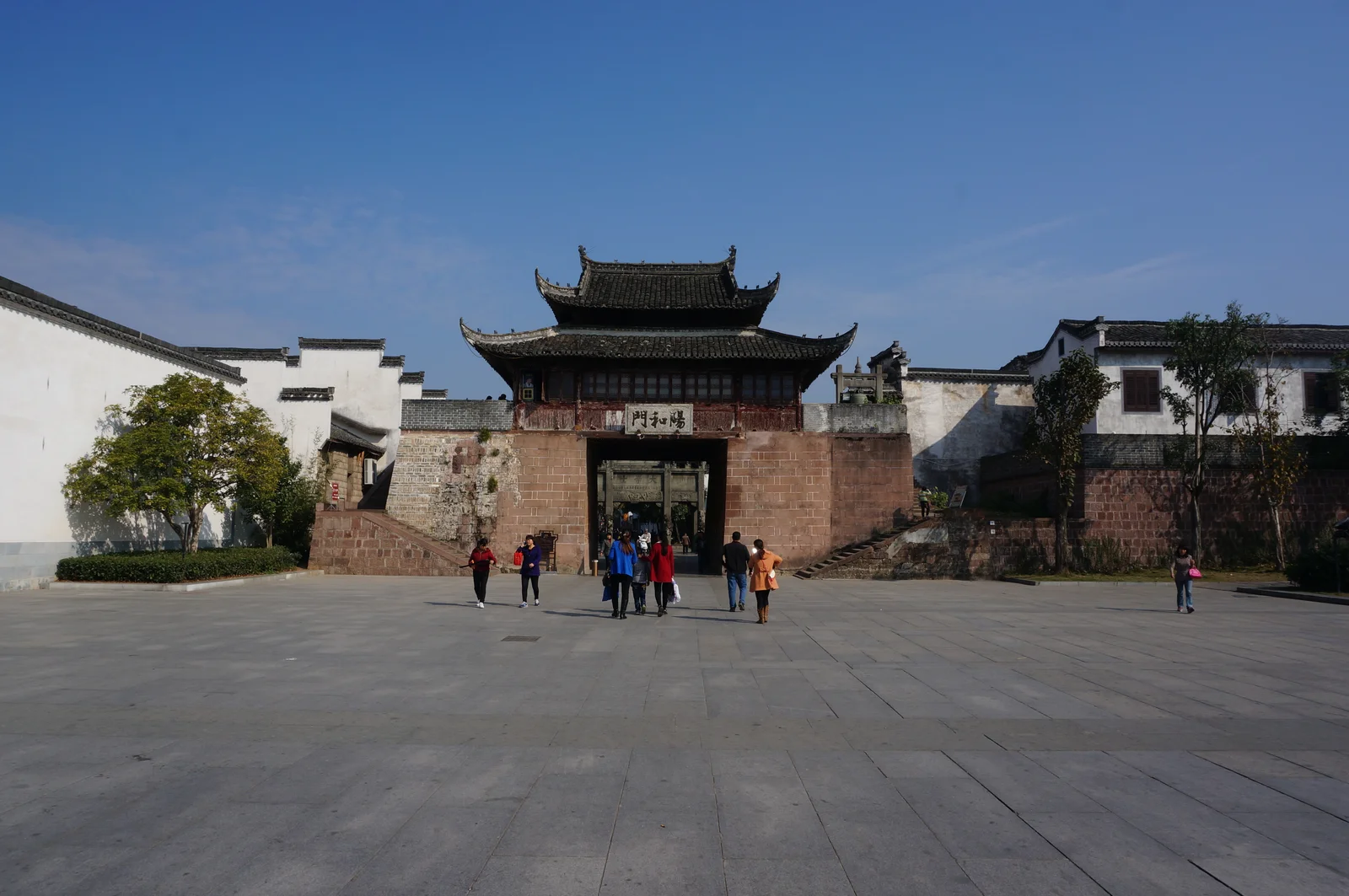
At the center of the Ancient Huizhou Walled Town stands the Xuguo Stone Arch, the empire's only surviving eight-legged ceremonial gate, chiselled from tough blue Chayuan sandstone with mortise and tenon joinery. Downstream, the Yuliang Dam spans the Lian River, an ashlar weir built in the Song dynasty that served as the launch basin for thousands of merchant barges heading downstream to Yangzhou. Doushan Street winds between monumental whitewashed compound walls enclosing hidden courtyard lofts and carved timber screens.
What to eat
Huizhou cooking emphasizes rich braising, deep amber glazes, and wood-fired simmering. Fermented stinky mandarin fish cures in light brine until a delicate savory pungency develops; seared in lard, the garlic-clove flakes of white meat yield clean, sweet umami beneath rich braising sauce. Hairy tofu grows a dense coat of white mycelium before pan-frying to a blistered golden crust, served with homemade chili paste. Wenzheng Mountain bamboo shoots simmer with aged cured ham, turning clear mountain spring water into a rich, savory broth.
Getting here & around
Shexian North Railway Station connects to high-speed lines right beside Huangshan North. Taxis reach the ancient walled core in fifteen minutes. Reaching Yuliang Dam is an easy walk or trishaw ride along the riverside, while travelers heading to Shendu Port for Xin'an River ferry cruises can take direct shuttles from the central bus terminal.
Choose a neighbourhood
Each area offers a different side of the city. Pick one to explore at your own pace.
Ancient Huizhou Walled Core & Xuguo Arch
The historical administrative seat enclosed by brick ramparts and the towering Drum Tower. Erected in 1584 for Grand Secretary Xu Guo, the central stone archway features eight colossal pillars linked by stone beams, completely carved with imperial dragons, cloud scrolls, and court scholars.
Studying the empire's only eight-legged Ming stone gateway and climbing ancient city wall parapets.
Yuliang Ancient Dam & River Wharves
The primary historical water-control weir on the upper Xin'an River system. Built in the Song dynasty with interlocking granite blocks, water cascades like a wide waterfall over the apron. This served as the primary departure quay for Huizhou salt boats; riverside streets retain ancient fishmonger stalls and tea resting stations.
Walking atop a thousand-year-old stone weir and tracing the waterborne departures of historic merchant guilds.
Doushan Street & Merchant Courtyards
The best-preserved patrician residential quarter in the walled town. Narrow flagstone lanes weave between thirty-foot-high fireproof brick walls with tiny upper security windows. Intricate lintels open onto deep interior courtyards with hidden silver vaults and timber lofts.
Wandering secluded granite lanes and admiring high-walled Huizhou vernacular spatial planning.
The stone joinery of the eight-legged arch
Under Ming sumptuary laws, civilian commemorative arches were restricted to four columns and three bays. In 1584, Xu Guo of Shexian rose to Grand Secretary and Minister of Personnel, receiving permission to erect a monument in his hometown. Huizhou masons bridged two parallel four-column gates with transverse stone architraves, producing a freestanding rectangular monument with eight solid pillars that respected protocol while doubling structural mass.
Hewn from dense Chayuan blue sandstone, every lintel, bracket, and hip-and-gable rooflet interlocks via stone mortise-and-tenon joints. Flared swallow-tail stone eaves sweep outward above intricate relief friezes of soaring phoenixes, rolling lions, and court dignitaries. Centuries of rain and frost have failed to budge the seams, testifying to Huizhou masons' masterful mastery over gravity and compression.
Ten thousand hammer strokes in black soot
The pinnacle of classical Chinese ink-making has always resided in Huizhou, with Shexian as its historical workshop. The essence of Huizhou ink lies in its carbon source and binding collagen. In sealed kiln rooms, artisans burn bowls of tung oil or aged Huangshan pine timber beneath ceramic covers, collecting the microscopically fine soot from the flames; ten pounds of oil yield only a few ounces of prime carbon.
This velvet-fine black soot is worked into warm oxhide glue and ground with musk and camphor to impart fragrance and ward off insects. Before the collagen cools, blacksmiths wield fifteen-pound iron hammers over cast-iron anvils, pounding the dough in rhythmic cadence. Known as the discipline of ten thousand strikes, this ceaseless beating forces glue and carbon nanoparticles into absolute molecular cohesion. Cast into carved pearwood molds, the resulting inksticks ring like jade when tapped, releasing lustrous, jet-black ink that remains indelible for over a thousand years.