Wuyuan
A stand of centenary camphor trees guards the village threshold; mountain water cuts under the stone arch bridge, shielding the domestic quiet within.
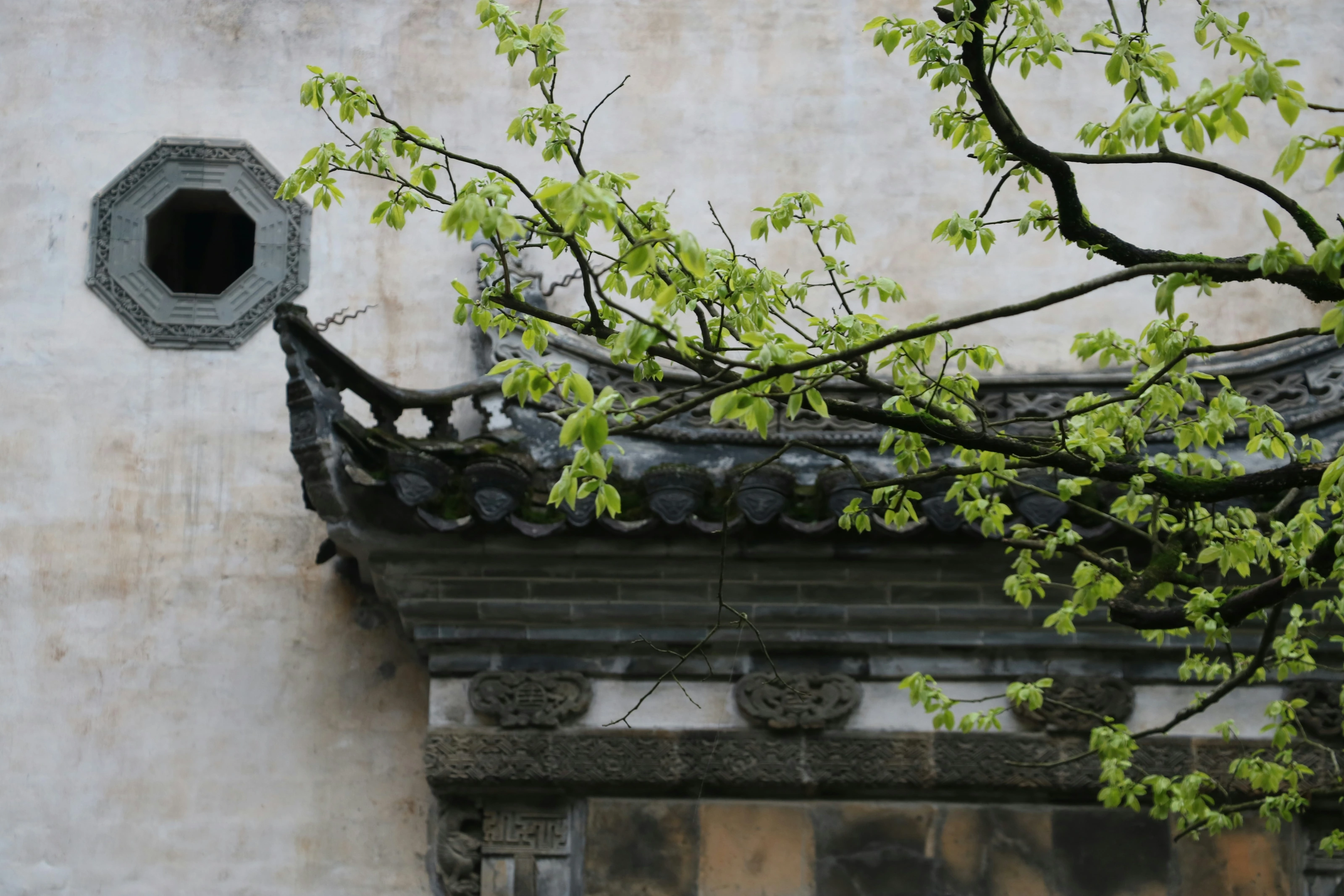
Wuyuan rests cradled in the green mountain folds where northeastern Jiangxi meets old Huizhou. Villages here orient around the shuikou, the symbolic water gate: travelers approach along flagstone paths shaded by stands of centuries-old camphor and autumn-maple trees, where clear brooks eddy beneath timber-covered bridges. Stepped gables of white plaster rise in rhythm with the contours of the slopes; in spring, yellow rape blossom blankets dry-stone terraces, while autumn turns slate rooftops into tapestries of sun-drying scarlet chilies and imperial chrysanthemums. Deep in valleys like Likeng, Hongguan, and Lingjiao, spring water ripples through open stone gutters beside doorways, and flagstones retain the soft, oiled sheen of centuries of footfalls.
What to see
Rainbow Bridge in Qinghua preserves Song-dynasty timber-frame bridgecraft, its stone piers cut into sharp cutwaters to deflect spring spates; Sixiyan and Likeng harbor the residences of retired Huizhou merchants with multi-layered wood and brick reliefs. To the east, the terraced slopes of Jiangling rise into misty cloud banks, while Qiukou's Moon Bay reveals solitary skiffs drifting through morning fog.
What to eat
Cooking in Wuyuan revolves around hudoufu and seasonal mountain harvests. Minced tofu simmers with dried shiitake, winter bamboo shoots, minced pork, and dried shrimp in thick rice slurry, finished with ground white pepper and garlic chives. Steamed local purse carp is eaten with its tender scales intact; steamed pork coated in coarse ground rice rests on fresh bamboo shoots, letting savory fat melt deep into the fiber. In spring, wild mugwort rice cakes are stuffed with cured pork and preserved greens.
Getting here & around
Wuyuan Railway Station links high-speed rail lines connecting Huangshan and Jingdezhen in twenty minutes. Because historic settlements are scattered along northern and eastern valleys with infrequent public minibuses, renting a car or hiring a driver along the Qinghua, Mount Zhanggong, and Jiangling routes is recommended.
Choose a neighbourhood
Each area offers a different side of the city. Pick one to explore at your own pace.
Qinghua Town & Rainbow Bridge
The historical heart of the northern valley route. Built in the Southern Song dynasty, Rainbow Bridge spans the upper Le'an River, resting on granite piers carved into sharp swallow-tail cutwaters and topped by tiled pavilions that shield travelers from storms. Ancient lanes retain ink and oilpaper umbrella shops, with mountain waters turning aged timber waterwheels along the bank.
Admiring Song-era timber and stone bridge architecture along the rushing Le'an River.
Likeng & Deep Mountain Hamlets
A scholar-official village tucked deep into the Tuochuan valley. Mountain brooks flow directly past stone thresholds, leading to grand Ming residences such as the Shangshu Mansion and Tiangong Hall. Carved timber corbels depict classical operas, while laundry mallets echo against quiet cobblestones.
Studying intricate Ming-dynasty architectural carvings in an unspoiled mountain valley.
Jiangling Terraces & Lingjiao Ancient Trail
High mountain terrain in northeastern Wuyuan. Thousands of dry-stone terraced fields ascend from the river basin to cloud-wrapped crests, where spring blossoms frame white gabled hamlets. Nearby Lingjiao village marks the trailhead for the historic stone-paved pass leading into Zhejiang.
Taking in panoramic views of terraced mountain settlements and walking ancient merchant trails.
The water gate grove and the covered bridge
In Wuyuan, every ancient hamlet begins with deliberate spatial choreography. Encircled by rugged mountains, settlers lived along river bends but avoided straight, rushing currents that might carry away vitality. At each village entrance, elders planted dense groves of camphor, oak, and sweetgum, framing a covered bridge that closed the view into the valley.
Rainbow Bridge in Qinghua stretches 140 meters across the Le'an River. Its massive ashlar piers taper upstream into knife-edged cutwaters that cleave roaring mountain floods. Above, gabled timber roofs shelter long benches with wooden backrests. When mountain cloudbursts strike, tea pickers, traveling peddlers, and schoolchildren gather under the rafters, watching white torrents roar below. The bridge functions as the valley's open-air communal parlor.
The dense slate of Mount Longwei
Historically part of Huizhou Prefecture, northeastern Wuyuan quarried the slate for She inkstones along the streambeds of Mount Longwei. Workers entered water-filled caves to pry loose fine-grained metamorphic rock tempered by millions of years of pressure. Tapped with a bronze coin, prime Longwei stone chimes like a bell; stroked with the thumb, it feels smooth as polished jade.
Natural patterns ripple across the stone: wave ripples, golden star flecks, and woven silk threads. Master carvers hollow the ink pool according to the stone's organic grain. When an inkstick is circled across the wet slate, the friction is almost silent; dark soot yields instantly into deep, glossy ink that remains fresh on the stone for days without gumming or drying.