Yangzhou
A morning begins over a pot of spring tea and finely sliced bean curd, smoothing the hours until noon.
Where the Grand Canal meets the broad flow of the Yangtze, grain barges from the south and merchant wealth from the salt monopolies converged for centuries, cultivating an unhurried, exacting appreciation for subtle craft. Its private gardens avoid sheer vertical crags, relying instead on the intellectual wit of scholars and stone carvers; morning tea tables feature slivers of firm tofu sliced thinner than matchsticks, scalded with boiling water purely to rinse away any hint of raw bean. Rushing has no place here: life moves with the gentle steam of bamboo dumpling baskets and the measured stroke of sculling oars through weeping willows along Slender West Lake.
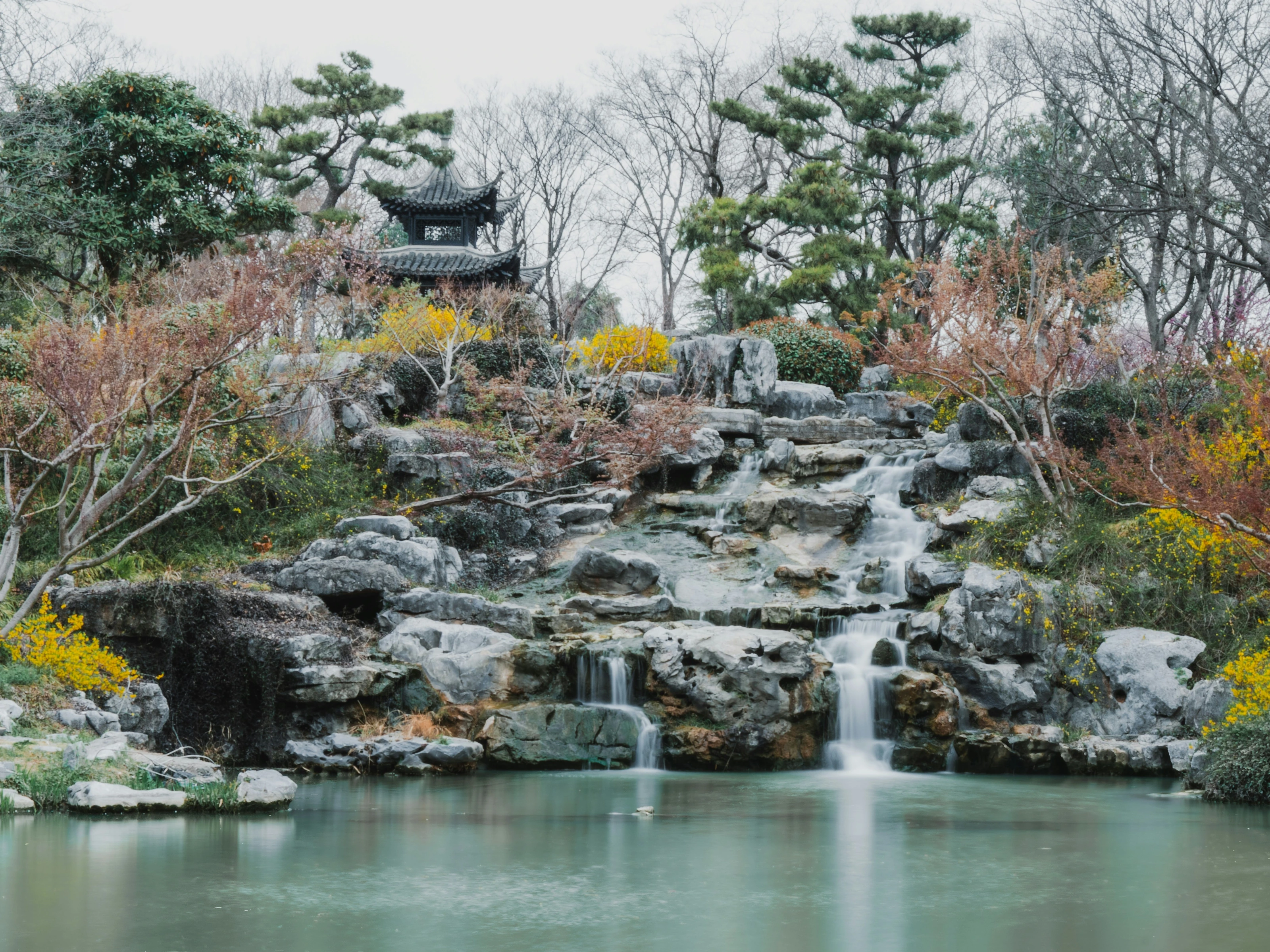
What to see
Slender West Lake is best seen at early morning mist from a wooden sculling boat passing under the Five Pavilion Bridge and the Twenty-Four Bridges. Geyuan Garden is famed for its four-season miniature rockeries and bamboo groves, while Heyuan's double-decker elevated corridors represent the apex of late-Qing domestic architecture. Dongguan Street and Nanhexia preserve the tall brick compounds of ancient salt merchants.
What to eat
Huaiyang gastronomy balances razor-sharp knife work with absolute broth clarity. Morning teahouses serve three-dice pork and bamboo shoot buns, emerald-green vegetable siu mai, and shredded tofu bathed in cured ham broth. Dinner calls for clear-simmered pork meatballs that melt on the tongue without greasiness, alongside Wensi tofu cut into gossamer threads floating in clear chicken broth.
Getting here & around
Yangzhou East Station connects via high-speed rail to Shanghai and Beijing, while Yangzhou Station serves traditional trunk lines. Taxis and bicycles easily traverse the historic lanes, and walking along the ancient canal promenade between Geyuan and Slender West Lake is delightful.
Choose a neighbourhood
Each area offers a different side of the city. Pick one to explore at your own pace.
Slender West Lake & Xiaojinshan
A meandering waterway adapted from historic canal tributaries. The ornate five-roofed pavilions of Wuting Bridge span the water, facing the distant white Tibetan-style stupa across weeping willows. Hiring a wooden sculling boat at dawn lets you glide in quiet serenity past imperial stone docks.
Drifting beneath weeping willows and admiring the most celebrated waterside pavilions of the Grand Canal.
Dongguan Street & Geyuan Garden
A bustling historic commercial corridor near the ancient canal ferry docks. In its center lies Geyuan, the former estate of salt magnate Huang Zhiyun, who used different geological stones to craft four miniature mountain ranges depicting spring, summer, autumn, and winter.
Exploring four-season garden rockeries and strolling historic lanes filled with heritage cosmetic shops.
Nanhexia & Heyuan Garden
The quietest residential quarter of the salt merchant elite. Heyuan Garden features a kilometer-long double-tiered covered walkway uniting residential quarters with a central water pavilion where theatrical performances echoed over the pond.
Studying innovative late-Qing residential architecture and wandering tranquil brick-walled lanes.
The blade work of scalded tofu
In an old Yangzhou teahouse, as soon as a pot of green Lüyangchun tea is poured, the first dish to land is scalded dried tofu. The chef lays a dense, firm square of pressed bean curd flat upon the wooden cutting block. With a broad mulberry blade, his wrist glides horizontally with calm precision, cleaving a single cake into twenty-eight to thirty paper-thin translucent leaves.
Stacked tightly, the sheets are cut into hair-thin strands, each uniform in length. Three successive showers of rolling boiling water leach away raw soy astringency before rich chicken broth warms the threads. Gathered into an elegant mound, drizzled with virgin sesame oil and aged soy sauce, then garnished with dried sea shrimp and ginger threads, each bite is meltingly silky and infused with clean, savory sweetness.
Clarity from the slow ember
Huaiyang cooks never boil soup over a roaring flame; they seek a broth as transparent as spring water. An old stewing hen provides a sturdy, gelatinous backbone; aged Jinhua dry-cured ham lends deep fermented savory salts; and dried sea scallops impart sweet marine umami.
The cauldron rests over glowing charcoal, maintained at that delicate boundary where bubbles barely ripple the surface. Lard and impurities are skimmed constantly. Finally, minced chicken breast is stirred into the warm liquor; like a magnet, the pure protein captures every microscopic suspended particle before being lifted out. The resulting broth is crystal-clear without a single bead of oil, yet unfolds across the palate with staggering, lingering savory resonance.
One hundred coats of lacquer
The glory of Yangzhou lacquerware lies in its quiet negotiation with time. Carved cinnabar lacquer requires brushing natural tree sap over a timber core in layer upon microscopic layer, each requiring days in a climate-controlled curing room to harden. Only when nearly one hundred coats reach several millimeters in thickness does the master carver set chisel to the surface, cutting intricate pavilions into the deep red resin.
Dianluo inlay pursues microscopic brilliance: iridescent green-and-purple pearl shell is ground down to a fraction of a millimeter. Using needle-sharp tweezers, artisans embed fragments smaller than sesame seeds into wet black lacquer. Once polished glass-smooth, the black surface shifts with prismatic brilliance whenever light glides across the angle.