Yinchuan
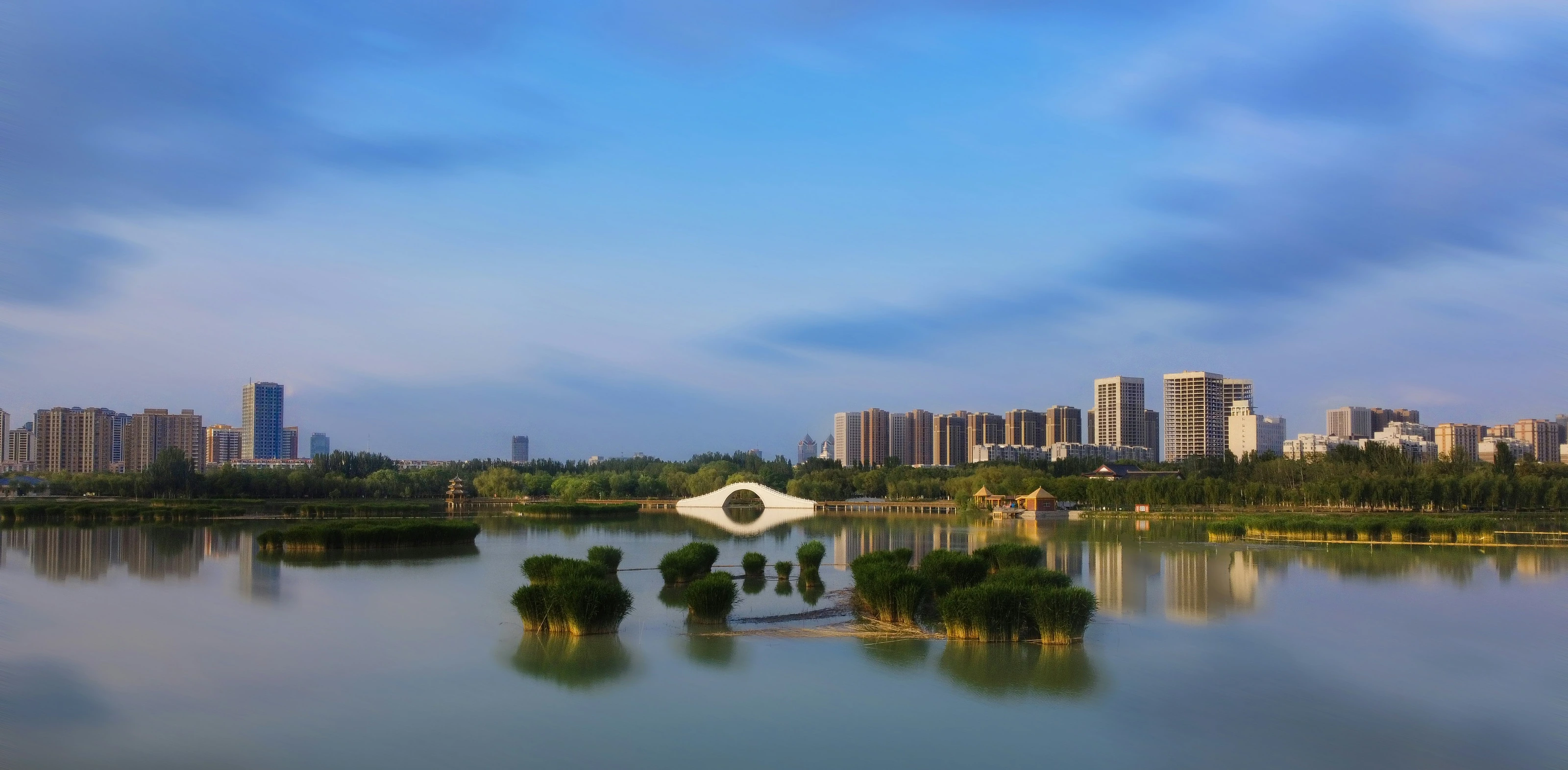
The Helan Mountains hold back the Siberian sandstorms while the Yellow River feeds seventy-two interconnected lakes, carving a fertile water haven along the desert edge.
The Helan Mountains rise as a stark slate barrier along the northwest, halting the encroaching dunes of the Tengger Desert and cold Siberian gales. Spreading across the alluvial plain below, gravity-fed canals first excavated under the Qin and Han dynasties channel Yellow River water into a vast mosaic of rice paddies, reeds, and seventy-two historic lakes, creating an anomaly known as the Jiangnan of the Frontier. Nine colossal conical loess mausoleum mounds of the Western Xia kings rise beneath rugged peaks, evoking the lost Tangut dynasty that held Central Asian trade corridors for three centuries. At rock faces along Helan gorges, prehistoric petroglyphs chisel horned deities into stone. Food traditions reflect desert salterns and grassy flats: Tan sheep forage wild licorice and bitter beans across saline pastures, yielding sweet, odorless meat boiled into hand-grabbed mutton. Mornings awaken to bowls of spicy sheep offal soup, its ivory broth gleaming with chili oil and accompanied by hot unleavened fried oil flatbreads.
What to see
The Western Xia Mausoleums National Archaeological Park preserves nine imperial tombs and hundreds of satellite burials, their stepped loess burial mounds dubbed the Pyramids of the East. The Helan Mountain Rock Art gorge reveals thousands of prehistoric petroglyphs depicting sun gods and galloping wild horses. Sand Lake fuses golden sand dunes with thousands of acres of wetland reed beds teeming with migratory waterbirds. Shuidonggou uncovers China's earliest excavated Paleolithic site alongside Ming garrison ramparts and subterranean troop-hiding tunnels.
What to eat
Dining in Yinchuan centers on Yanchi Tan sheep, river carp, and wheat dough. Hand-grabbed mutton boils grass-fed lamb ribs in simple spring water with whole ginger and Sichuan peppercorns, producing delicate, sweet meat and buttery fat. Morning sheep offal soup balances three whites (tripe, intestine, tendon) with three reds (lung, chili oil, red broth), simmered until the soup turns rich and ivory white. Haozi noodles grind wild artemisia seeds into wheat flour for aromatic elasticity. Feasts conclude with Hui eight-treasure covered-bowl tea steeping wolfberries, red dates, longans, sesame, and rock sugar.
Getting here & around
Yinchuan Hedong International Airport sits east of the Yellow River, linked downtown by rail shuttles and express coaches. Yinchuan Railway Station connects high-speed links to Xi'an in three hours. While urban areas are easily navigated by taxi, visiting the Western Xia Tombs, Helan Mountain Petroglyphs, and Sand Lake is best achieved by renting a car.
Choose a neighbourhood
Each area offers a different side of the city. Pick one to explore at your own pace.
Helan Foothills & Western Xia Mausoleums
The imperial burial ground situated along the fault lines of the Helan Mountains. Nine royal complexes dot the gravel steppe, where conical rammed-earth towers rise with distinct horizontal compaction striations exposed by centuries of wind erosion. The onsite museum exhibits Tangut movable-type books, glazed architectural finials, and a massive gilded bronze bull.
Surveying monumental Tangut earthen burial pyramids against the dramatic backdrop of the Helan range.
Xingqing Old Town & Drum Tower
The historic Islamic and civic core. The Ming Drum Tower and Yuhuang Pavilion anchor central crossroads lined with traditional Hui bakeries and teahouses. Nearby night markets along Xinhua and Jingde streets feature heritage stalls serving tender hand-grabbed lamb ribs, steaming sheep offal soup, and fragrant covered-bowl tea.
Sampling authentic Yanchi boiled lamb ribs and strolling historic Ming-era watchtowers.
Helankou Rock Art & Han Meilin Gallery
A prehistoric petroglyph gallery inside a rugged gorge. Cold mountain brooks flow between sheer basalt cliffs where nomadic hunters carved thousands of circular sun deities, masks, and mountain ibexes into dark desert patina. At the mouth stands a contemporary museum housing monumental bronzes and calligraphy inspired by these ancient glyphs.
Tracing millennia-old rock engravings and exploring modern art integrated with desert geology.
The earthen pyramids of the Tangut kings
Below the jagged granite wall of the Helan Mountains, nine colossal conical mounds of pale yellow earth rise from fifty square kilometers of gravel wilderness. These are the imperial burial keeps of the Tangut Western Xia Empire, which contested northwestern China between the eleventh and thirteenth centuries.
Devout Buddhists, Tangut builders departed from Chinese subterranean flat-topped tumuli, drawing instead on Indian and Tibetan stupas. They compacted fine loess earth within timber formwork, raising octagonal towers seven to nine tiers high that were originally enveloped by timber verandas and green-glazed roof tiles. Although fire and nine hundred years of desert winds destroyed the timber shells, the monolithic rammed-earth cores stand indomitable, dubbed by foreign explorers the Pyramids of the East. Gazing across the gravel plain, shattered glazed tiles beneath the cliff walls summon echoes of an empire buried in desert dust.
The salt-marsh grazing of Tan sheep
The celebrated reputation of Ningxia Tan sheep owes everything to the saline geography of the Yanchi plains surrounding Yinchuan. Across arid steppe flats, herds graze over a hundred species of wild halophytic herbs, feeding on wild licorice, bitter beans, and astragalus, while drinking from mineral-rich alkaline springs. Natural plant compounds inhibit the formation of volatile branched-chain fatty acids, purging the meat of gamey taint.
Preparing hand-grabbed mutton requires restraint. Chefs select ribs from six-to-eight-month wethers, cutting long strips into cold spring water. The pot receives only sliced ginger, scallion whites, and Sichuan peppercorns to skim impurities. Simmered over low embers for an hour, the meat softens until a wooden chopstick pierces the bone with ease. Plated hot, the fat glistens like alabaster, tender and moist. Diners lift ribs with their fingers, dipping meat into coarse roasted pepper salt or crushed garlic juice; the fat dissolves like warm cream, releasing pure grassy sweetness.
The Hui eight-treasure covered bowl tea
In Hui teahouses and family homes across Yinchuan, welcoming a guest requires presenting a three-piece covered gaiwan. The porcelain ensemble combines a wide cup, domed lid, and saucer. At the bottom rest eight carefully balanced treasures: crimson Zhongning wolfberries, dried Xinjiang red dates, walnut meats, dried longans, sesame seeds, raisins, brown rock sugar, and spring green tea.
Rolling boiling water cascades around the inner rim before the lid is set to steep. Technique governs drinking: holding cup and saucer together, the drinker uses the lid to scrape inward across the surface in three circular sweeps. The first scrape submerges floating tea leaves; the second dissolves the rock sugar crystal; the third releases deep fruit syrups from wolfberries and dates. Drinking through the narrow gap between lid and rim, early sips balance tea astringency with soothing fruit sweetness, concluding with eating the tender, plumped wolfberries.