Yixing
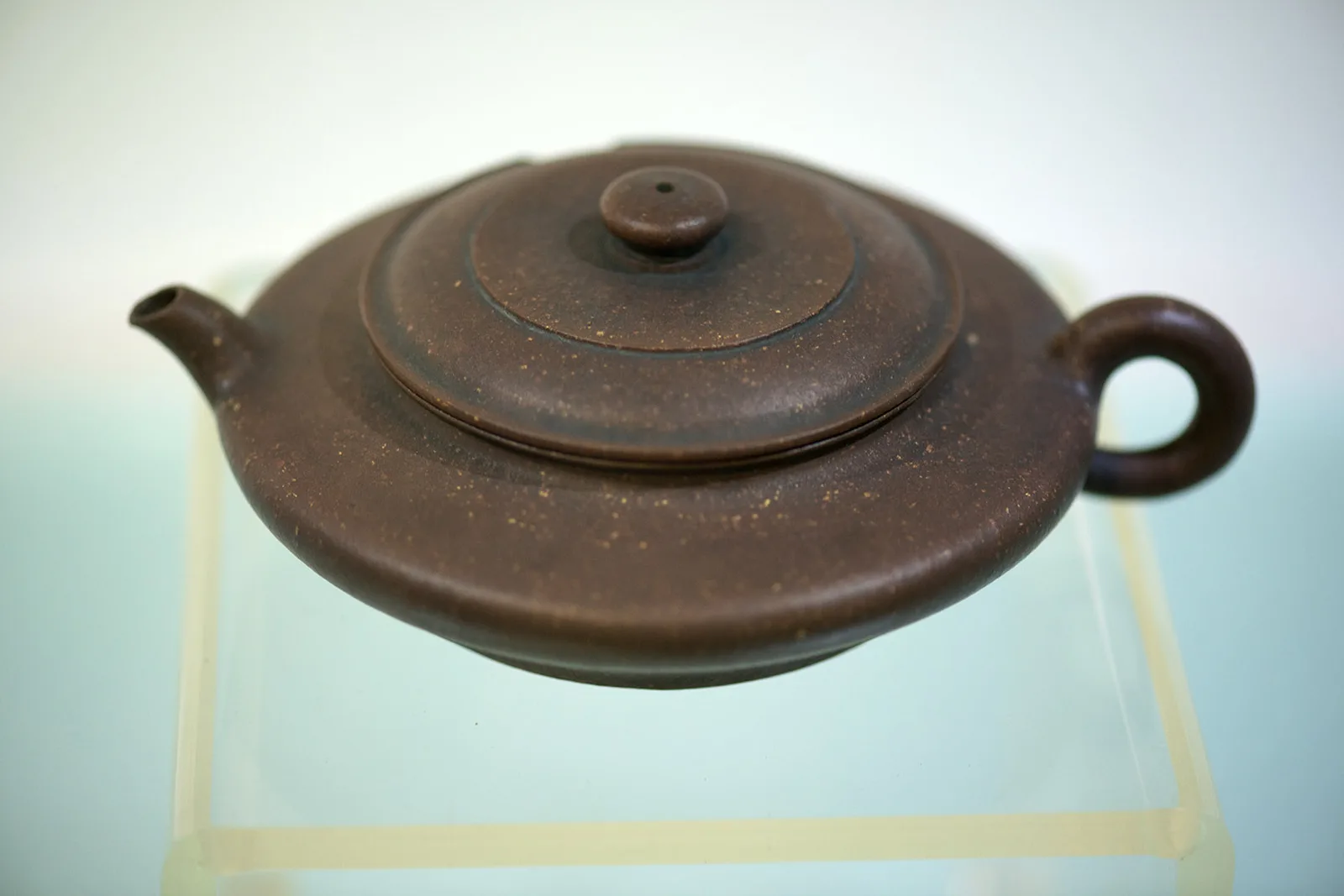
Zisha clay takes no glaze, shaped by wooden paddles; fired to eleven hundred degrees, it still breathes without leaking a drop.
Tucked into the low hills southwest of Lake Tai, the bedrock of Mount Huanglong conceals an extraordinary geological gift: five-colored zisha clays. Yixing's artistic heart beats in the town of Dingshu, where teapots are never turned on a potter's wheel. Instead, master potters wield wooden paddles and horn scrapers over heavy benches, beating flat clay ribbons stroke by stroke into taut, curving vessels. Microscopic double porosity allows fired clay to breathe without sweating, absorbing essential tea oils over decades until the bare clay glows with the deep, lustrous patina of antique bronze.
What to see
Dingshu town is the living epicenter of purple-clay ceramics; Shushan Ancient South Street preserves historic Ming and Qing workshops alongside canal transport wharves. The Qianshu Dragon Kiln sprawls over sixty meters up a wooded slope, one of the last wood-fired kilns still active in China. Southward, the Yangxian hills offer endless green seas of bamboo and heritage Tang dynasty tea estates.
What to eat
Lake Tai freshwater delicacies meet mountain hill country produce. Spring features sweet bamboo shoots and the 'Three Whites of Lake Tai' (whitefish, white shrimp, and silver fish), alongside pasture chicken slow-simmered in mountain spring water. A pot of fragrant Yangxian Xueya green tea provides a clean, floral counterpoint.
Getting here & around
Yixing Railway Station on the Nanjing-Hangzhou high-speed line connects both provincial capitals in under an hour. Exploring Dingshu and the surrounding tea slopes is best managed with rented cars or local buses, while Shushan Street is strictly pedestrian.
Choose a neighbourhood
Each area offers a different side of the city. Pick one to explore at your own pace.
Dingshu Town & Shushan South Street
The birthplace of purple-clay art along the stone embankments of the Li River. Weathered timber shophouses and family ateliers line the flagstones, including the ancestral home of master Gu Jingzhou. The rhythmic clap of wooden paddles against moist clay echoes from open windows as elders sip tea from well-seasoned stone teapots.
Stepping inside authentic artisan clay studios and discovering the heritage roots of the pottery capital.
Qianshu Dragon Kiln & Mount Huanglong
A wood-fired dragon kiln stepping sixty meters up the hillside beneath rows of roof tiles. During periodic firings, kiln workers feed bundles of pine wood through side combustion ports as roaring flames sweep through the interior. Nearby Mount Huanglong contains the original quarry shafts for rare purple, red, and duan clays.
Witnessing traditional wood-fired kiln spectacles and learning about raw geological zisha ores.
Yangxian Tea Hills & Zhanggong Cave
Rolling slopes covered in manicured tea bushes interlaced with towering moso bamboo forests. Celebrated since the Tang dynasty when tea sage Lu Yu praised its spring water, limestone caverns here yield cold, mineral-rich runoff prized for brewing fine tea.
Hiking misty tea terraces and relaxing amid pristine mountain bamboo.
Shaped by wooden paddle
While Jingdezhen porcelain relies on centrifugal spin on a throwing wheel, Yixing teapots are crafted through the rare method of paddling and slab construction. Aged clay, cured for months in cellars and beaten thousands of times to alignment, achieves extraordinary plasticity. The artisan uses a wooden mallet to pound the raw lump into uniform sheets and strips.
Curved into an open cylinder on a small turntable, the potter places one hand inside while the right hand wields a flat pear-wood paddle, striking the exterior rim inward with rhythmic, skimming taps. The hollow cylinder slowly arches and closes, forming a seamless, bulbous body. Finally, an ox-horn scraper dipped in clean water smooths and compresses the surface pores, leaving the unfired raw clay glowing with a natural, oily sheen.
The double porosity of clay
Zisha clay is not ordinary mud; it is a dense hydromica rock packed with kaolinite, quartz, mica, and iron oxide crystals. Fired inside kilns to approximately 1,150 degrees Celsius, quartz particles fuse into a rigid framework without fully vitrifying into glass. This creates a unique dual-pore network: microscopic pores within clay aggregates, and capillaries between them.
These invisible channels grant the finished teapot its magical ability to breathe without letting liquid weep through. It captures volatile tea oils and aromatics, ensuring summer tea steeped inside does not spoil overnight. With years of gentle brewing and handling, the pores drink in tea lipids; even when plain boiling water is poured into an empty vessel, a subtle, sweet tea aroma rises, while the exterior develops the smooth, warm luster of jade."