Yuanyang
Water cascades down from the forested peaks tier by tier; only when upper basins fill do wooden allocation combs release flow below.
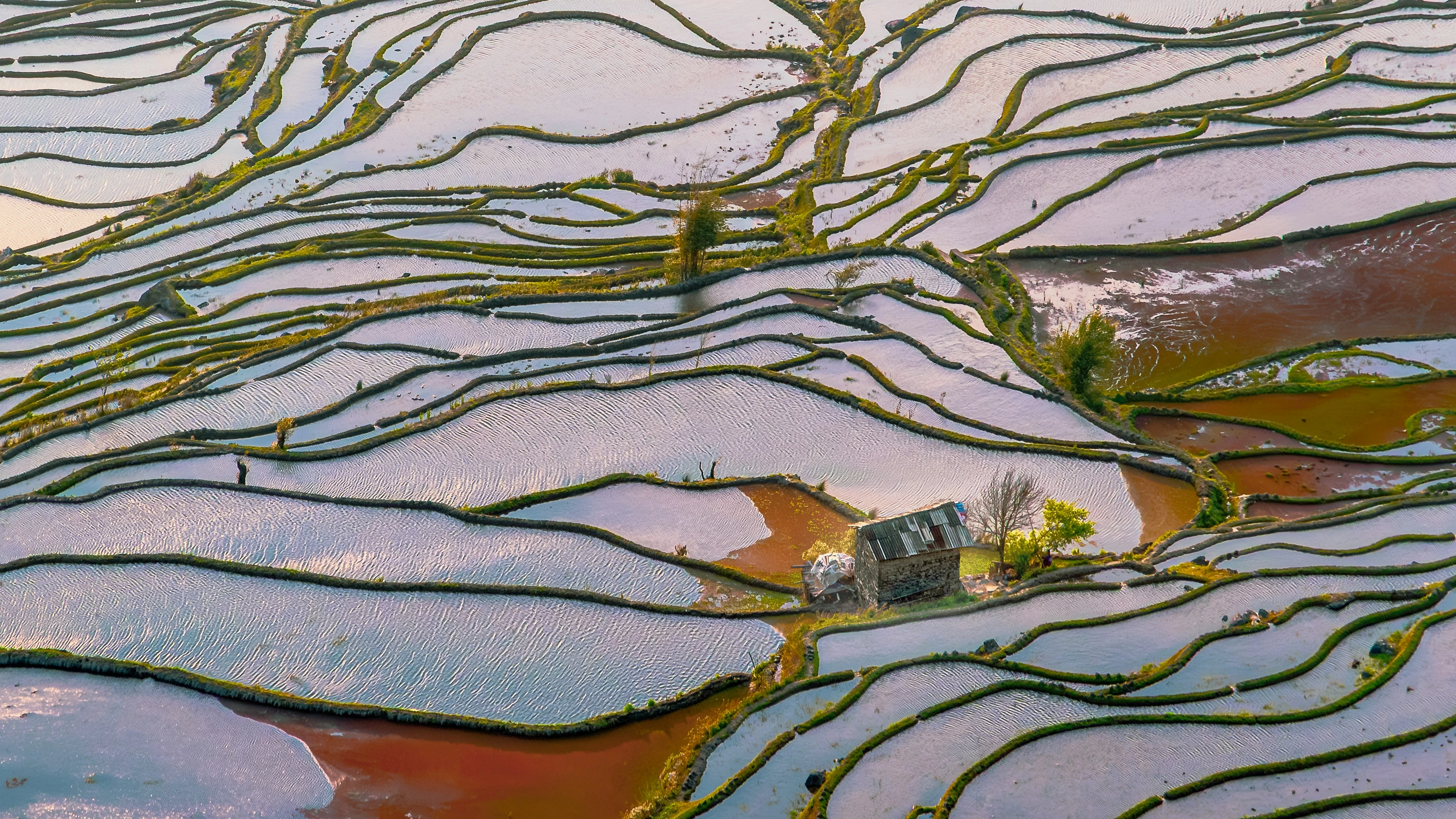
Yuanyang rises across the precipitous southern ranges of the Ailao Mountains above the deep gorge of the Red River. Over thirteen centuries of hand cultivation, the Hani people transformed steep tropical mountain slopes into hundreds of thousands of terraced paddies scaling heights above 2,000 metres. Primeval summit forests capture clouds into mountain springs, feeding hillside mushroom-thatched hamlets before spilling across three thousand terraced tiers to the valley floor. During the winter flooding season, mist rises as sky and clouds reflect across thousands of water mirrors.
What to see
Duoyishu terraces offer majestic sunrise panoramas where mist catches gold and purple dawn light across flooded steps; Bada terraces display monumental vertical scale descending 3,700 tiers into the canyon; Jingkou Hani Folk Village showcases traditional rammed-earth thatched dwellings and water-mill streams; Aichun terraces reflect brilliant sapphire blues under midday skies.
What to eat
Highland red rice is the heritage grain cultivated across centuries, slender and mahogany-hued with a nutty, chewy tooth; paddy-raised carp are simmered in wild watercress broth; served alongside cold Hani chili chicken, banana flower stir-fries, and bamboo shoots.
Getting here & around
Arrive via long-distance buses from Kunming South Station or Jianshui to Yuanyang Nansha in the valley, then transfer to a mountain minibus climbing up to Xinjiezhen. Terraced viewpoints are scattered along mountain ridge roads, making private drivers or shared minivans essential.
Choose a neighbourhood
Each area offers a different side of the city. Pick one to explore at your own pace.
Duoyishu Terraces & Pugao Old Village
The primary amphitheatre for sunrise photography, where thousands of flooded steps curve inside a massive horseshoe ridge, reflecting pink and golden clouds through valley fog.
Witnessing dawn reflections over flooded tiers, walking slate lanes of Pugao hamlet, and bird watching.
Bada Terraces & Malizhai Tea Slopes
The most expansive and vertically dramatic terrace network, plunging from 2,000 metres down to 800 metres, bathed in molten bronze light at sunset.
Panoramic golden-hour photography, admiring immense vertical scale, and hiking agricultural ridge trails.
Jingkou Hani Village & Cultural Forest
The quintessential living model of Hani quadripartite ecology: mountain summit forests, mushroom-shaped thatched houses, gravity-fed water channels, and terraced paddies.
Inspecting traditional mushroom-shaped vernacular architecture, learning sacred grove customs, and water rights history.
Summit Clouds and Wooden Water Combs
The survival of the Hani terraces across a millennium rests on an elegant closed-loop hydrological system. Dense evergreen broadleaf forests crowning the ridges act as sponges, collecting tropical cloud moisture into perpetual cold mountain springs. Water channels down through villages for household use before flooding the agricultural terraces. To apportion flow fairly, the Hani developed carved wooden water allocation barriers: oak logs placed across main flumes are notched with channels of varying widths proportioned to each family's acreage. Governed purely by custom, this gravity system ensures upper and lower paddies never run dry.
Rammed Earth and Thatched Mushroom Roofs
Hani mountain homes blend naturally with the terraced landscape. Villagers mix local clay with rice straw, ramming it inside wooden slip-forms into solid walls over half a metre thick that insulate against plateau cold and damp mountain winds. A heavy cedar frame supports a steep hipped roof layered with thick bundles of wild mountain reeds, rounded at the ridge to resemble a forest mushroom. Ground floors shelter water buffalo, second storeys center around an open hearth for cooking and sleeping, while airy attics store dried red grain. Heavy downpours roll off the thatch, scenting the air with damp loam.
Heirloom Red Rice of the Terraces
The terraces of Yuanyang preserve heirloom highland red grains bred across generations. At high altitudes with broad diurnal temperature swings, red rice matures in chilly mountain runoff, requiring two months longer to ripen than lowland varieties. Harvested late in autumn and stored in the husk, grain is de-husked with wooden foot-pestles as needed. The bran exhibits a natural garnet-red hue rich in iron and fiber. Steamed in cedar tubs, the rice remains separate, chewy, and distinctly nutty, paired with fresh carp netted directly from the flooded paddies.