Yungang Grottoes
Forty-five caves cut into a kilometre of sandstone, and the Buddha's face changed from an imported one to a local one.
Yungang is sixteen kilometres west of Datong, on the south face of the Wuzhou massif: a kilometre of sandstone cliff. When the Northern Wei held Pingcheng as their capital, they began cutting caves here in 460 and kept going until the move to Luoyang. There are forty-five main caves and more than 51,000 figures.
- Region
- Shanxi · Datong
- Main caves
- 45
- Figures
- More than 51,000
- Founded
- 460, Northern Wei
- Listed
- 2001, World Cultural Heritage
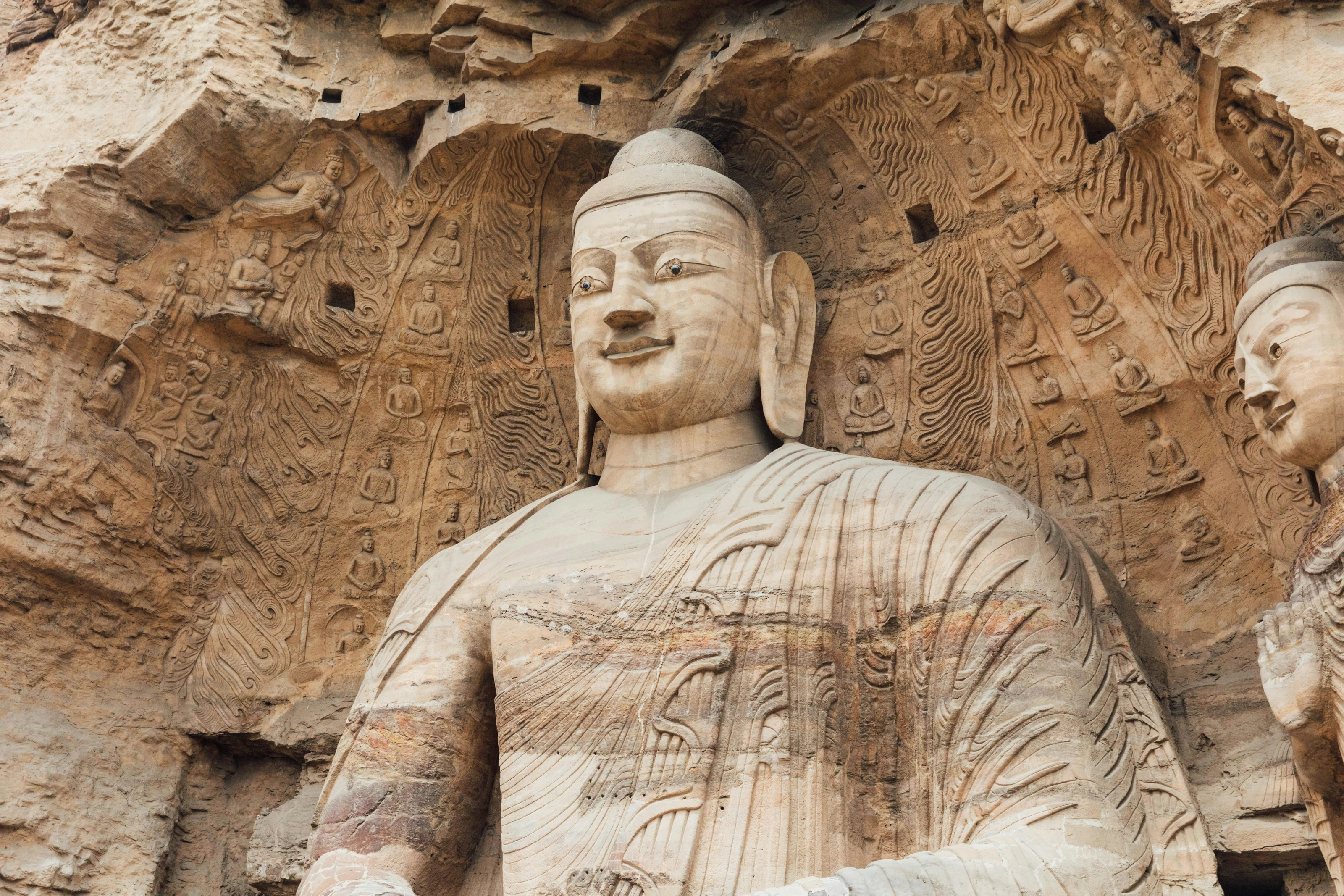
The cliff is Jurassic feldspathic quartz sandstone, thick-bedded, even in grain, moderately cemented. That makes it good to cut: a chisel does not skate, and the same block takes a colossus and a fine line. What it does not take is water. Water soaks in and the stone crumbles. So the caves once had timber fronts, and drains were cut along the top of the cliff. Most of the timber is gone, and the stone is out in the rain.
The Tanyao caves
Sixteen to twenty, the first group. Each main figure is over ten metres and is said to stand for one of the Northern Wei emperors.
Cave 12
Dozens of flying musicians carved on the ceiling and walls, holding pipa, bili and drums. A full court orchestra.
Caves 5 and 6
A pair with a fifteen-metre pagoda column between them and the life of the Buddha carved on all four walls.
The front wall fell long ago and the figure is fully exposed: over thirteen metres, broad in the shoulder, straight in the nose.
Good sandstone to cut, bad sandstone in rain
The cliff is thick-bedded Jurassic feldspathic quartz sandstone. The grains are even and the cement is not strong, and a chisel does not slip in it: one block can take a colossus and can take a fine line. Fifteen metres of Buddha is possible because of that.
What it does badly is hold water. The stone is porous. Rain soaks in, dissolves salt out of the rock, and when the water dries the salt crystallises; as it expands it takes the surface off in layers. Many of these faces are blurred, and not because anyone cut them. They powdered. Each cave once had a timber front, and a drain was cut along the top of the cliff to lead water away; most of the fronts are gone, and the stone stands in the rain.
A white bloom on the surface
Close up, the rock carries a white powder that comes off on a finger. That is salt that has come out. Under the salt the stone is flaking, layer standing away from layer like pastry, and a fingertip will break it.
The bedding runs level, band after band across a shoulder and a back. On the colossus in Cave 20 there is a dark water stain down one shoulder, left by water coming from above. On some walls the carving has lost its lines and only a shallow outline remains.
How far the light reaches in
A cave has depth, and light enters a certain distance for part of the morning, then retreats to the door. Relief carving depends on that raking light; once it has gone, the wall goes flat.
Under cloud there is no contrast inside and everything reads grey. With people in a cave, the moisture in their breath makes it close and the stone surface damp. No flash inside.
Between 2008 and 2012 the cliff top was sealed and the water led away; between 2012 and 2015 caves 9 to 13 got timber fronts, so rain no longer falls straight onto the figures.