Mogao Caves
Caves cut into the cliff of a seasonal river: painted inside, and kept by darkness and drought.
Mogao sits at the eastern foot of the Mingsha dunes south-east of Dunhuang, where more than seven hundred caves were opened in the cliff of a seasonal river between the fourth and fourteenth centuries. The figures and murals are not carved into stone but built on mud plaster, because the cliff here is loosely cemented conglomerate and will not hold a chisel.
- Region
- Gansu · Dunhuang
- Caves
- 735 survive
- Founded
- 366
- Murals
- About 45,000 m²
- Listed
- 1987, World Cultural Heritage
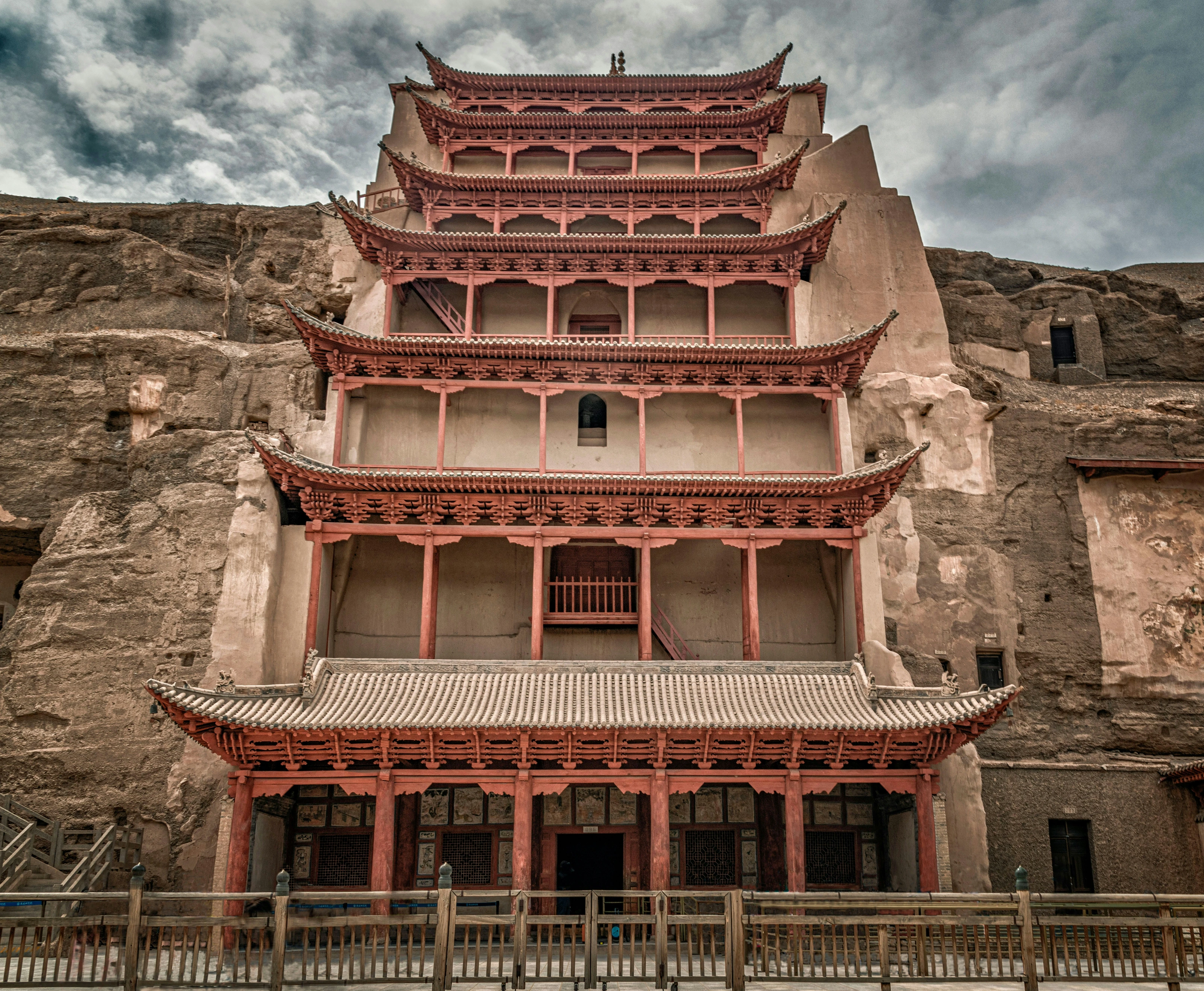
The cliff is conglomerate with weak cement, so it cannot be carved directly. Figures were therefore modelled over timber armatures in clay, and murals painted onto mud plaster reinforced with chopped straw. The extreme aridity suppresses salt movement and mould; the caves are dark and sheltered, and mineral pigments are stable, which is why the painting has survived sixteen hundred years.
Clay figures on timber
A frame is tied, wrapped, plastered and painted, not chiselled out of rock.
Mineral pigments
Azurite, malachite and cinnabar: ground stone, which does not fade in light.
The conglomerate cliff
Rounded pebbles are visible in the face, with very little cement between them.
Read upward: the door surrounds differ one from the next, each added in its own century.
The rock would not hold a chisel
Yungang and Longmen were cut into sandstone and limestone, rock that takes a chisel. The cliff at Mogao is conglomerate: rounded river pebbles held in weak lime cement, which crumbles at the first blow. So the figures here were built, not carved.
A timber frame first, bound with straw rope, then a coarse clay mixed with chopped straw, then a finer clay, polished, whitened, painted. The figures are hollow, far lighter than stone, so the cliff does not have to carry much. The material set the form in return: clay can be added to and adjusted, and drapery cut thinner than stone allows.
A white line along the bottom of the murals
Close to the floor, the lower edge of many murals carries a white line, as if powder had been scattered there. That is salt. Salt in the cliff is carried to the surface by water, the water evaporates, the salt stays, and in time it lifts the paint into scales.
The pigment itself does not mind light. Azurite for blue, malachite for green, cinnabar and iron oxide for red: ground stone, which light does not decompose. What destroys the murals is water.
In the cliff face rounded pebbles sit in the sand, and a fingernail will take one out. Over each doorway the surrounds stack one on another, no two built the same way, added by different centuries.
Dark, dry and few people, all three at once
The caves were never given windows. Light reached a little way in from the door and the rest was dark. Dark means little ultraviolet, a narrow temperature range, and no wind. Opening a door, hanging a lamp, letting people in: each of those changes all three.
The guide works with a cold torch and moves the beam off the wall as soon as it has passed. With more people inside, the moisture in their breath raises the humidity and the salt starts to move. That is why visits run in groups against a clock, and why a cave holds a party for about a quarter of an hour.
The digital exhibition centre opened in 2014: visitors watch the dome films first and then spend about fifteen minutes inside a cave. Class A tickets are capped at 6,000 a day.