Mount Danxia
Red conglomerate lifted up, then cut apart along its joints by water, leaving flat-topped walls and pillars.
Mount Danxia stands in Renhua, in northern Guangdong, with the Jin River running around it. The rock is red conglomerate: laid down in a lake basin, lifted into a plateau, then cut into blocks by water working down vertical joints. What is left are flat-topped mesas and pillars with steep sides and gentle feet, and the landform type takes its name from this mountain.
- Region
- Guangdong · Shaoguan
- Main peak
- Bazhai, 619 m
- Named
- 1928, when the Danxia beds were named here
- Rock
- Red sandstone and conglomerate, Cretaceous
- Listed
- 2010, World Natural Heritage (China Danxia)
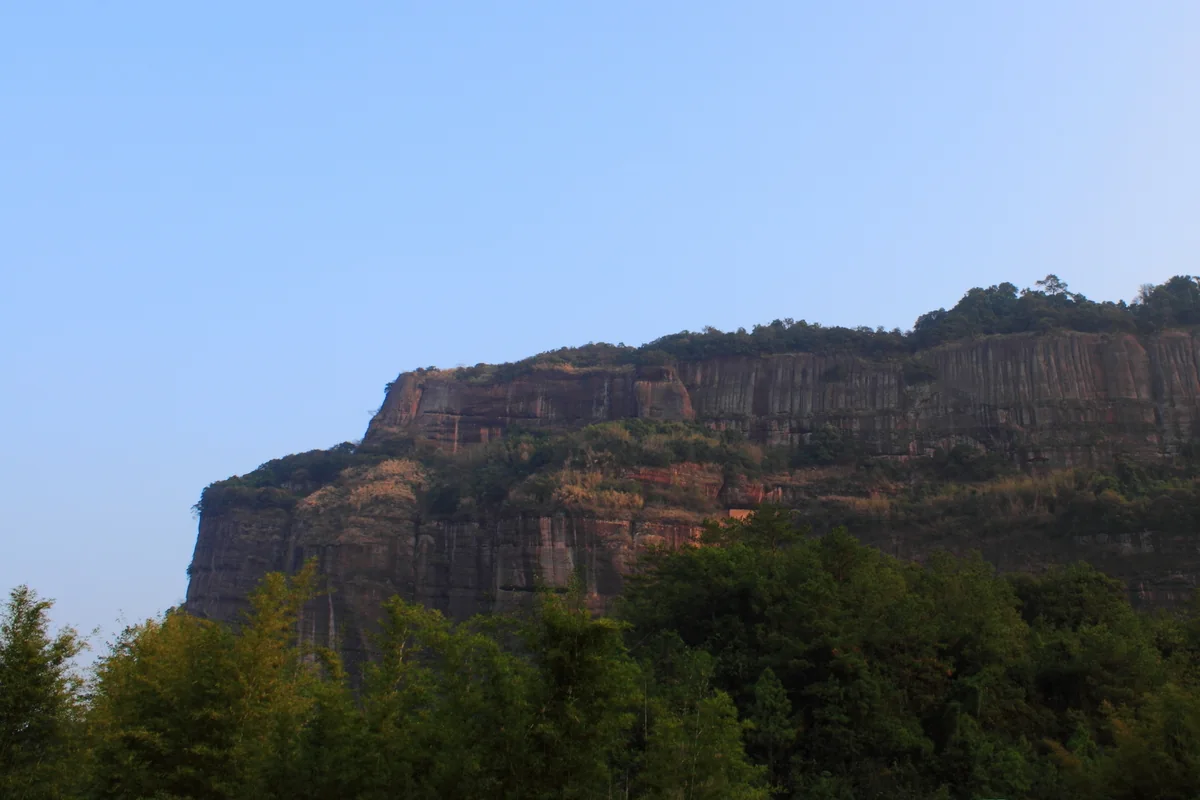
Cretaceous red conglomerate was deposited in a hot, dry basin, its iron oxidised to red. Himalayan uplift raised the beds, which lie almost horizontally and carry well-developed vertical joints. Water and gravity strip the rock along those joints: soft beds erode into gentle slopes, hard beds remain as walls and flat tops.
Red conglomerate
Individual pebbles are still visible in the face, set there when it was deposited.
Flat top, steep side, gentle foot
On one mountain you can walk the summit, face a wall in the middle, and climb a slope at the base.
The Jin River
The water follows the strike of the beds, turning where it meets a hard layer.
Water on one side, path on the other, and one rock face lit in two different reds by the river.
Lay the stone flat first, then cut it
In the Cretaceous this was a hot, dry lake basin. Gravel and sand went down layer on layer, lying almost level, and iron oxidised as they settled, fixing the red in the rock. Then the whole block was lifted, and the lifting pulled it apart into parallel vertical joints, a set of cuts already made.
Water went down those cuts. The top bed is cemented hard and resists, so the original depositional surface survives as a flat top; the softer beds between are stripped back into slopes. Flat top, steep side, gentle foot are one set of beds seen at three heights.
Pebbles set in the wall
Close to a rock face, the red stone has pebbles in it, round and worn smooth. They came off other mountains, rolled in a river and came to rest in this basin. They carry their own account: round means a long carry in water, and coming to rest here means the water had gone quiet.
Gravel beds and sand beds alternate. Soft ones wear in, hard ones stand out, so the face runs in horizontal bands. The pitting on the walls, a honeycomb of small hollows, follows the soft beds in rows.
Wet stone is the deepest red
What changes is brightness, not hue. After several dry days the face is a pale pink-red; after rain the stone takes water and the colour presses down towards brown, then begins to lift within hours.
Light matters more than season. In the morning the sun is on the face, the whole wall goes white and the bedding disappears; in the afternoon light comes across it and the relief returns. The stretch of the Jin where the boats run has red walls standing straight out of the water, and that face has no path beside it.
The boats on the Jin run one stretch only: eight kilometres, from Yangyuan bridge down to the Danxia power station. The red walls on both banks have no path beside them, so the water is the only way to see that face.