Enshi Grand Canyon
This cliff is what a cave roof left behind. The fissure at the bottom is the same cave, still falling in.
Enshi Grand Canyon lies in the northern Wuling range, where tributaries of the Qing River cut through limestone for more than a hundred kilometres. Both walls go nearly straight up, and there is hardly a gentle stretch anywhere. At the bottom there is a narrower cut, the Yunlong fissure, seventy-five metres deep, with water moving along its floor and out of sight.
- Region
- Hubei · Enshi
- Length
- About 108 km
- Rock
- Permian to Triassic limestone
- Cloud Dragon crack
- About 3.6 km long, 75 m deep on average
- Location
- Tunbao, Enshi
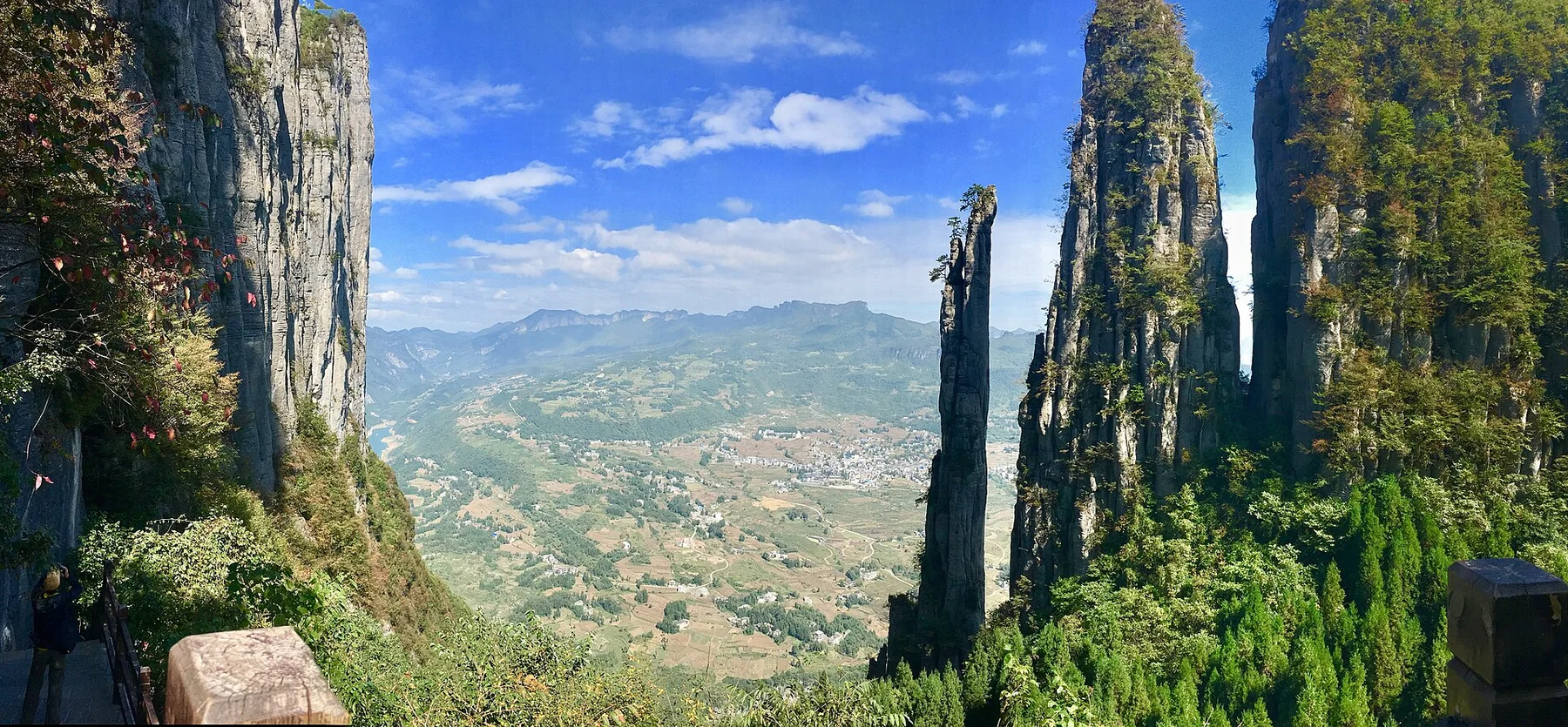
Limestone dissolves, and rainwater working down joints enlarges an underground channel year by year. After uplift the channel kept cutting, the cave roof thinned and collapsed, opening a fissure with walls on both sides; the debris was carried off and the cliff face was left exposed.
The cliff face
Vertical rock, a collapse surface, with no grooves cut by water.
The fissure
Two walls fifteen metres apart on average, seventy-five metres deep.
The underground river
Audible but invisible; it resurges further down the gorge.
A strip of sky between two walls overhead, and water you can hear and cannot see underfoot.
What came down was the roof
The limestone is thick and the beds lie almost flat. Water works down the bedding planes and the joints, finds a way through, and given enough time there is a river inside the rock. Then the ground rose and the river’s outlet dropped, so the underground river cut down after it: the cave grew taller, the roof thinner, until the roof could no longer carry itself and came down. The water carried the blocks away, and what was left standing was the wall of the cave, which is this cliff.
The face is flat, with no rounded hollow and no groove following the fall of water. Water cuts those into the rock it works on. This face came off instead.
The wall is split
In the Yunlong fissure the beds on one side line up with the beds on the other. The third layer up on the left is the third layer up on the right, fifteen metres away. It was one wall. It split down the middle, the water took away what came loose in between, and the two halves now face each other across the gap.
The blocks on the floor came off the walls. Their corners are worn round; they sat in water long enough for that. Higher up there is a horizontal notch, a shallow groove where water stood and dissolved the rock away.
Water runs the whole time and stays out of sight. The sound comes out of the stone at foot level, not from overhead.
The sound follows the rain
After a run of dry days the fissure carries a thread of water, the sound is thin, and voices carry along the boardwalk. One storm and the river below rises: the sound comes up through the floor and two people have to shout.
In mist the top half of the cliff goes and a line is all that is left. Wet stone on the boardwalk turns slick, with a skin of moss on the steps. The Qixingzhai stretch is step after step with nothing level in between. Afterwards the legs are still shaking, and the next day the stairs need a hand on the rail.
After 5A status in 2015 came a cableway, an outdoor escalator, and a boardwalk through the crack. The full walk once took a day; now it takes half.