Libo Xiaoqikong
The river drops sixty-eight steps in a kilometre and a half, and the trees stand on stone in the water.
Libo is in southern Guizhou, where the Guizhou plateau tilts down toward the Guangxi hills. Xiaoqikong is a side valley of the Zhang River: a narrow floor with dense cone karst on both sides. The water comes down in steps, set by how hard each layer of rock is, and lands in a chain of pools with tree roots in the stone.
- Region
- Guizhou · Qiannan
- Rock
- Limestone, dissolved into peak clusters
- Falls
- The 68-step falls at Xiaoqikong
- Forest cover
- 72%
- Listed
- 2007, World Natural Heritage
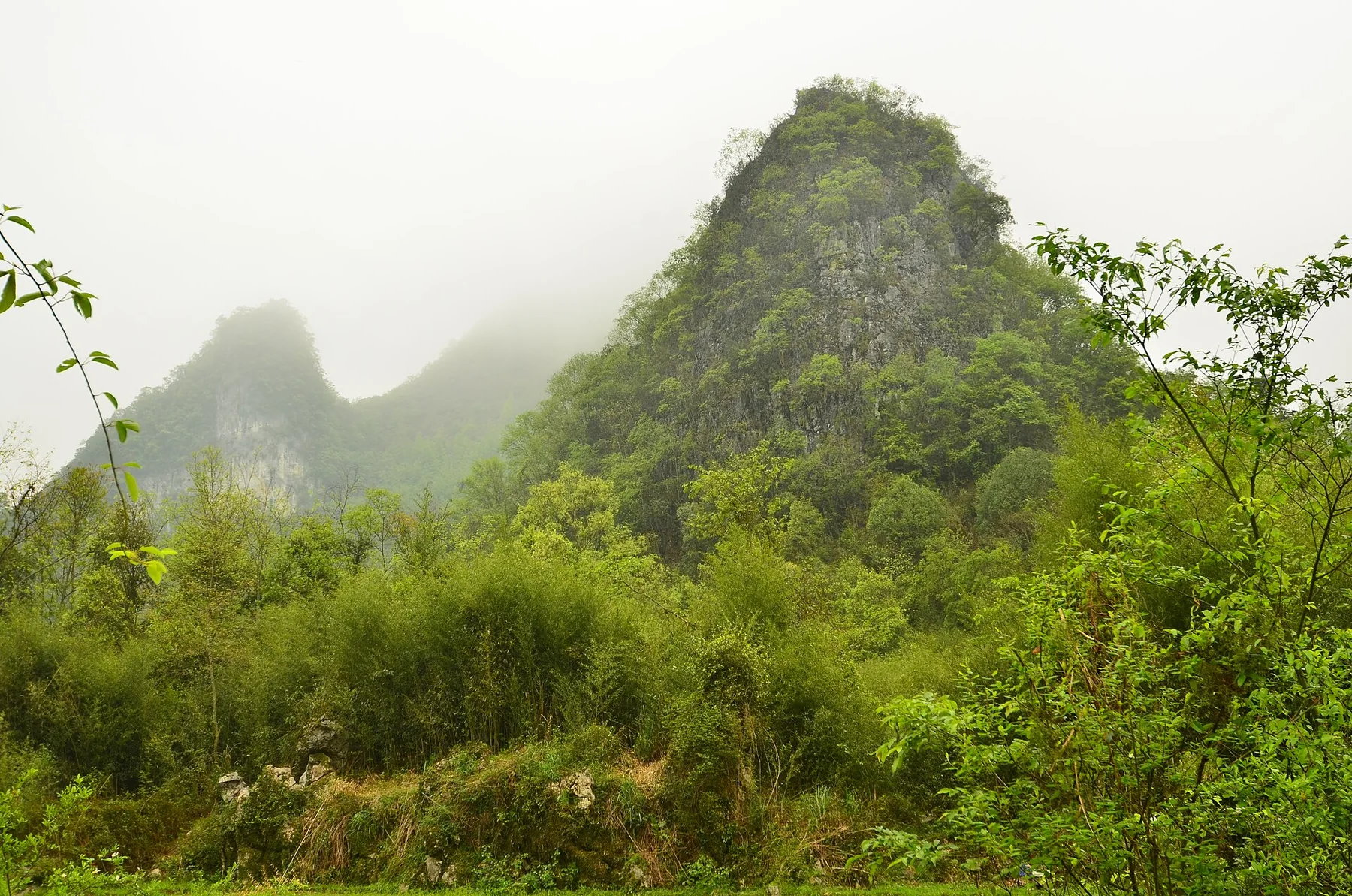
This is thick limestone, and rainwater with carbon dioxide in it dissolves the rock, widening the cracks until they are an underground river. Where the roof of that river collapses, a window opens and the valley floor gets a deep pool. On the bed, soft layers go first and hard ones are left standing as steps; the water speeds up at each step and scours a new pool below it.
The sixty-eight steps
Sixty-eight tufa ledges in a row, a pool below each one, and water noise the whole way.
Water forest
Shrub roots hold in cracks in the rock mid-stream, and you walk between roots and stone through moving water.
Xiaoqikong bridge
A blue-stone arch bridge from the Daoguang reign, seven spans, most of it now covered in vine and fern.
Seven stone arches over the water, each completing a circle with its own reflection. The deck is narrow enough for two people side by side.
The steps are built out of dissolved lime
The bed of the Xiaoqikong is not flat. The limestone alternates hard and soft, the soft beds go first, and a hard one is left standing as a ledge. Once a ledge exists the water falls over it, the falling water churns, carbon dioxide leaves, and calcium carbonate comes out of solution on the spot. Algae and moss take hold on the lip, tufa grows along them, and the ledge gets higher and more solid year by year.
The pool below does not deepen. Tufa settles on its floor at about the rate the water scours it, so the pool stays at the depth it reached, and the colour sits deep in it.
The stones under the water are white
The pools read blue-green, and the water itself is nearly colourless. The colour comes from two things: calcium in solution, and very little suspended matter. Light goes in, the long wavelengths are taken out in the first few metres, and what comes back is blue-green, deeper the further down it started.
Everything under the water wears a white skin of tufa. Where a foot can reach, the stone is rough, like fine sand set hard. The shrubs of the water forest carry the same skin on their roots, and what the roots hold is tufa and the grit jammed into the cracks.
The water level changes how the valley is walked
In the wet months the water forest is ankle deep, and the route between the stones is walked barefoot or taken on the boardwalk instead. With that much water all sixty-eight steps sound at once, and voices have to be raised; the noise does not leave the gorge.
After rain the water carries silt, the blue-green goes, and the pools turn grey until it settles, a day or two. In the dry months the water is clear, the colour is at its deepest, the falls thin to threads, and the bedding of every ledge shows and can be counted. The valley floor is thick with trees and does not move air, so a summer walk to the end leaves clothes wet.
The Guiyang-Nanning high-speed line opened in 2023. Libo station to Xiaoqikong is now under an hour, where the road took half a day.