Zhangye Danxia
The red is iron in the rock. The beds were lifted, then planed off, and the tilted stripes now show on the slope.
Zhangye Danxia sits in the middle of the Hexi Corridor, on the northern foot of the Qilian Mountains, across Linze and Sunan. It is a field of low coloured hills, gobi on every side, little growing on them. Beds of rock come out of the ground at an angle, in stripes of red, orange, grey-green and grey-white.
- Region
- Gansu · Zhangye
- Rock
- Cretaceous red beds, 135 to 65 million years old
- Outcrop
- About 50 km²
- Colour
- The difference between ferric and ferrous iron
- Listed
- 2020, national 5A scenic area
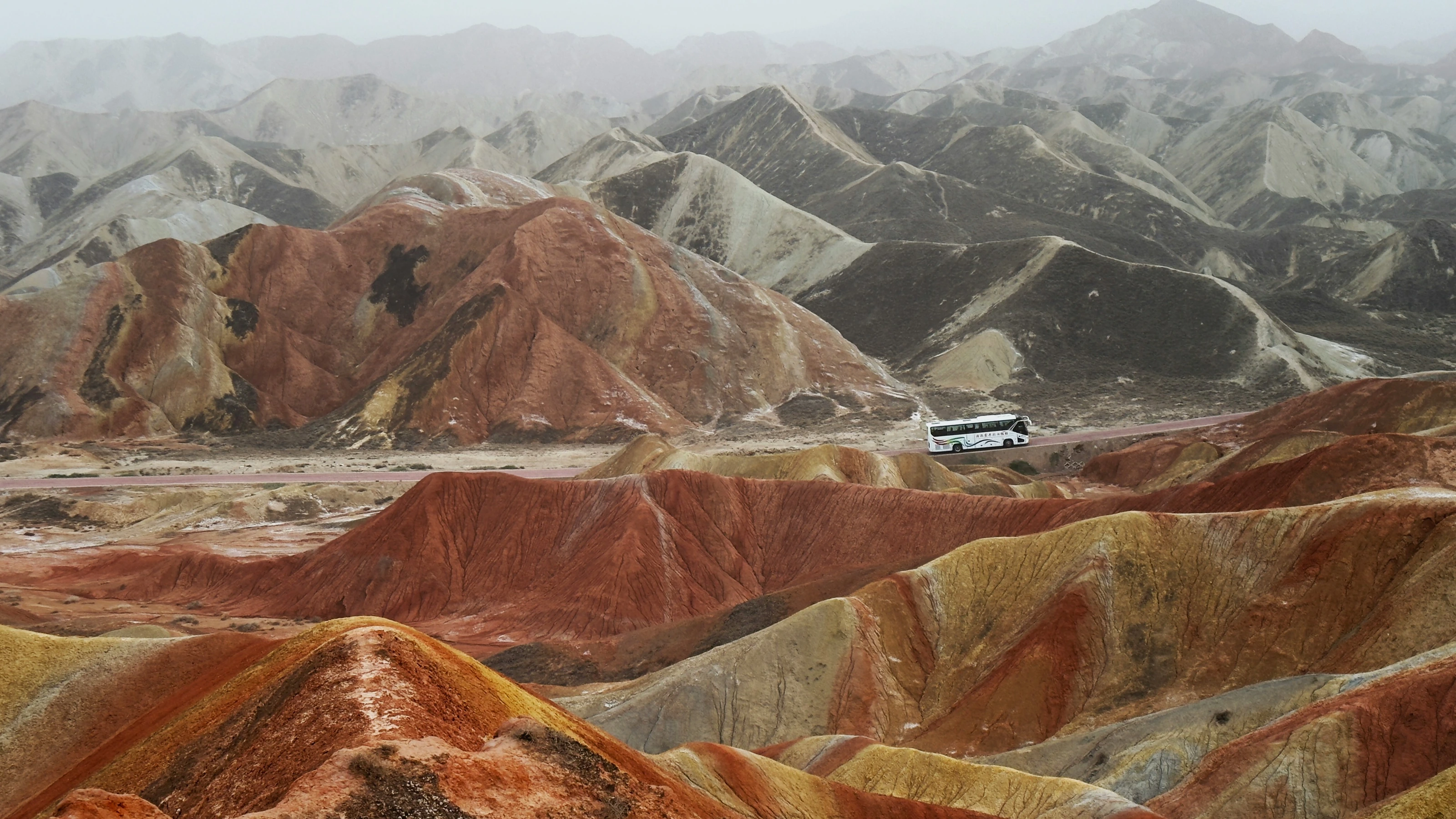
In the Cretaceous this was an inland lake basin taking mud and sand layer by layer. Each layer recorded its own climate, and with it how much iron the sediment held and how far that iron had oxidised. When the Tibetan Plateau rose, the flat beds were squeezed, tilted and broken. Exposed, wind and seasonal water took the surface away and the tilted section came out on the slope.
Qicai Screen
A near-vertical wall of sandstone with the bands running parallel, one above the next.
Great Scallop
Weathering has cut a hill into concentric rings, grey-white against orange-red.
Binggou
The same rock in a different shape: walls and pillars rather than hills, and paler.
The densest run of them, each band throwing its own shadow when the light is low.
One band is one stretch of climate
One band is one stretch of deposition. How deep the lake was, how wet the climate, how much sediment came in: those decided how much iron the layer held and how far it oxidised. Iron in oxygenated shallow water goes ferric and reads red. Iron in still, oxygen-poor water stays ferrous and reads grey-green. Layers heavy with gypsum and lime read grey-white.
So the colours countable in a cut face are a count of climate swings. The thickness of a band is how long that stretch lasted.
Scratch it with a fingernail
A fingernail will cut a white line in the soft mudstone bands and come away with powder on it; the hard sandstone bands will not take a mark. Soft alternating with hard means the soft weathers back first and the hard stands out, so the slope comes out in steps.
The bands cross a hill at an angle, and across a whole field of hills that angle runs the same way, which says the beds were tilted together. The tops usually carry a layer of gravel, the hard bed that lay above and has kept the colours underneath.
Half an hour after rain
A dry rock face is rough, and most of the light that hits it scatters, so the colour washes out. Rain fills the gaps between grains, less light bounces off, more goes in and comes back, and the colour deepens. It lasts as long as the surface stays wet. The same hills are two different colours half an hour and two hours after a shower.
With the light low, each band throws its own shadow below it and the beds separate; with the sun overhead the hills go pale and the bedding disappears. On a windy day the dust rises and everything a few kilometres out is yellow.
Boardwalks and platforms now keep people off the coloured hills. A slope packed flat takes many years to regain its colour.