Mingsha Shan & Crescent Lake
Sand hills close around a pool of water, and the wind carries sand up the slope instead of into it.
Mingsha Shan stands a few kilometres south of Dunhuang: dunes with thin crests and a gold cast to the sand. They close into a ring, and in the hollow at the bottom lies a crescent of water about 100 metres long and twenty-odd wide, reeds and dry willow along the edge.
- Region
- Gansu · Jiuquan
- Dunes
- 100-600 m from base to crest; main peak 1,715 m
- Spring
- About 100 m long, 25 m wide
- Water level
- Below one metre at its lowest, in the 1990s
- Location
- Five kilometres south of Dunhuang
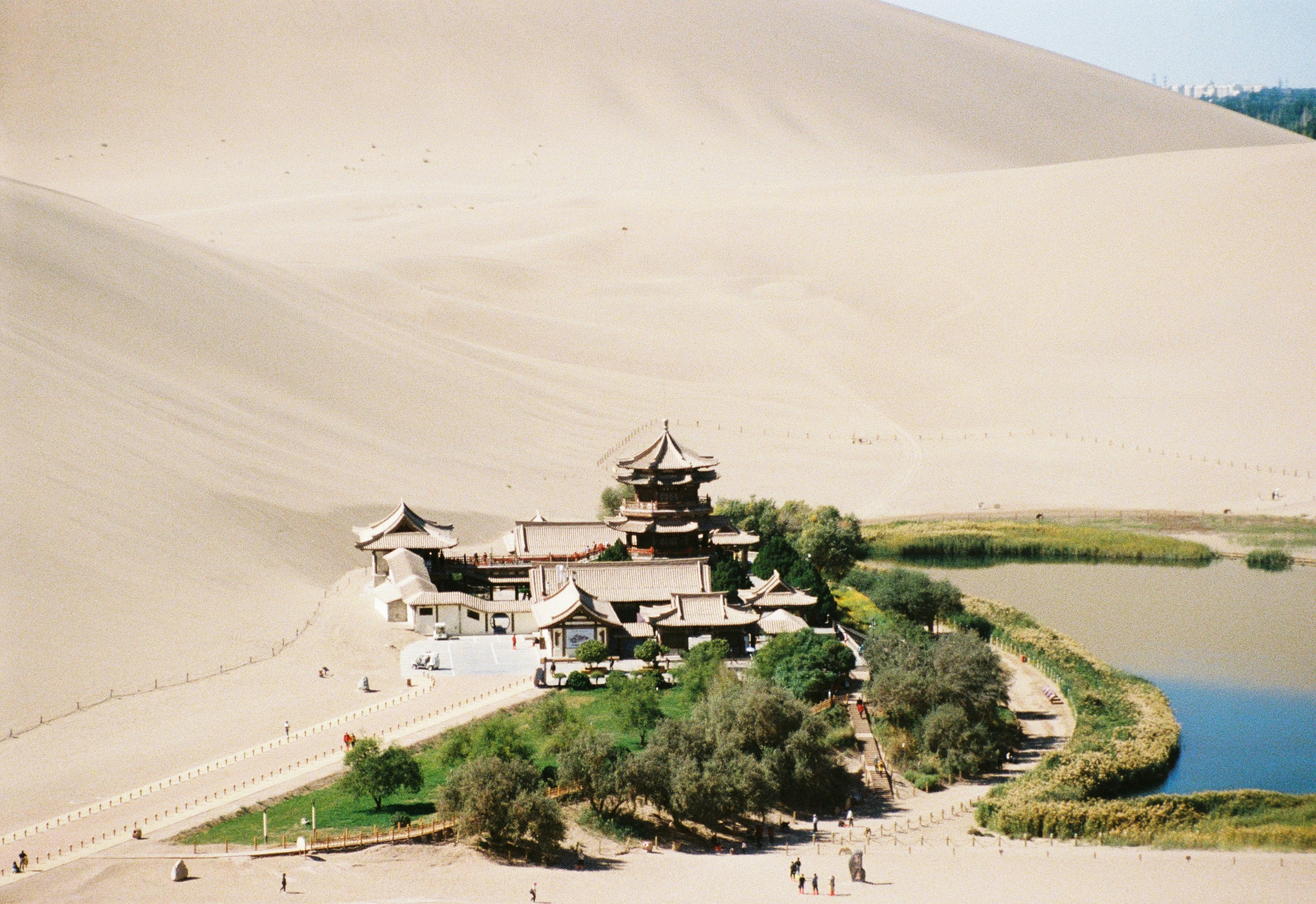
The pool is fed by groundwater in the Dang River area surfacing in this hollow. Sand does not fill it mainly because of the shape of the ground: wind runs up the dunes on either side, meets above the crest and rises, carrying grain uphill rather than letting it fall into the pool. The wind shifts direction over the year, so sand circulates on the dunes instead of settling in the middle.
Crescent Lake
The spring sits at the bottom of the hollow, dunes on every side; the reeds and willows at its edge live off this one body of water.
The crest
Windward face gentle, lee face steep. You feel the difference in the two slopes underfoot.
Yuequan Pavilion
A group of four-storey halls with upswept eaves on the north bank, lit at night.
Look west from the crest and the water makes a whole crescent, both tips hidden behind reeds.
The sound needs several conditions at once
When the sand is dry, round and roughly one size, a whole face can slump at once, and friction between grains produces a low frequency that arrives as distant thunder, or as an aircraft somewhere behind. The key word is together: a handful of sand sliding makes nothing, and it takes a large area moving at the same moment.
It does not sound after rain, and it does not sound on a face trampled firm, because the surface has set and cannot slide. How the sound is actually produced is still argued. The conditions are not.
The sound comes up through the feet
Sit on a crest and slide with the shins buried, and the sound arrives in the body: a low hum coming up through the soles and the thighs, still there for a moment after stopping. A hand laid flat on the surface feels a fine vibration as well.
Take a handful and spread it out: the grains are nearly all the same size, round, no corners. Sand like that slides as a sheet. The two faces of a crest differ steeply. The windward side is gentle enough to walk up; the lee side gives way under a step.
Dry sand and low sun decide what there is to see
The sand has to be dry to sound, and dry to shine. With the sun low the lit face is gold-red, the shaded face goes dark, and the crest becomes an edge. At noon the light comes straight down, the dunes lose their shadows and read flat.
A dune takes a step forward and half a step back, and climbing one takes half an hour or more.
In summer it is not dark until half past nine, and there are still people sitting on the crest. In spring the wind carries sand that stings the legs and keeps the eyes shut.
Since 2000 the spring has been kept up by seepage and the wells around it were shut. A railing now runs along the water; you pay the scenic-area ticket to come close.