Badain Jaran Desert
Dunes stand four and five hundred metres high, and more than a hundred lakes sit between them, reeds at the edge.
Badain Jaran is in Alxa Right Banner, Inner Mongolia: 49,200 square kilometres, the third largest desert in China. The sand is not low ripple but dunes rising past 400 metres, with thin crests. Between them are hollows holding more than a hundred lakes, most of them salt, none of them dry in winter.
- Region
- Inner Mongolia · Alxa
- Area
- 49,200 km²
- Dunes
- Bilutu, 460 m from base to crest
- Lakes
- 144 basins, twelve of them fresh
- Listed
- 2024, World Natural Heritage
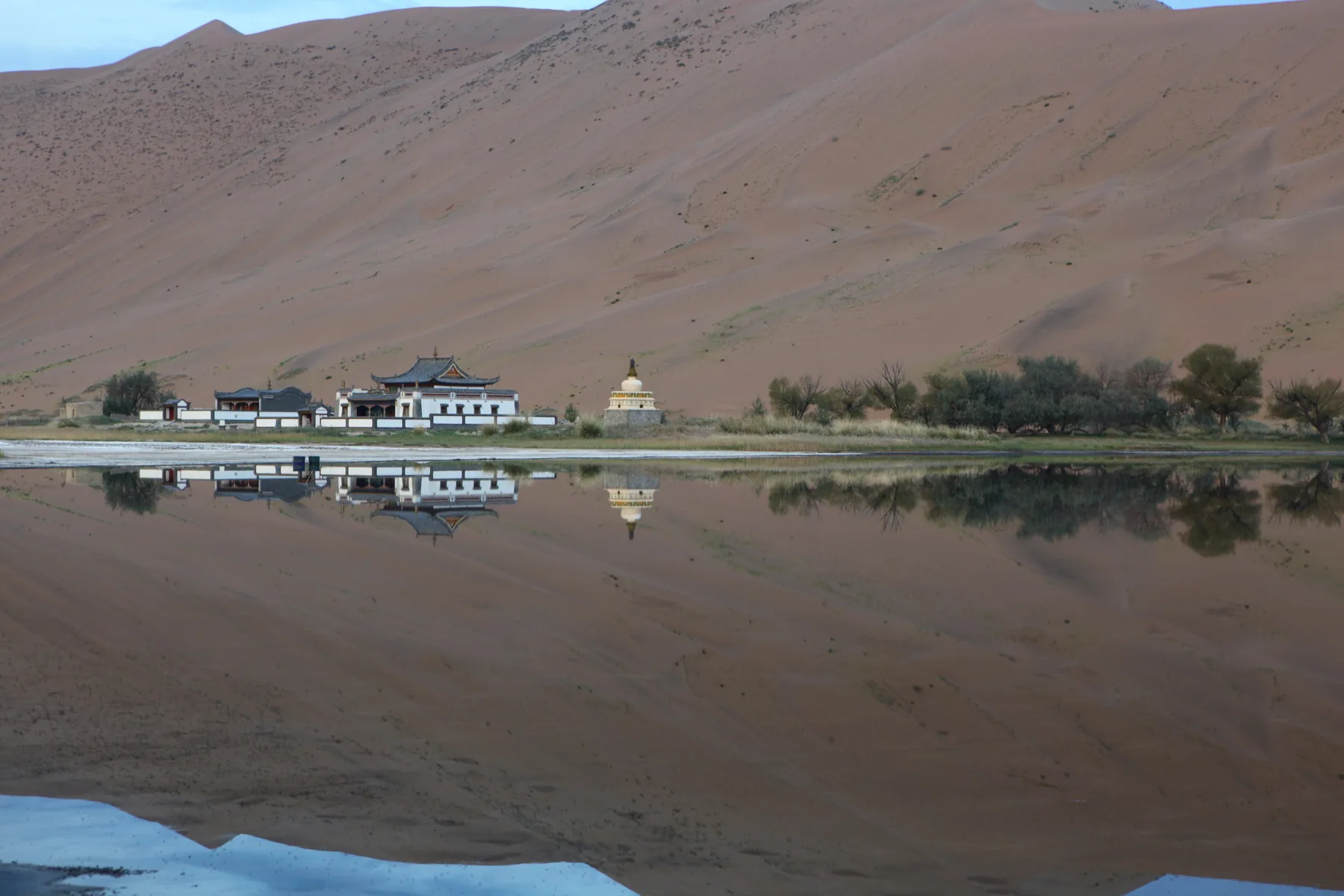
Grain comes off the gobi and the dry riverbeds; the north-west wind drives it until the ground slows and it piles. A lake lasts between dunes because the hollow has already been cut below the water table. Where that water comes from is still argued. One account has rain on the Qilian Mountains sinking, travelling along deep faults, and surfacing at the lowest points here.
Bilutu
Over 400 metres of relative height, the highest dune here, with a crest as thin as a blade.
Sumin Jaran and the temple
A white Tibetan Buddhist temple on the shore, finished in 1755, its brick and timber carried in by camel.
Yinderitu spring
Freshwater eyes come up through one rock in a salt lake. The lake and the spring run opposite.
Sand underfoot, sand on every side, and one or two lakes catching the light below.
The dune grows this tall because there is water under it
Dunes elsewhere top out at a few tens of metres. Higher than that, wind carries away more than it brings. These reach 400 metres because the hollows between them are cut below the water table: the sand at the foot stays wet, wet sand holds, the wind cannot take it, and the dune grows up off a base that will not shift. Dune and lake are one system. The lake stays, so the dune stands.
A sharp crest is the work of dry sand. Above the crest line the sand is dry and slides the moment wind crosses it, and the slide settles a little over thirty degrees, so the lee face always sits at that angle while the windward face runs far gentler. One dune, two slopes.
A white ring at the shore, ripples on the crest
At the lake edge the first thing is the white band. Where the water has drawn back, salt is left as a crust that breaks underfoot. The smaller the lake and the fewer its outlets, the wider the band.
Across the crest run ripples a hand’s width apart, laid by wind. Climbing, the foot breaks a thin crust with loose dry sand beneath. Night moisture binds that surface and the sun takes it off again.
The Yinderitu spring comes up through a rock in the middle of a lake. From the shore a small circle of paler water sits around the rock, and the lake deepens beyond it. Fresh and salt do not mix. The fresh floats.
Half the colour of the sand is the light
At first light the sand is grey-yellow and shows no red. As the sun climbs, the grain surfaces catch it and the whole field goes pale. At a low angle the lit side is gold-red and the shaded side nearly black, and the crest becomes an edge. At noon the surface is too hot to stand on through a sole.
On a windy day there is no crest line, only a moving yellow. Bilutu takes an hour or two from the foot, with no shade on the way and no water but what is carried in.
There is no road between the dunes. You go in by four-wheel drive with a driver who knows the sand, and only a few of the basins have a stopping point.