Hulunbuir Grassland
The Greater Khingan takes the last of the moisture, the grass grows to the knee, and the river doubles back across it.
The Hulunbuir grassland lies on the west side of the Greater Khingan, tilting gently toward the Mongolian plateau. Nothing blocks the view; the rises are slight, the grass stands to the calf, and when wind crosses a slope the whole slope lies down together. Most grazing is now allocated to households and there are fences, but a single paddock can run to a thousand mu, which is why it still reads as open.
- Region
- Inner Mongolia · Hulunbuir
- Grassland
- About 90,000 km²
- Rainfall
- 300-400 mm a year
- Leymus
- The main grass; its rhizomes run underground
- Haying
- Begins in late August
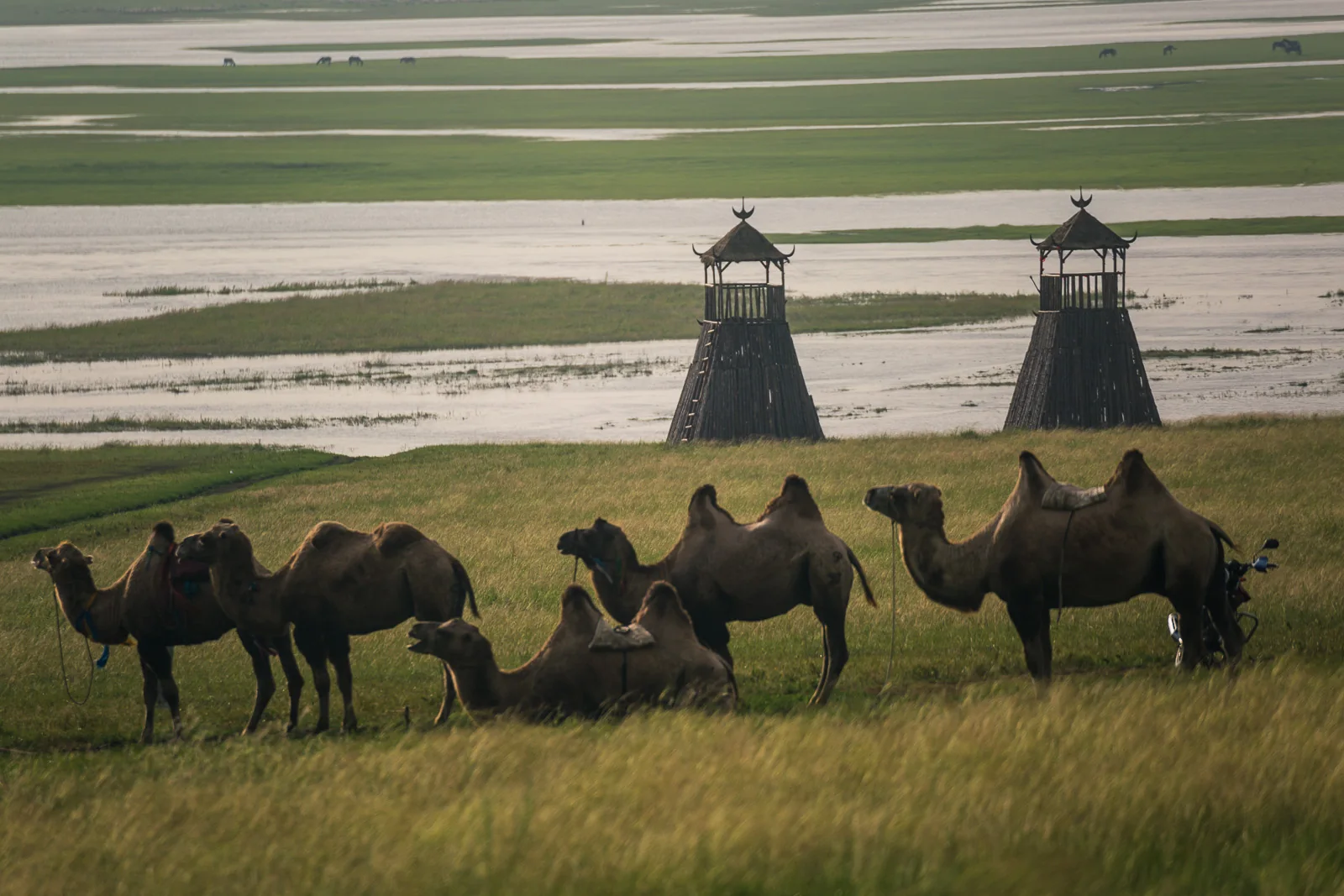
Pacific monsoon air is close to dry by the time it reaches the Greater Khingan, and what is left falls on the west slope as a few good rains each summer. Grass grows, winter stops the decay, and one year of dead growth is pressed under the next, which is how the black soil got this thick. Trees fail here for want of rain, and also because winter wind scours the snow off and the seedlings freeze above ground.
Mergel River
It doubles back and forth across the grass at Chen Barag, bending tightly, and the banks are low, so when it rises it simply spreads.
Genhe wetland
The river splits and rejoins here, and the loops fill with red willow and tussock grass.
Argun River
The border with Russia. Narrow enough to see the trees on the far side and the roofs of the villages.
From up there the channel has cut whole circles into the grass, and the water in them barely moves.
The grass spends its effort underground
The part of this grass that stands above ground dies every year. Leymus runs sideways on underground rhizomes, and a node pushes up a new tuft; needlegrass grows in bunches whose roots knot together, holding soil and taking water first. Whatever is cut above, the underground part stays and comes back from the root next spring. Over a few thousand years the dead roots and stems have built tens of centimetres of black soil.
Trees cannot hold here for two reasons. Three or four hundred millimetres of rain is enough for grass and not enough for a tree to transpire; and winter wind takes the snow away and leaves bare ground, so a seedling freezes before it is tall enough to survive. This is grassland, not forest, and the line is drawn by water.
Where a road is cut, the soil is black
There is no hill to read a section from, so the section is wherever a road has been cut. On a highway cutting the top thirty or forty centimetres are black and crumble in the hand with grass root through them; below that the colour turns yellow at once, subsoil the grass has never worked. One face shows how deep the grass has been.
Fences show something else. On the same ground the grass inside differs from the grass outside by a finger’s width or a hand’s, depending on how many animals have been kept there. The blade carries a groove down its length and rolls up in dry weather, hiding the stomata inside.
When the wind comes, the whole slope goes over
With no wind the grass stands, and the awns catch the low sun in a sheet of thin white. When wind comes the slope goes over from near to far, all in the same direction, and looks like water moving. When it stops, the grass springs back one stem at a time.
Cutting starts at the end of August. The grass is laid out to dry, turned once, rolled into bales and stacked at the roadside, and that is the winter’s feed. After cutting the colour goes from green to yellow with nothing in between. September mornings bring mist, and the bales are only outlines in it. Temperature falls fast after dark, and a thick quilt is needed even in summer.
Since 2000 the pasture has been fenced household by household, grazing retired from worn ground, and hay cut by machine. Herders settled, and yurts now mostly appear at summer camps for visitors.