Pingyao
Six kilometres of wall around a county town where, in the Qing, silver was counted and never carried.
Pingyao sits on the loess plain of central Shanxi. The wall runs a little over six kilometres, twelve metres high, brick outside and rammed earth within. Inside are four main streets, eight lanes and seventy-two alleys, stone paved, with high brick courtyard houses on both sides. The temples at Shuanglin and Zhenguo stand on the same loess outside the wall.
- Region
- Shanxi · Jinzhong
- Wall
- 6.4 km around, about 12 m high
- Rebuilt
- 1370, third year of Hongwu
- Draft bank
- Rishengchang, opened 1823
- Listed
- 1997, World Cultural Heritage
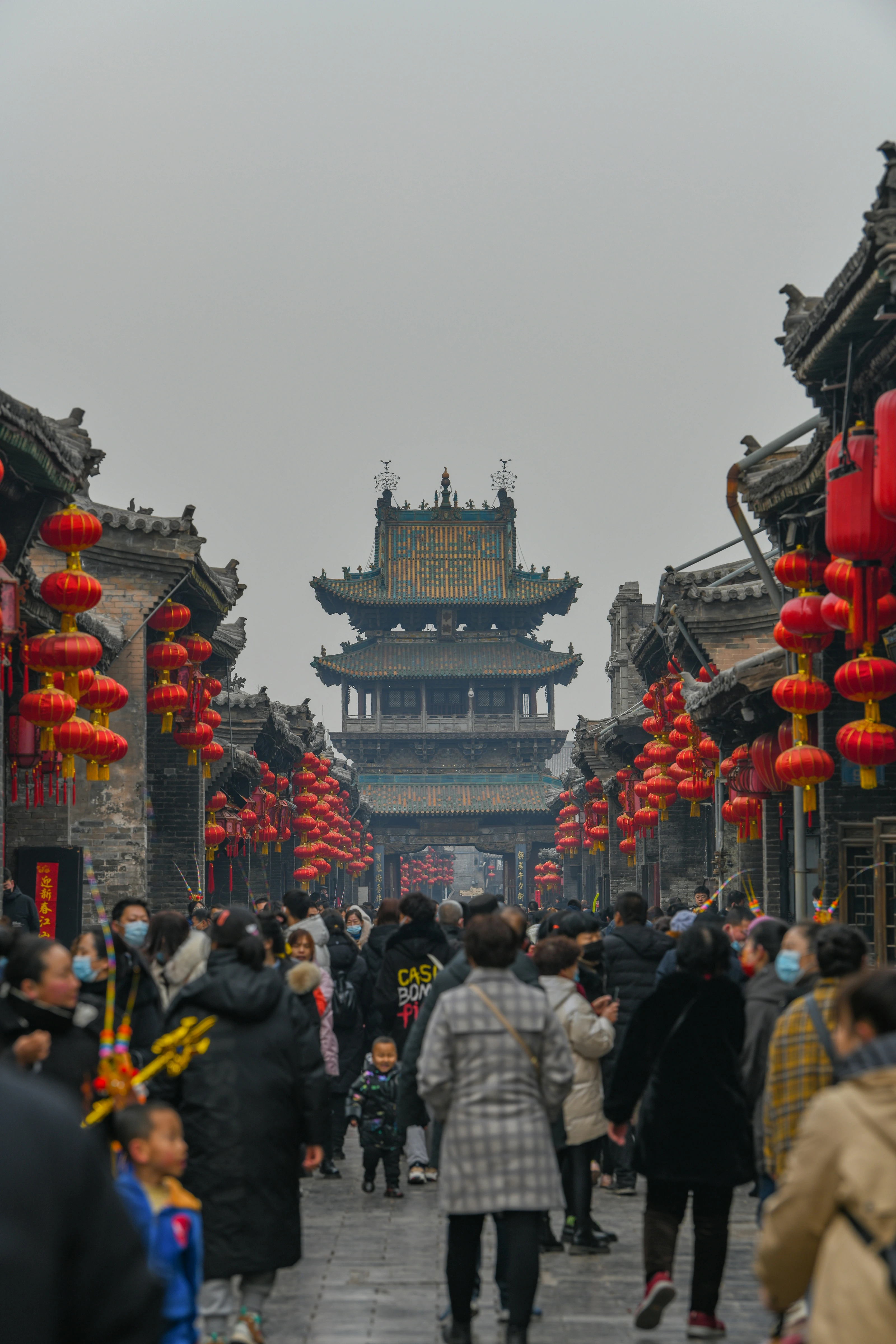
The town survived partly by luck. When the Zhengtai railway was built at the end of the Qing, the line ran south of here and Pingyao was left out of the modern rebuild. By the 1980s the county had no money to demolish and rebuild, so the old houses stayed up. World Heritage listing in 1997 is what turned preservation into a budget line. Nobody set out to save the town. It was bypassed first and recognised later.
Rishengchang
A shopfront in three courtyards, with a low counter and the counting house behind. The well in the yard has niches cut in the shaft, where silver was kept.
The wall
The top is wide enough for several people abreast, with seventy-two watchtowers and three thousand crenellations.
The county yamen
Main hall, second hall, living quarters and jail on one axis. One walk through explains how a county ran.
Tiled roofs on tiled roofs, hardly a tree, and every ridge at much the same height.
The wall is earth, the brick is a coat
The wall is not solid brick. Inside is rammed earth, laid in lifts of ten or twenty centimetres with lime between and chopped straw mixed in, pounded with a wooden tamper. Outside is a skin of blue brick, with broken brick packed between skin and core. The brick keeps rain off; the earth carries the load.
The top is paved, with parapets on both sides, and the fall leads water into a gutter at the foot. So when a wall fails it is usually the skin that bulges and drops while the core still stands. Repair means taking the skin off, ramming again, and laying the brick back. The method is common across the north. Pingyao’s advantage is six kilometres of it without a break.
The earth at the foot is a different colour
At the foot of one stretch near the south gate the new earth is paler than the old and coarser, and it is plain which part was filled later. Where nothing has been repaired the rammed lifts run in level lines, soft enough to score with a knife.
The top of the wall is wide enough for several people abreast. There are seventy-two bastions and three thousand crenellations, numbers fixed when the wall was built and not added to since.
The counter at Rishengchang is low, and its top is visible from the street. Three courtyards run back from it, with the accounts office at the far end, darker than the street because that is the light the work wanted. In the courtyard well, holes are cut into the shaft lining. The silver went in there.
Light decides the colour of stone and brick
The flagstones have been walked for centuries and are lower in the middle than at the edges. In the morning the light comes in at an angle and lies thin and bright on them; at noon it comes straight down and the whole street is one flat grey. Brick is blue under cloud and warm in sun, and the difference is easy to see.
Winter dries the mortar and the joints shed grit. Autumn dries it too, at a temperature that lets a walk down the street stay dry. Early morning the street is empty, the shop boards are still up, and someone is throwing water down in front of a door.
Rain in October 2021 brought down stretches of rammed earth on the inner face; one section collapsed to its core. Repairs went in, and new earth does not match old, so the repaired lengths are visible.