Wudalianchi Volcanoes
Lava dammed a river into five lengths. The stone is black and the lakes come in a chain.
Wudalianchi is in western Heilongjiang, where the Lesser Khingan comes down to the Songnen plain. It is a young volcanic field: fourteen cones in two lines. Basalt that came out after 1719 ran for more than ten kilometres and cut the Bai River into five sections, and the five lakes are strung along what is left of it.
- Region
- Heilongjiang · Heihe
- Cones
- Fourteen
- Last eruption
- 1719-1721
- Lakes
- Five, strung along one river
- Listed
- 2004, Global Geopark
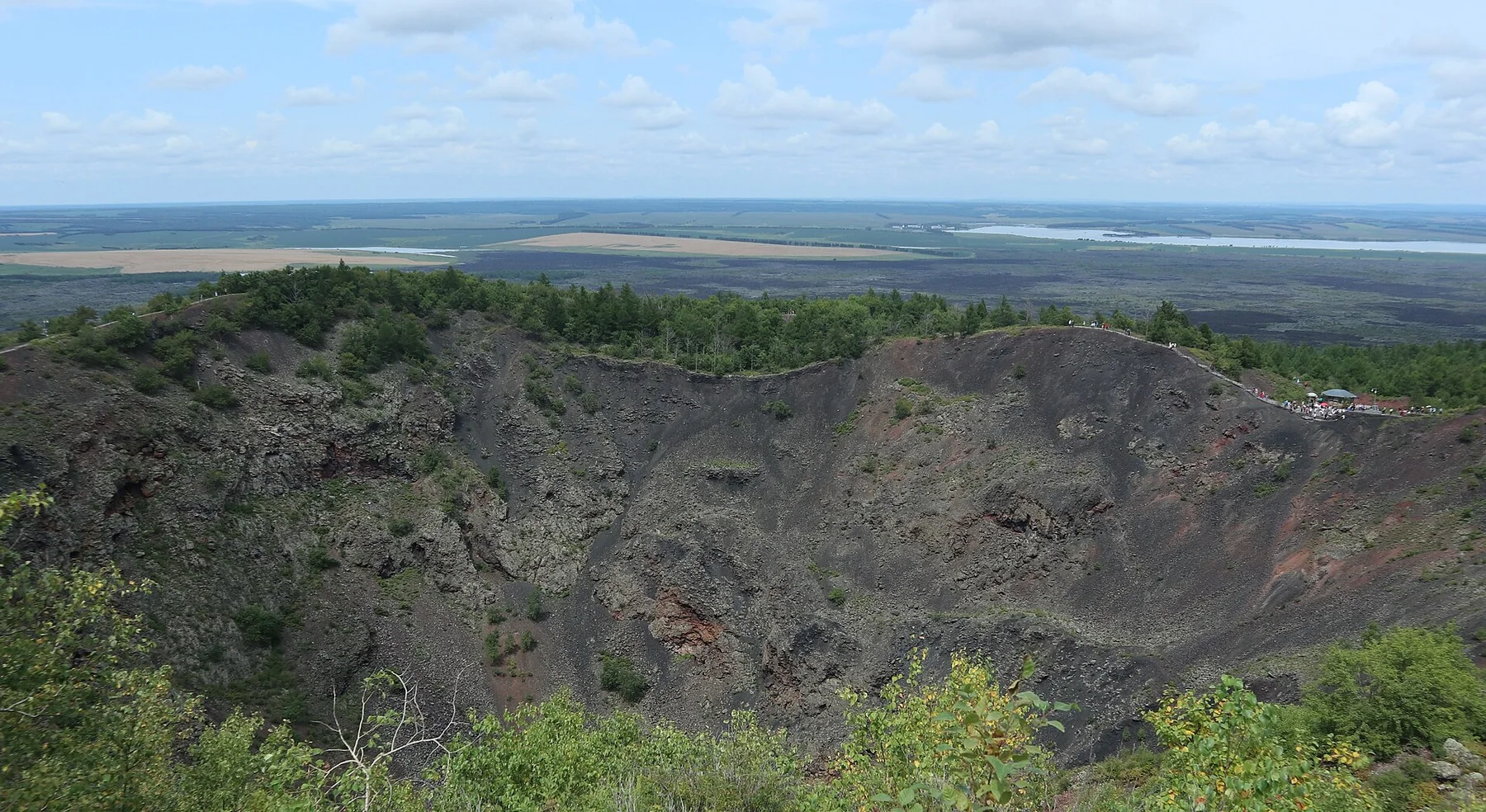
Laohuishan and Huoshaoshan erupted in turn between 1719 and 1721. Lava left the vent hot and fast, the surface chilled into a crust while the flow underneath kept pushing, and the crust was lifted, torn and rolled over. What cooled is what you walk on. The flow blocked the Bai, water could not get out, and it backed up section by section.
Laohuishan
The cone that erupted after 1719. The crater is intact and reads as a black bowl.
Longmen stone fortress
A field of blocky lava stacked into square masses, moss and fern in the gaps.
Wenbo
A stretch of spring that never freezes, steam on the water in winter and green moss underneath.
The crater is a funnel, its walls made of loose scree that slides underfoot, black stones at the bottom.
A crust that kept moving
Lava reaching the air skins over first. Underneath, the flow keeps pushing, and the push lifts the crust, tears it and rolls it over; it cools where it lands, which is why the field is covered in points facing up.
The points are called flower lava.
Slope decides the shape. On a steep pitch the lava is drawn into rope and left with crosswise ridges, one after another; on a gentle one it spreads into slabs whose cracks run straight down. The shape of the stone reads out the tilt of the ground it crossed.
The spines lean the way the lava went
The spines are not random. Most lean one way, and that was the direction of flow, so a whole field leaning together means the field came out in one run.
It sounds underfoot. The crust is a few centimetres thick with a void beneath, so a step crushes the fragments against each other and they crack. Birch and azalea have already taken the cracks, low trees with their roots in the rubble.
On ropy lava the ridges curve upstream, the way water ripples do, except that what ran here was stone.
Black rock takes the heat
Basalt is black. In summer the sun makes the surface hot enough to feel through a sole, and standing on it for a while heats the feet. Winter reverses it: snow covers the stone field and the cones come out of the white as outlines.
The springs at Wenbo do not freeze. The colder the air, the clearer the steam on the water, and the moss underneath stays green. The rim of the crater is windy enough that standing is difficult and crouching is easier.
The mineral water stays at a few degrees all year: it bites in summer and feels mild in winter. The gas comes out of it, so a cup fizzes and takes a ring of rust-brown on the inside within minutes.
Mineral water was bottled at scale for years; extraction has been tightened since the 2010s. The paths worn up the cones are closed and replaced by boardwalks.