Hailuogou Glacier
The glacier on the east face of Gongga comes down to 2,800 metres and ends inside the fir forest.
Hailuogou is a valley on the east side of Gongga, in western Sichuan. The main peak is 7,556 metres, the valley floor is around 2,000, and the whole drop is used up in a few kilometres. The glacier comes off the summit, runs the length of the valley and stops at roughly 2,800 metres, in the trees.
- Region
- Sichuan · Garzê
- Glacier snout
- About 2,850 m
- Length
- About 13 km
- Icefall
- About 1,080 m high
- Aspect
- East slope of Gongga
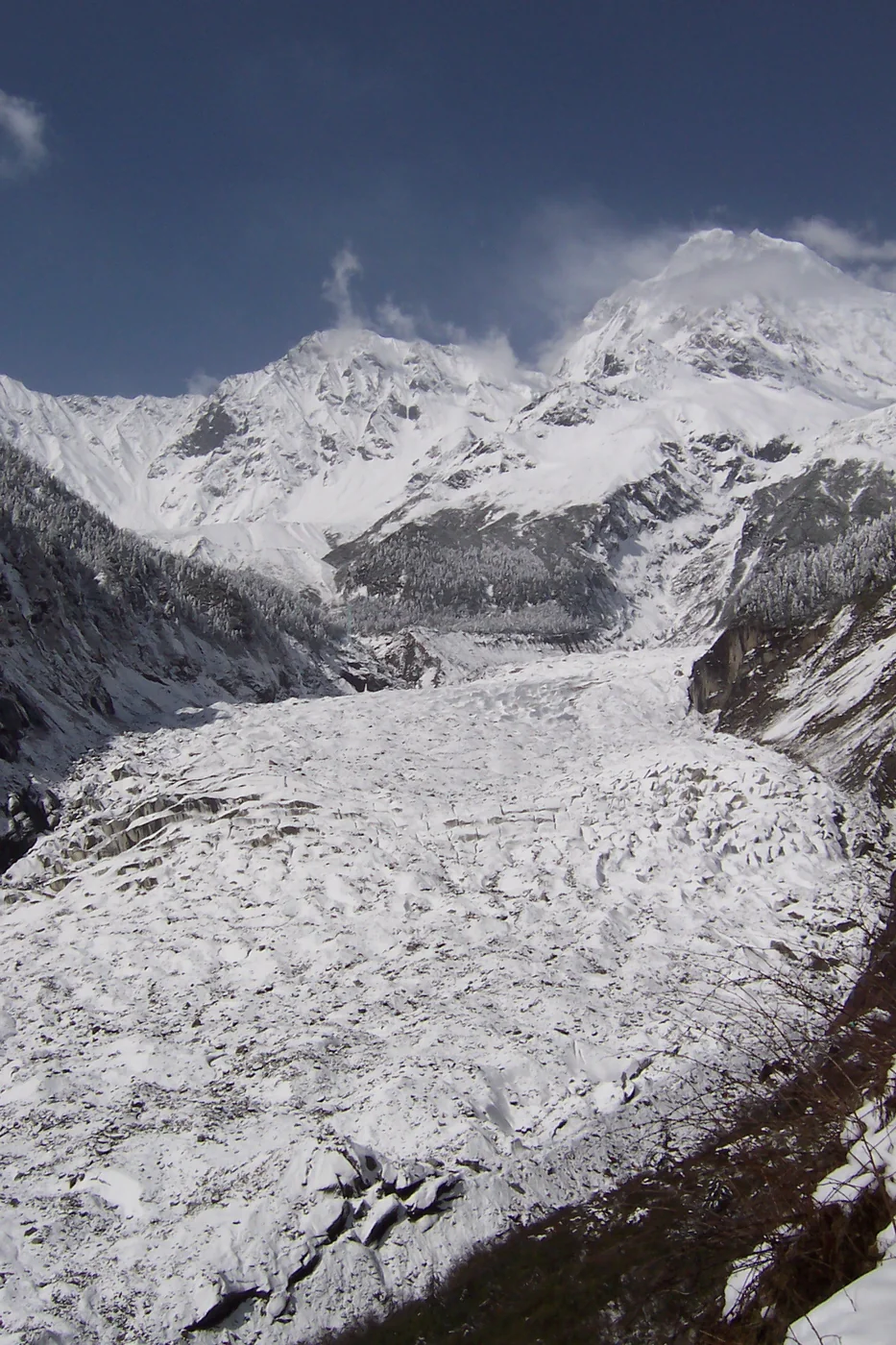
Warm wet air from the Indian Ocean comes north up the Dadu valley, is forced up the east face of Gongga, and leaves far more snow than other mountains at this latitude get. Deep snow makes heavy ice, heavy enough that the pressure at the base brings it to melting point, and with a film of water under it the glacier slides. Fast ice travels further. Other glaciers stop near the snowline; this one walks into the forest.
Great Icefall
Over a thousand metres of ice on a steep step, breaking off in blocks and packing again below.
Glacier tongue
The end of the ice, under a skin of rubble. From a distance it looks like a grey scree slope; close up it is ice.
The springs at Camp Two
Pools built into the fir forest, filled from below, with snow at the edge.
Close enough to hear the ice break, a muffled crack every few seconds, on no schedule.
Ice slides because there is water under it
A glacier looks solid and moves like something very thick. Gravity is not the only thing taking it down; meltwater underneath is. Snow piles up year after year, the ice at the base is pressed to melting point, a film of water appears between ice and rock, and the whole glacier slides on it. Hailuogou gets a great deal of snow, the ice is thick, there is more of that water, and it moves fast: tens of metres a year.
Where the end stops is where supply and melt balance. If the ice arrives faster than it can melt, it keeps going down to 2,800 metres and into the trees.
The rubble on the end helps. It covers the ice, keeps the sun off, and what is beneath goes slowly, so the tongue reaches a little further.
Grey stones underfoot, ice under the stone
At the glacier tongue the ground is a grey field of stones with no ice in sight. Lift one and there is ice under it, with a layer of wet mud in between. The rubble comes down from above: a layer of ice melts, a layer of stone settles on what is left, and the tongue ends up buried under its own luggage.
The icefall is the opposite, with everything showing. Ice breaks off the step, smashes at the bottom, and is packed and recrystallised by the weight above, so the ice below carries fewer bubbles and reads deeper in colour than the ice above. The breaking does not stop. A muffled crack comes at no fixed interval, and it arrives after the ice has already moved.
Cloud comes up the valley and takes the fall
In the morning the valley is still empty, the icefall hangs whole, and the fracture faces and the blue are clear. In the afternoon cloud comes up off the floor of the gorge, eats the lower half first, then the rest, until there is only white.
Melting ice leaves the stones loose, and a stone will slide underfoot. In snow season the edges of crevasses are covered, and nothing shows where the gap is. The hot spring at Camp Two sits in fir forest with snow still at the edge of the pool: the water is hot, and hair freezes on the way out.
The Luding earthquake of September 2022 wrecked the road and the hotels in the valley, and the park closed for more than a year. It reopened on 12 December 2023, at first one stretch of the glacier forest park only, with 500 visitors a day.