Huangshan
Granite cut by water into columns, and pines growing in the cracks.
Huangshan is in southern Anhui, one block of granite lifted up. The rock carries sets of parallel vertical joints; water works down them and cuts the mass into columns and ridges. The pines do not grow in soil. They grow in the fissures, and the roots follow the crack.
- Region
- Anhui · Huangshan
- Summit
- Lotus Peak, 1,864 m
- Rock
- Granite, intruded about 120 million years ago
- Pine
- Huangshan pine, rooted in cracks
- Listed
- 1990, World Cultural and Natural Heritage
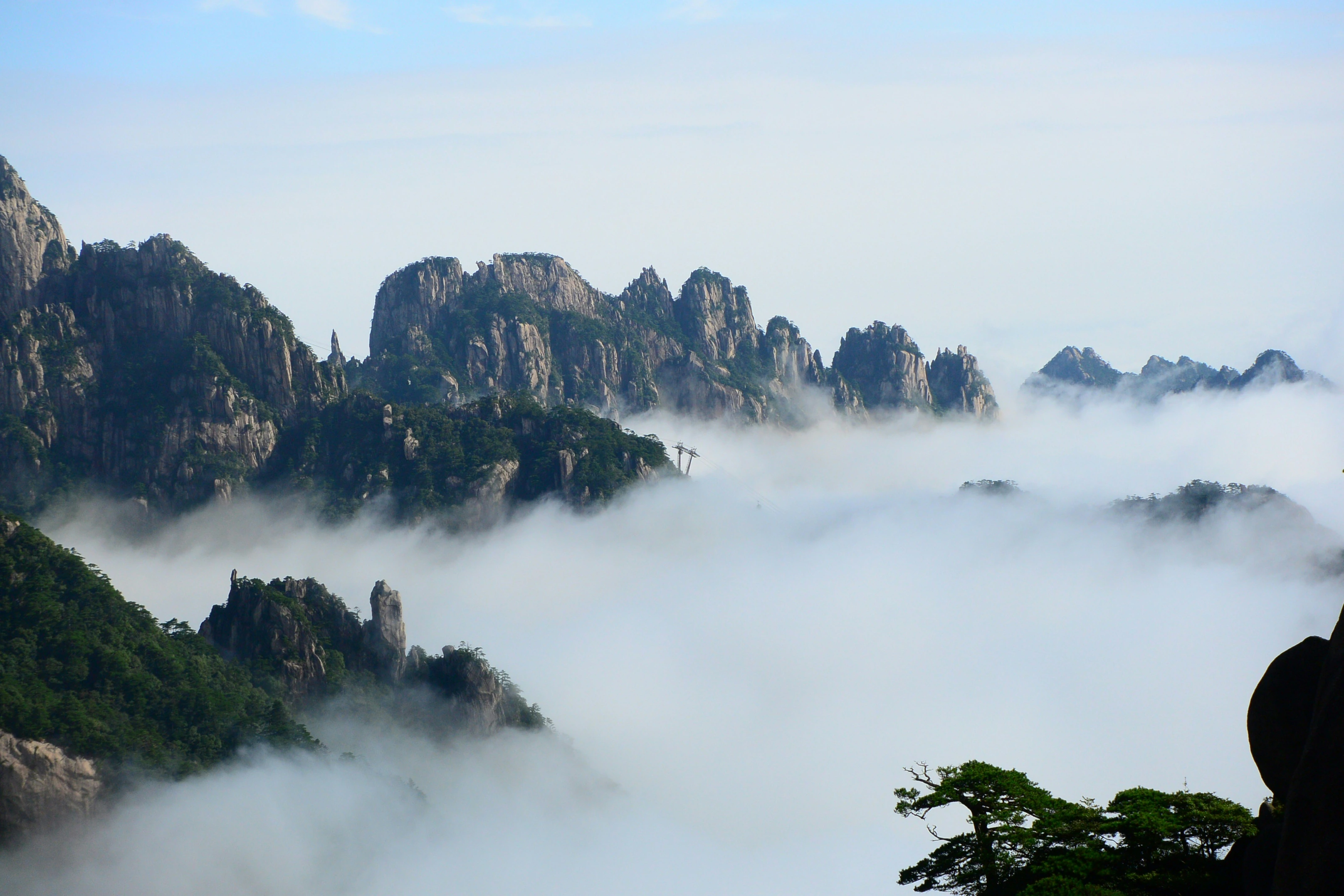
Granite is magma that cooled underground. Cooling contracts, and contraction is uneven, so the rock cracked along several sets of parallel planes. Underground those cracks were held shut by the weight above. When the mountain rose and the cover was stripped off, the pressure came off and the cracks opened. Water went in, froze each winter, widened them a little each year, and after long enough the mass was cut into upright columns. The debris went downstream long ago.
The granite peaks
Lianhua and Tiandu are columns of rock with near-vertical walls, cut by horizontal unloading joints.
Huangshan pine
Roots in a fissure, crown leaning one way, shaped by wind that blows from the same quarter all year.
Cloud sea
Cloud spread in a layer around a thousand metres, with summits standing out of it. How many you see depends on the height that day.
Cloud runs below you, and the summits above it come one at a time, floating.
The cracks were the rock’s own doing
Granite cools slowly, deep underground, and it shrinks as it cools. The shrinking happens in several directions at once and cracks the mass into sets of planes at right angles to one another, one set near vertical, one near horizontal. Underground those planes are clamped shut by everything above and cannot be seen. When the mountain rises and kilometres of rock come off the top, the clamp is released and the planes open into joints.
Water gets in. In winter it freezes, ice takes more room than water, and the joint widens a little; it thaws, refills, freezes again. A hairline a year, over a few million years, cuts the block into towers, and the water carries the debris away between them. The peaks that look stacked by hand were cut out of one piece of stone.
A patch of black soil in the crack
At the mouth of a fissure under a pine there is often a small patch of black soil that crumbles between the fingers. It did not blow in. The tree made it. Roots run metres down the crack and take the whole of it; acids off the roots break down feldspar a little at a time, and the needles rot back into what is left. The pine arrives first and the soil starts after it.
Every crown leans the same way, and only the sheltered side keeps its branches. Across the rock face run shallow horizontal grooves where the unloading joints have opened, crossing the vertical joints and cutting the surface into blocks. At the foot of each tower lie fallen slabs with their corners still sharp.
The height of the cloud decides what there is to see
The cloud sea is not a special kind of cloud. It is cloud whose base happens to sit at about a thousand metres. If the base is above the summits, the summits are inside it and there is nothing to see. If the base is below the ridge, the mountain stands clear and there is no sea either. Only when the base stops in between do the peaks float, and how many of them show depends on how thick the cloud is that day.
That is not something a walker arranges. A morning after rain gives better odds, and a morning after rain can also be a white mountain. Wet stone steps are slippery, and in winter they ice over and want straw sandals. There is little room to sleep up top, so sunrise means walking up in the dark.
Lotus Peak and Heavenly Capital Peak close in turn, five years each, to let the steps and the plants recover. Since the West Sea funicular opened, fewer people walk the whole gorge, and the floor is quieter.