Mount Tai
A 1,500-metre mass of stone at the edge of the North China Plain, with more than six thousand steps from the foot to the top.
Mount Tai stands in central Shandong. North of it are low hills; south of it the North China Plain begins almost at once. The main peak, Yuhuang Ding, is 1,532 metres, and from the Dai Temple at the foot the rise is more than 1,300. Stone steps start at Red Gate and run all the way up. The steepest stretch is called the Eighteen Bends.
- Region
- Shandong · Tai'an
- Summit
- Jade Emperor Peak, 1,532 m
- Stairs
- 6,293 from Red Gate to the top
- Inscriptions
- More than 1,800
- Listed
- 1987, World Cultural and Natural Heritage
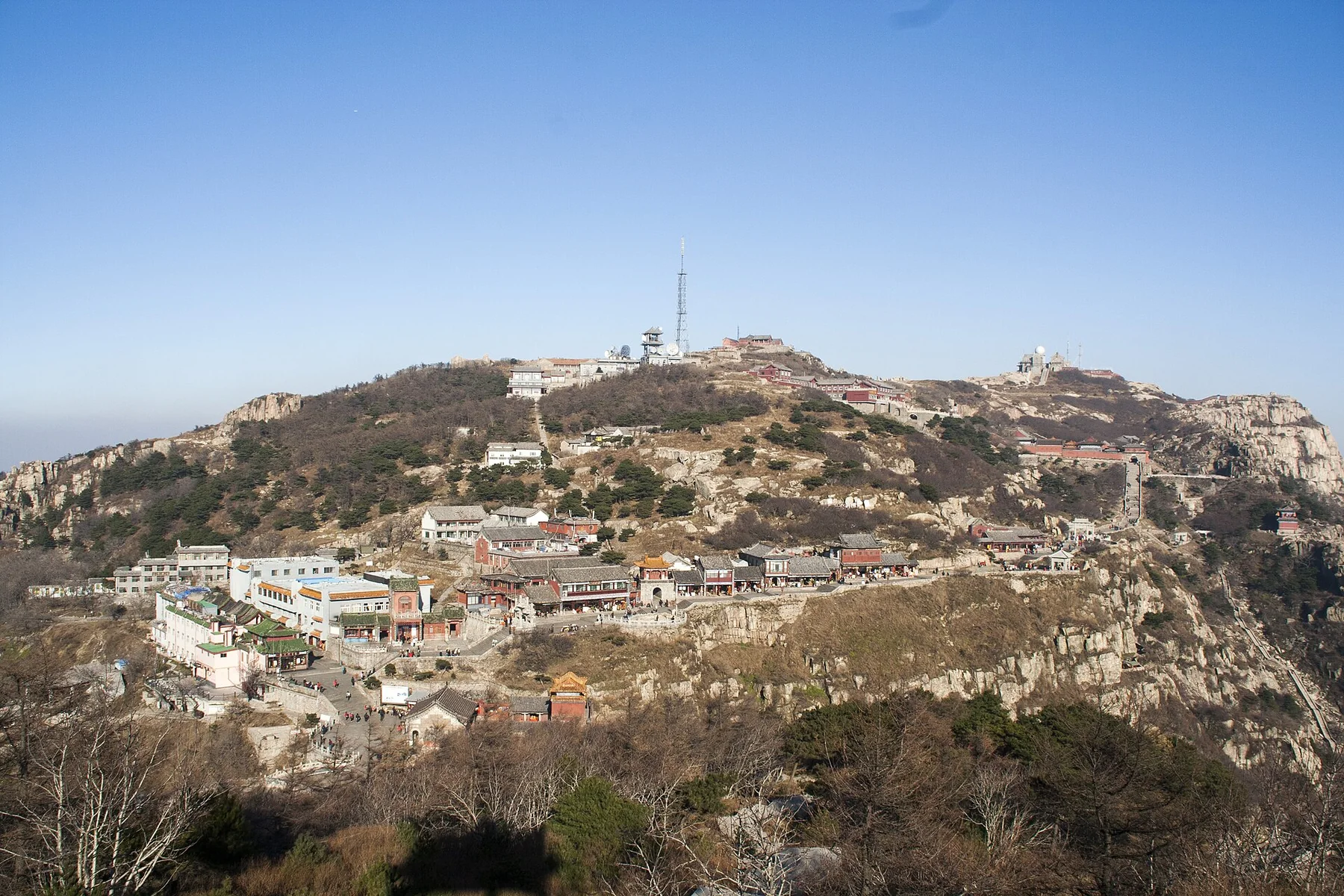
Tai is a block of old rock lifted out of the North China platform, mostly metamorphic rock and granite more than two billion years old. A large fault runs along the south side. The block on one side went up, the other went down, and it kept doing so for a hundred million years. That is why the south face is a cliff and the north side is a long slope. It does not read as a mountain so much as a piece of ground pushed up.
Eighteen Bends
Under a kilometre for 400 metres of rise, sixteen hundred-odd steps, approaching seventy degrees at the steepest.
Sutra Stone Valley
The Diamond Sutra cut into one granite streambed by Northern Qi craftsmen, characters half a metre across, water running over them.
South Heaven Gate
A red gatehouse pinned in the saddle between two peaks. Past it, you are on top.
Steep enough that you hold the chain at the side. Look back and you see the tops of the heads below you.
One side lifted, the other sank
The plain is sinking and the mountain is rising, and the two happen at once. The fault on the south side behaves like a gate: the ground on this side climbs a few millimetres a year, the ground beyond it drops, and the difference has accumulated past a kilometre. So the south face is a fault scarp with no transition, and the north side steps down in shelves.
The rock is hard as well, metamorphics and granite over two billion years old, and it does not weather quickly, so once it was up it kept its profile. The low hills nearby are the same rock with less lift, or softer beds, and they went down first.
Chisel marks are still in the steps
The steps were cut, hauled and laid, not worn into being. The treads still carry the slant of the chisel, and the edge of each step is worn higher than the middle: centuries of feet on one line cut a shallow channel in the stone.
On the Eighteen Bends the iron chain is polished bright by hands and reads darker than the rock beside it. The characters in Sutra Stone Valley have had water running over them for a thousand years and are clearer for it, because a groove does not wash away. Stone outlasts paper, and it also shows where later hands have made repairs.
The mountain at night is a different mountain
Night walkers leave from Red Gate, and their torches string out along the steps in a broken line. There is no mountain to see, only the heels of the person in front.
The summit runs more than ten degrees colder than the valley, and the wind is steady. People waiting for sunrise pack against a wall, and the rented coats pile up together.
Whether the sun shows depends on cloud along the eastern horizon. With some cloud the sky reddens first and the sun comes out of it minutes late; with thick cloud there is only a brightening. The descent costs more than the climb: six thousand steps, one drop each, and legs shaking at the bottom. Above Midway Gate a cable car takes half of it off.
A cable car arrived in the 1980s and now carries people above Mid-Heaven Gate. The stone steps have been replaced many times; the gradient never changes.