Yading
Three snow peaks of about six thousand metres stand in a triangle, with meadow and moraine lakes below.
Yading is in the south of Daocheng County, western Sichuan, in the southern Shaluli range. Xiannairi, Yangmaiyong and Xianuoduoji stand in a triangle, the highest of them at 6,032 metres, with meadow and streams at four thousand between them. Several lakes lie on the valley floor, all of them left by ice.
- Region
- Sichuan · Garzê
- Peaks
- Xiannairi 6,032 m; Yangmaiyong and Xianuoduoji 5,958 m
- Pasture
- Luorong, about 4,180 m
- Faith
- The three protectors of Tibetan Buddhism
- Location
- Yading village, Daocheng
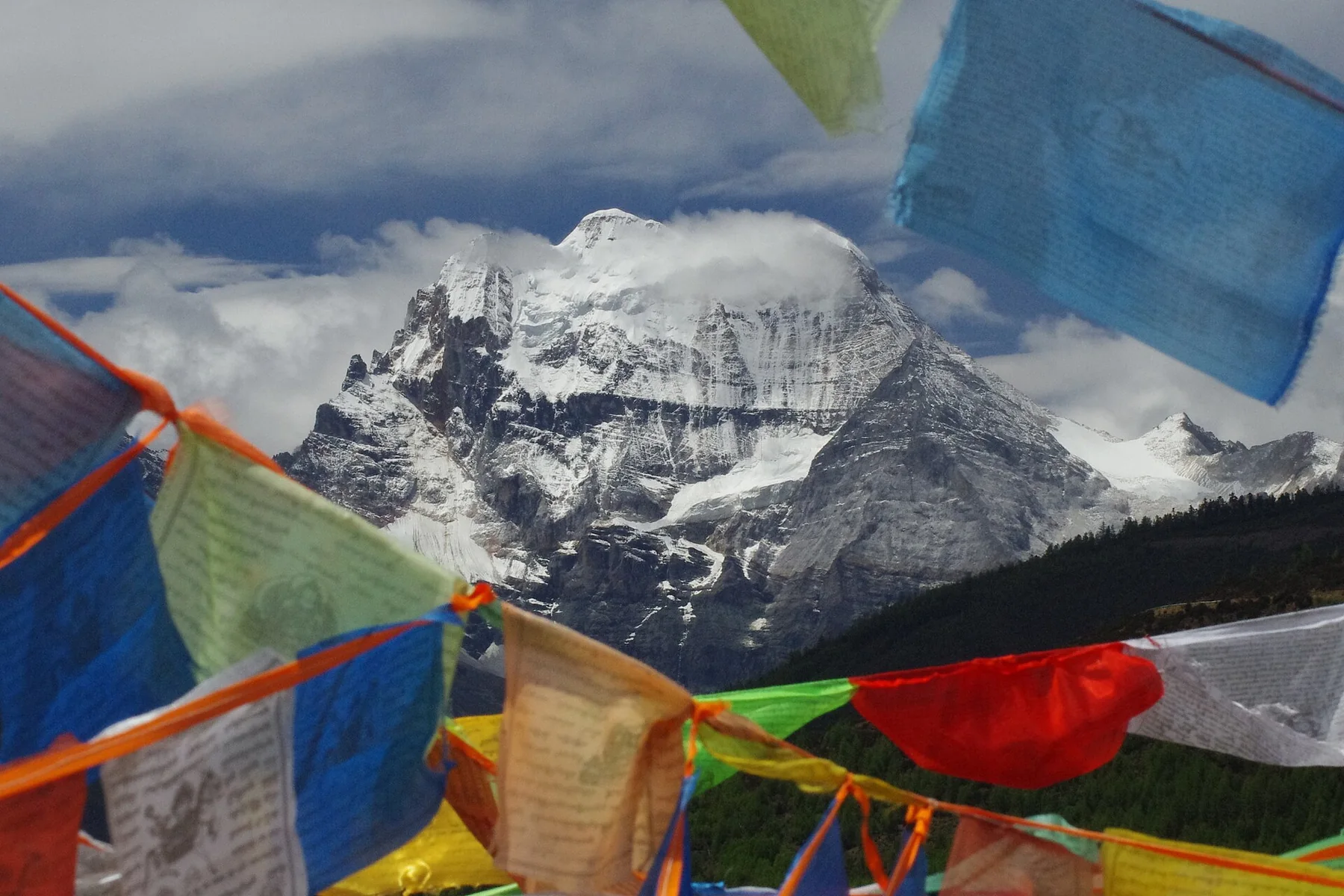
The ground was lifted high enough, and was cold enough, to carry large glaciers. Ice moving down the valleys ground the mountain into arêtes and horns, hollowed the floors into U shapes and dropped moraine at the mouths. When the ice left, moraine held the drainage back and the hollows filled. The shape of the three peaks is ice, cut away face by face.
Milk Lake
At 4,500 metres, with a ring of white deposit at the shore and water that is green-blue and opaque.
Five Colour Lake
In the hollow above Milk Lake. Shallow, with gravel underneath, so it changes colour when the light does.
Chonggu monastery
The old monastery at the foot of Xiannairi, tin roof, gilded top very small against the snow.
The stream splits across the grass and Yangmaiyong's snow wall stands straight ahead, with nothing in between.
Ice sharpens a summit
Ice does not come down one channel; it comes down several at once. Two glaciers side by side grind their own valleys, take the rock between them away, and leave a thin wall: an arête. Where several of those meet, the intersection is a horn. The three peaks are triangular cones because at least three glaciers worked each of them from different sides.
The floor was ground as well. Where ice has passed, the valley is U-shaped, walls straight and bottom flat, which is not what water cuts. When the ice withdrew, the blocks it had carried piled up across the mouth, water backed up behind them, and the lakes on the valley floor are what filled the hollows.
The white ring at the shore is not snow
Milk Lake is opaque. A glacier grinds its bed into a very fine flour and carries it out with the melt; the particles stay suspended, scatter the light, and the water stops being transparent, turning from blue to milky green. The name came from that colour.
The white ring at the shore is not snow either. It is rock flour and lime settling at the edge. Five Colour Lake lies one step above, shallow, gravel on the bottom and little suspended material, so its colour comes from the sky and the floor: the same lake is two colours before and after noon.
A few boulders stand scattered on the meadow with no relation to the rock around them. The ice carried them, the ice went, and the stones stayed.
When cloud takes the summits, the mountain is something else
The three summits carry cloud most of the time. In the wet months they may open several times in a day, for minutes each, with cloud coming over the ridge behind them, taking the highest first and then pressing down.
Above 4,000 metres, walking is counted in steps. The climb from the pasture to Milk Lake gains three hundred metres and takes two hours and more where it would take one: ten steps, a stop, ten more. Cloud builds fast in the afternoon, so people who go up in the morning come down inside it.
Vehicles transfer at Shangri-La town, with a daily cap in high season. There is no lodging above the pasture; you walk in and out the same day.