Zhangjiajie
Stone columns stand one after another along the valley floor, and trees still grow on top of them.
Wulingyuan lies in north-western Hunan, in Zhangjiajie. The mountains here are not a connected range but a set of separate columns: quartz sandstone was lifted, then cut apart by water along vertical joints, and what remains stands on the valley floor. You walk in the valley and look up at the tops of other people's columns.
- Region
- Hunan · Zhangjiajie
- Pillars
- Over 3,000, quartz sandstone
- High point
- Rabbit Watching the Moon, 1,264 m
- Pillars above 1,000 m
- 243
- Listed
- 1992, World Natural Heritage (Wulingyuan)
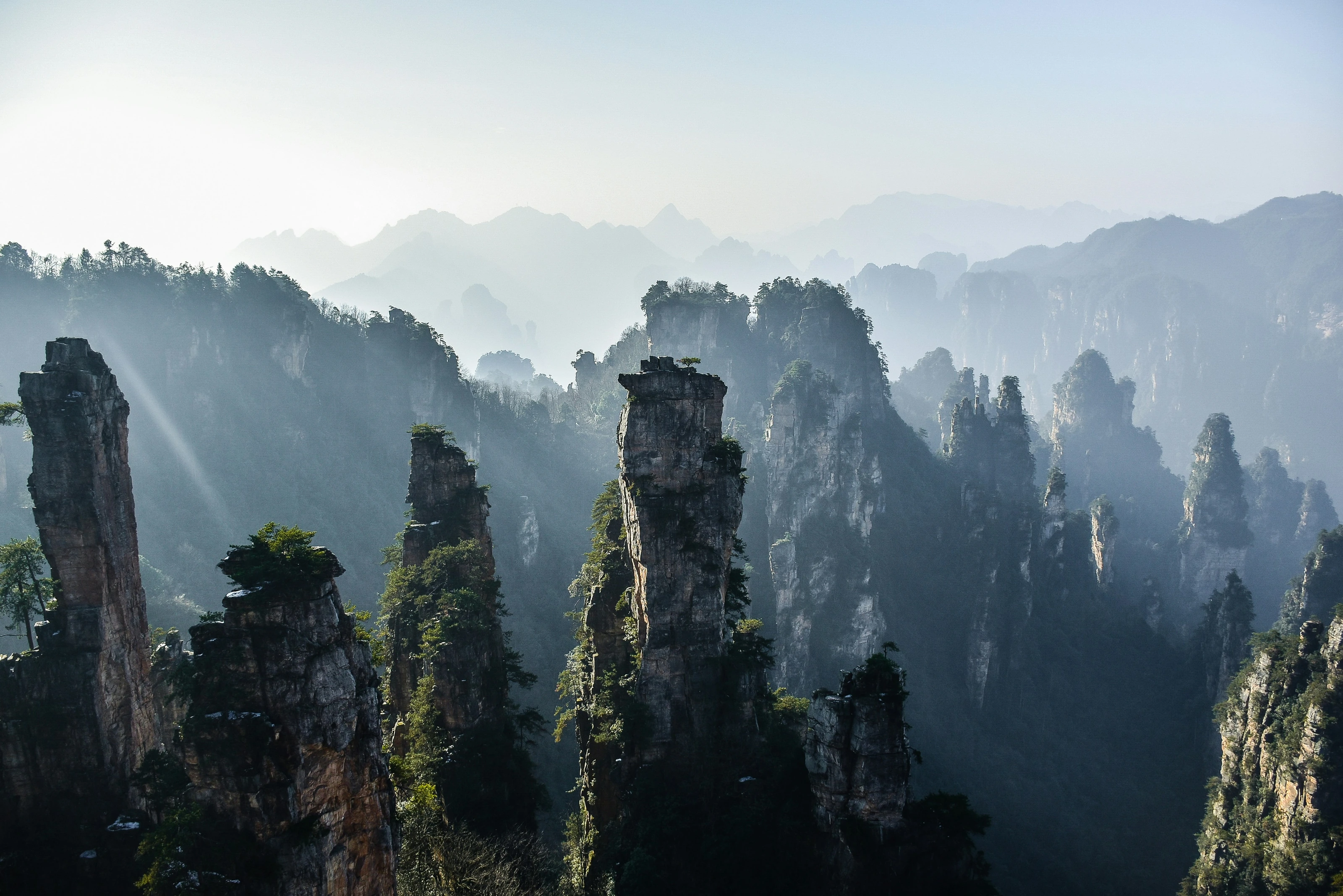
Around 380 million years ago this was shallow sea, laying down thick, level beds of quartz sandstone. After uplift, water cut down along vertical joints and gravity stripped the rock away in slabs, leaving isolated pillars. A column top is small and far above the water table, so its vegetation recovers slowly after damage, but it does recover.
Quartz sandstone columns
Horizontal banding on the shaft is the bedding, laid down layer by layer.
Vertical joints
The rock between two columns was once continuous; the gap was cut by water.
Trees on the summit
The top is small and the soil thin, so the trees grow slowly and stay low.
Mist takes the lower half of every column, and only the tops float, one disconnected from the next.
The pillars are what was left
Sandstone lies flat; joints run vertically. Water works down a joint, taking a little more each year, until the cut reaches the base and the rock beside it loses its support. The debris is carried away and what did not fall stays as a column.
The pillars were not built up. Everything around them was taken away.
Level lines on the shaft, fallen blocks below
A shaft carries level lines, band on band, laid down as sediment and evenly spaced. Look up one column and dozens of them can be counted.
House-sized blocks lie on the valley floor, corners still sharp, some with joint faces cut clean. They have not been down long enough for water to round them.
The trees on top are short and old. The top is small and holds no water, the soil is a thin skin, and the trees live on mist and dew, putting on very little in a year. High wind breaks them, and they come again from the root.
Mist decides how many layers there are
Clear weather shows depth: near columns dark, far ones grey, receding in steps to the horizon. Mist shows height: the lower half is erased and only the tops float, one apart from the next.
Mist comes at dawn and after rain, and leaves quickly. Waiting is the only method that works.
A cable car puts people on top in minutes, which makes the paths up there busier; there is little to sleep in up top, so a misty morning means starting in the dark.
The Bailong elevator and two cableways cut the climb to minutes, so the paths on top are busier. The glass bridge, opened in 2016, took some of the crowd away.